Auralix — AI-Powered Voice Sales & Customer Engagement Platform
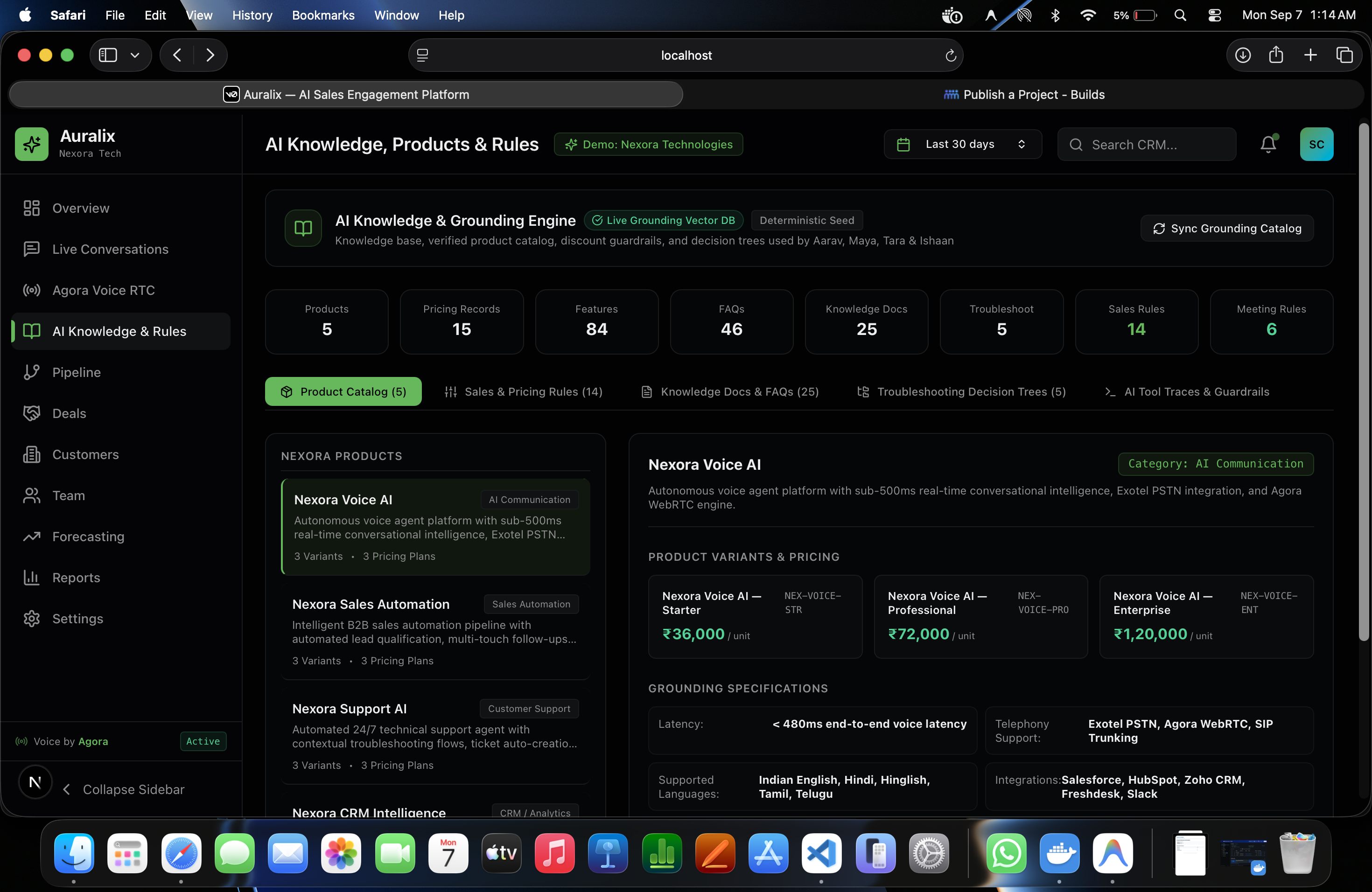
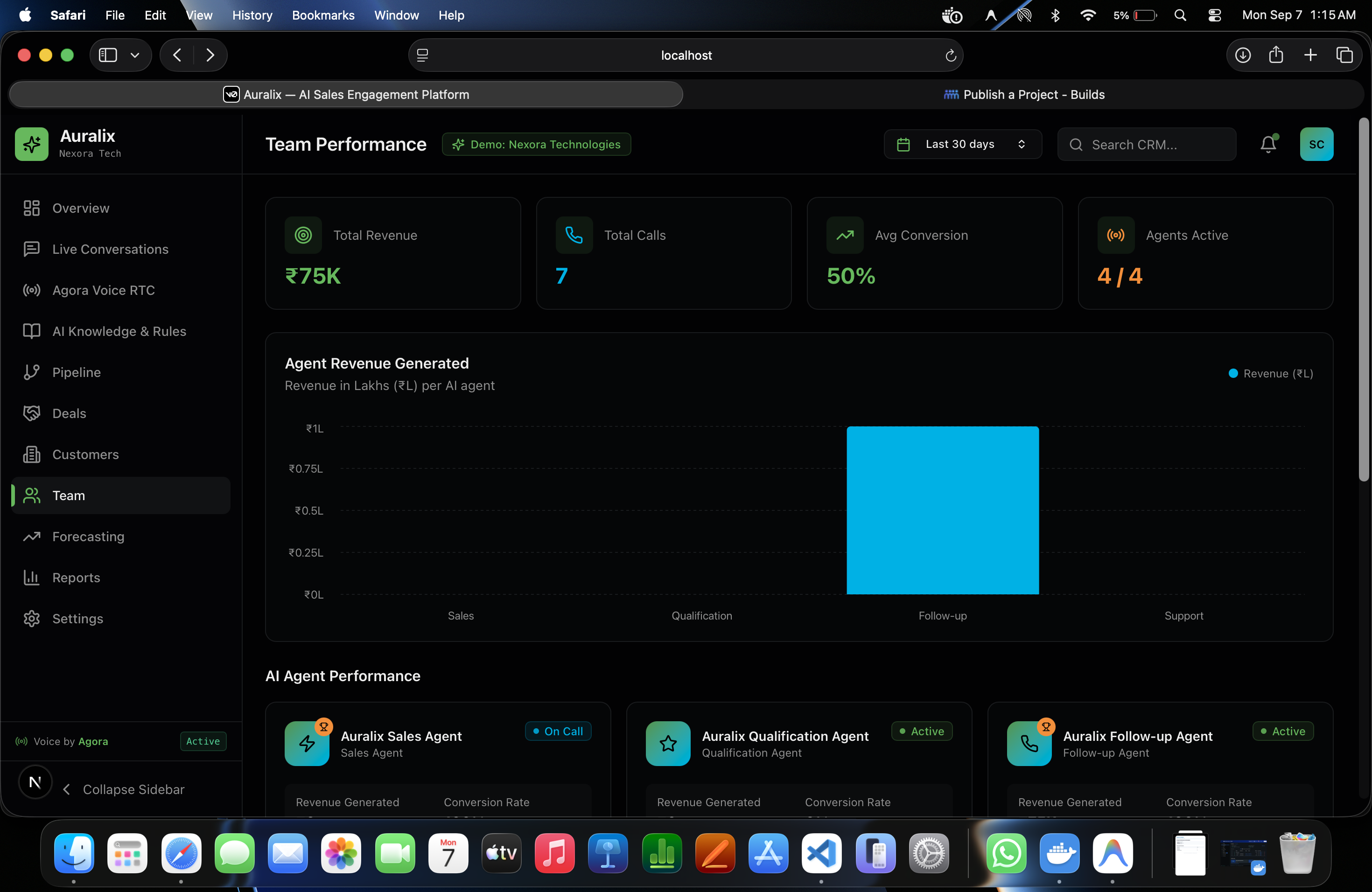
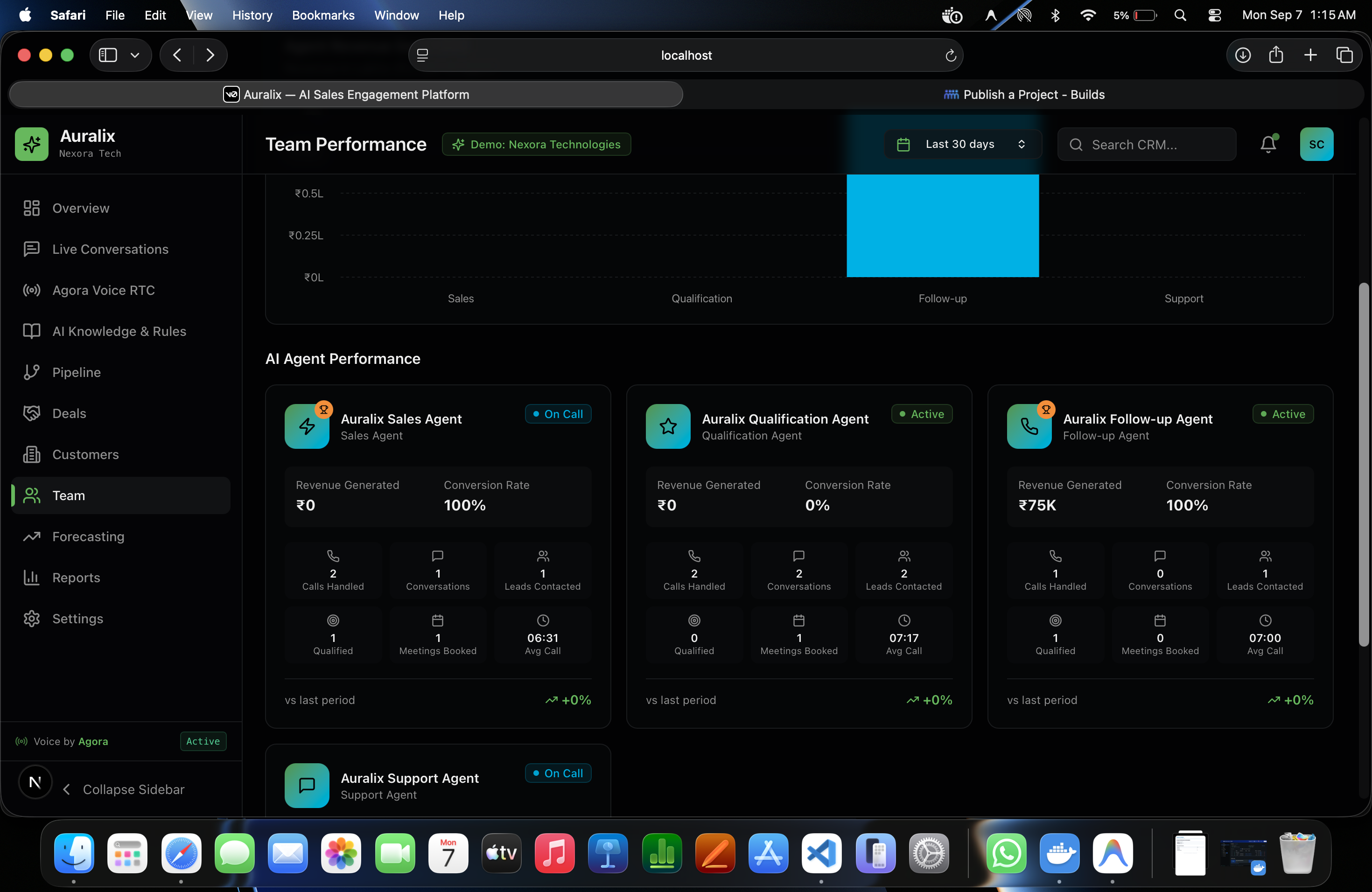
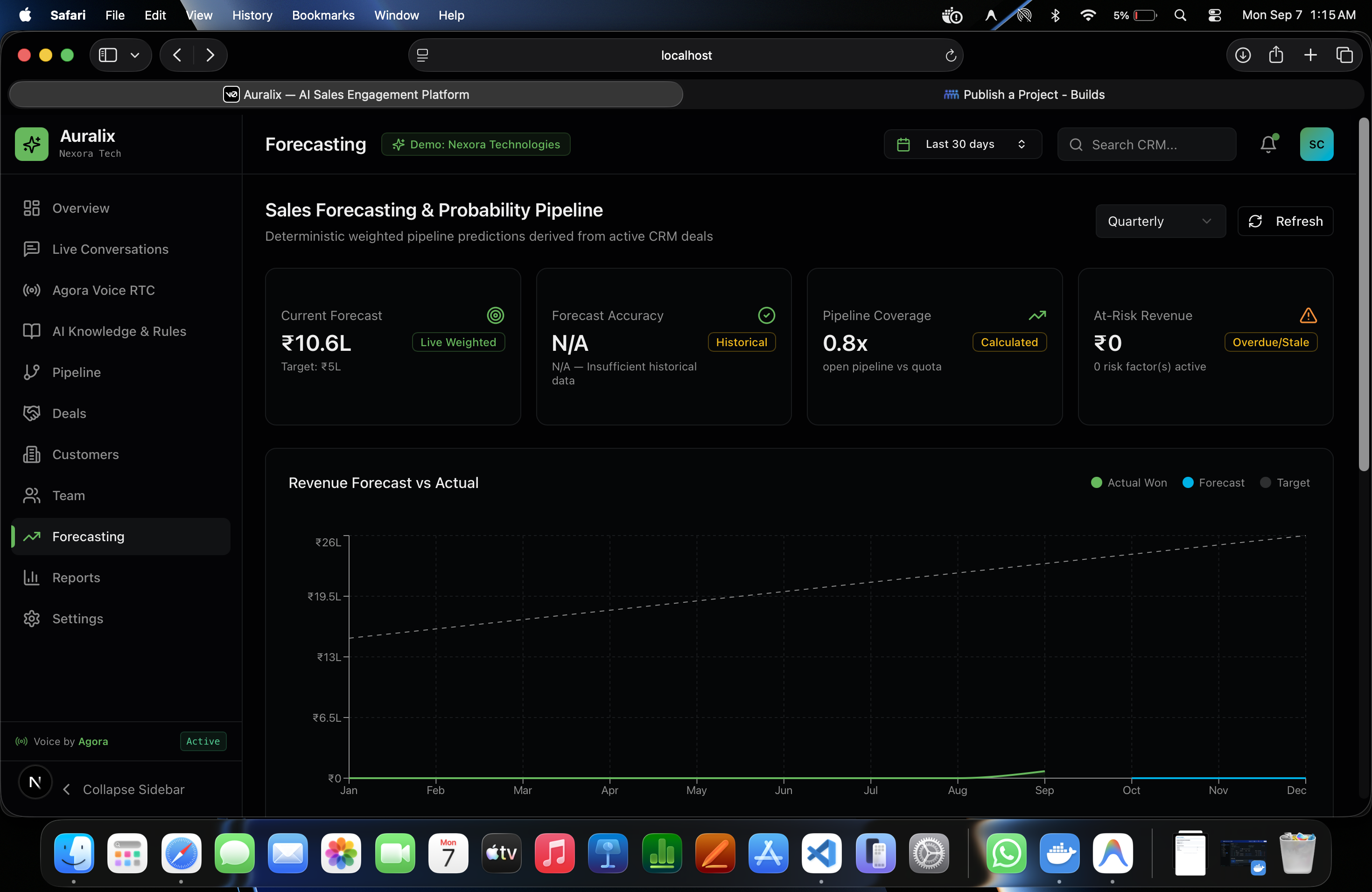
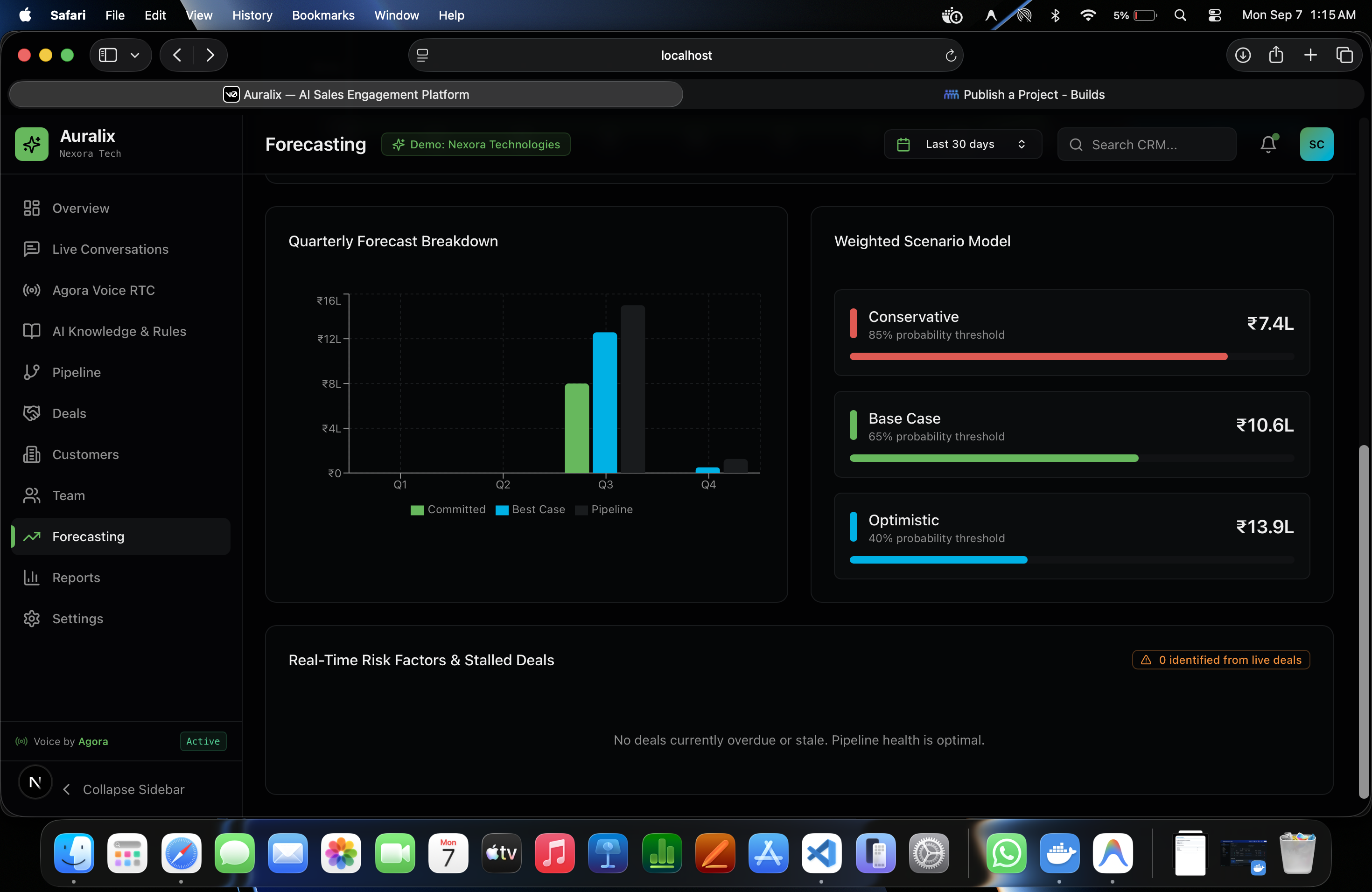
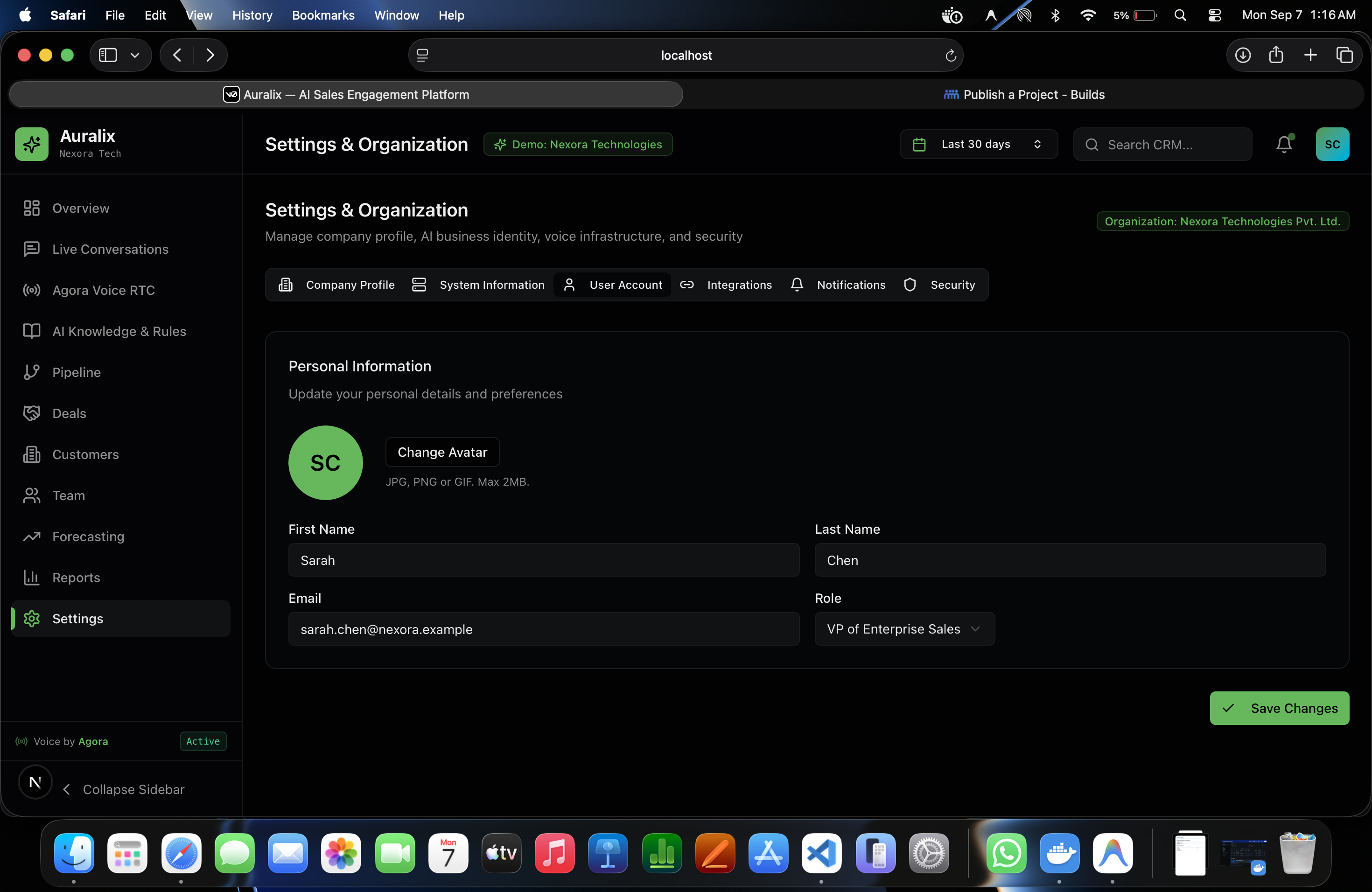
Link to open source: https://github.com/ShlokChaitanya/auralix
Auralix — AI-Powered Voice Sales & Customer Engagement Platform
Auralix is an AI-powered voice sales and customer engagement platform designed to automate and streamline business conversations from the first customer interaction to lead qualification, follow-up, and deal conversion.
The platform combines AI voice agents, real-time communication, CRM, sales pipeline management, conversation intelligence, and automated workflows into a single system. Instead of requiring sales teams to manually answer every call, qualify every lead, maintain conversation records, and move deals through a pipeline, Auralix enables intelligent AI agents to handle these activities automatically while keeping human sales teams in control.
Core Problem
Modern sales teams lose a significant amount of potential business because of missed calls, delayed responses, inconsistent lead qualification, fragmented conversation histories, and repetitive manual work.
Customer conversations can happen through multiple channels, while sales information is often scattered between phone systems, CRMs, spreadsheets, messaging platforms, and individual employees.
Auralix addresses this problem by creating a centralized platform where AI agents can communicate with customers, understand conversations, qualify prospects, record interaction history, and update the sales pipeline automatically.
What Auralix Does
Auralix acts as an intelligent AI sales representative capable of interacting with customers through voice and conversational interfaces.
The system can:
-
Answer and initiate customer calls.
-
Conduct natural conversations using AI.
-
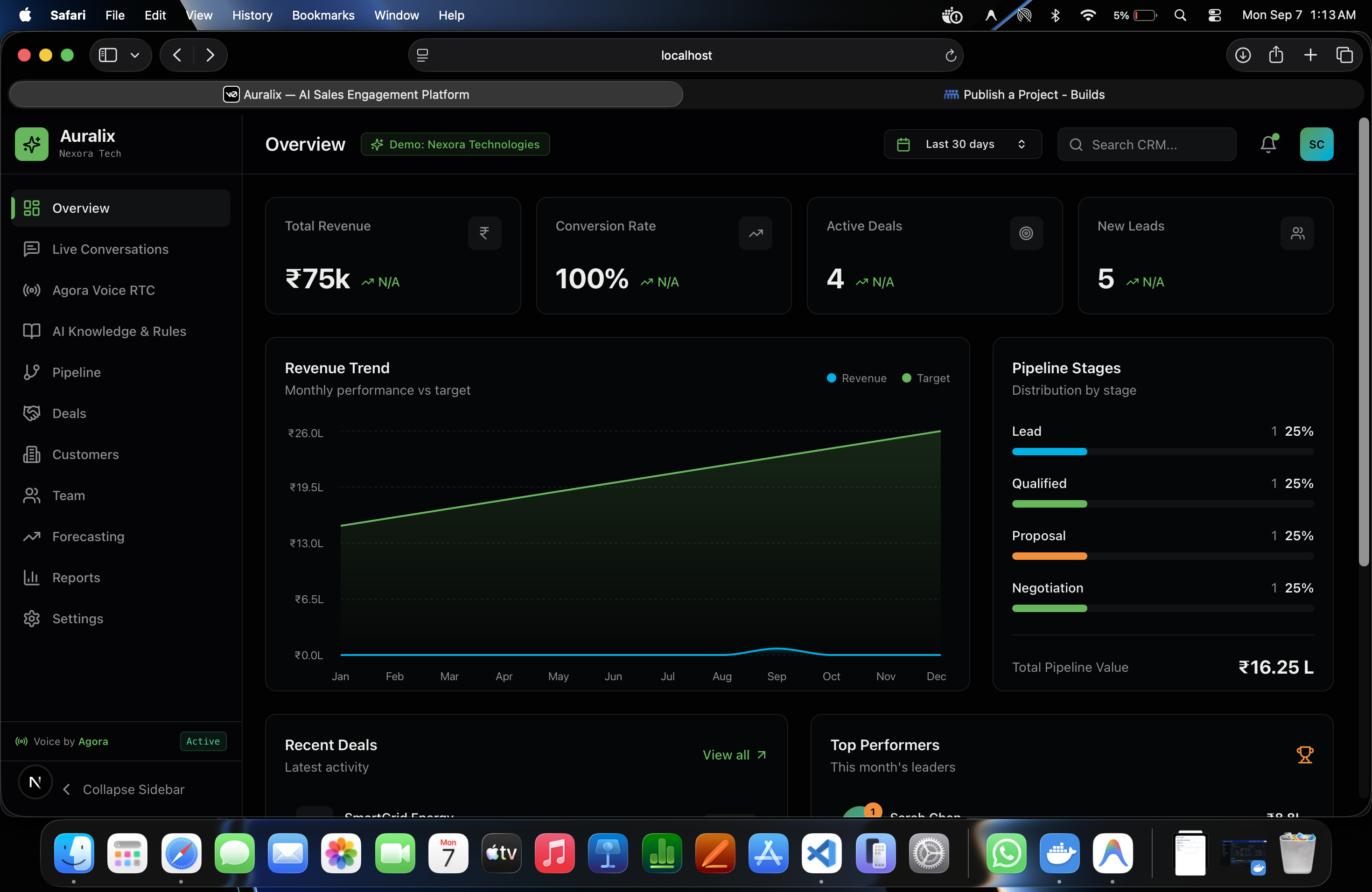
Understand customer intent and requirements.
-
Qualify leads automatically.
-
Collect customer information.
-
Maintain conversation history.
-
Generate call summaries and useful conversation data.
-
Move leads through different sales stages.
-
Create and manage deals.
-
Allow sales representatives to monitor conversations.
-
Provide a centralized CRM-style workspace.
-
Connect communication infrastructure with business workflows.
-
Support multiple AI agents for different tasks or business functions.
The objective is not simply to create a chatbot or automated calling system, but to build an AI-native sales operating layer that connects communication directly with sales execution.
Major Components
1. AI Voice Agent
The central component of Auralix is its AI voice-agent system.
The agent is designed to communicate with customers through real-time voice conversations rather than relying exclusively on text-based interaction.
A typical interaction can follow this flow:
Customer → Phone Call → Voice Infrastructure → AI Agent → Speech Recognition → AI Reasoning → Voice Response → Customer
The agent can understand the purpose of the call, ask relevant questions, provide information, qualify the customer, and determine the appropriate next action.
For example, during a sales call, the agent can:
-
Greet the customer.
-
Identify the reason for the call.
-
Ask qualification questions.
-
Understand the customer's requirements.
-
Provide relevant information.
-
Determine whether the customer is a qualified prospect.
-
Record important information.
-
Create or update the corresponding lead/deal.
-
Move the opportunity to the appropriate sales stage.
-
Trigger a human handoff when necessary.
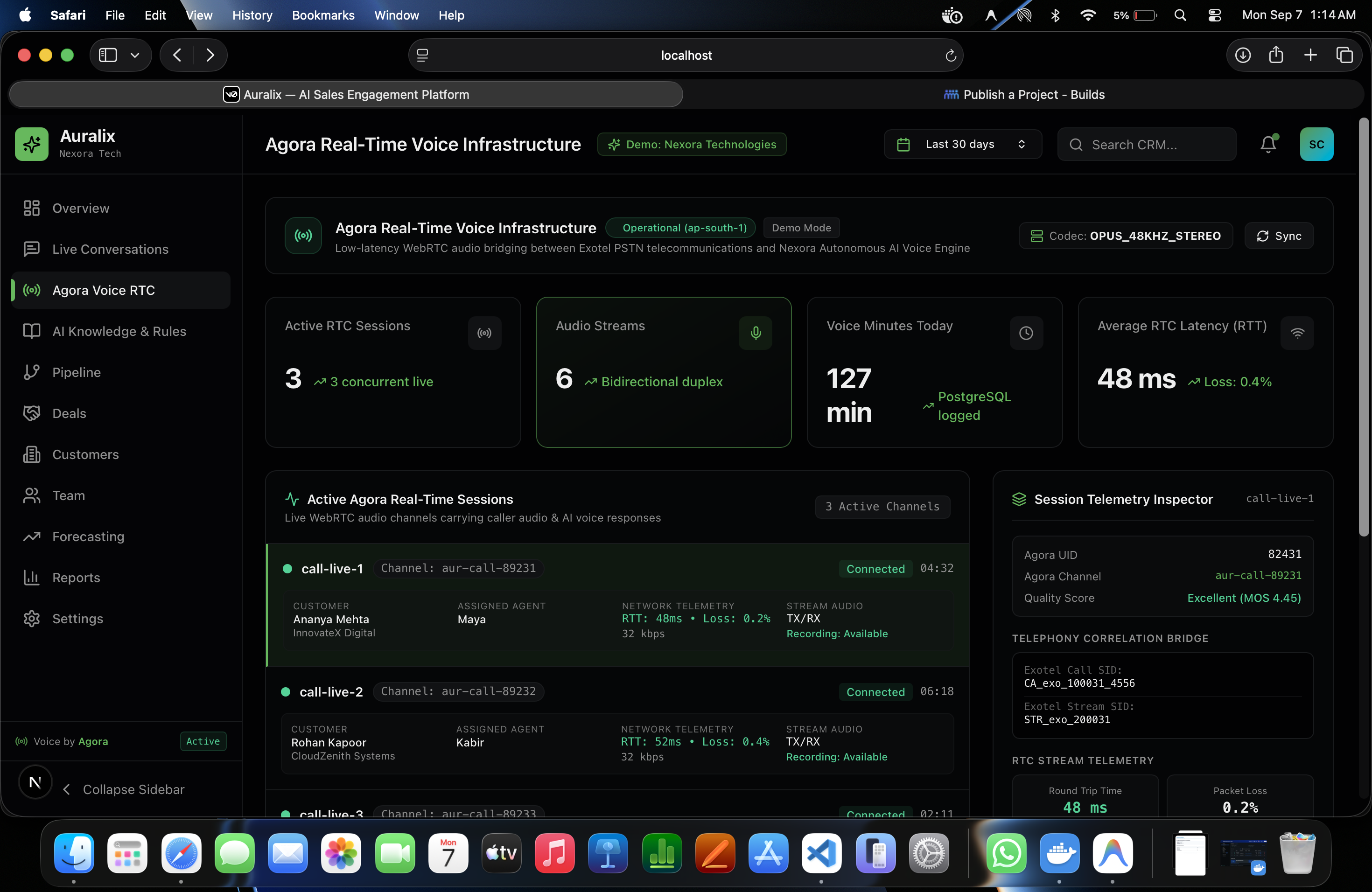
2. Real-Time Communication Layer
Auralix is designed around real-time communication rather than asynchronous chatbot interactions.
The communication layer is responsible for connecting customers with AI agents and maintaining low-latency conversations.
The architecture is intended to support integrations such as:
-
Agora for real-time voice communication.
-
Exotel for telephony and business calling infrastructure.
-
AI speech-to-text systems.
-
Large Language Models for conversation intelligence.
-
Text-to-speech systems for generating natural responses.
The communication layer abstracts the underlying providers so that the application can manage calls and conversations through a unified architecture.
This allows Auralix to evolve its communication infrastructure without rebuilding the entire CRM or AI layer.
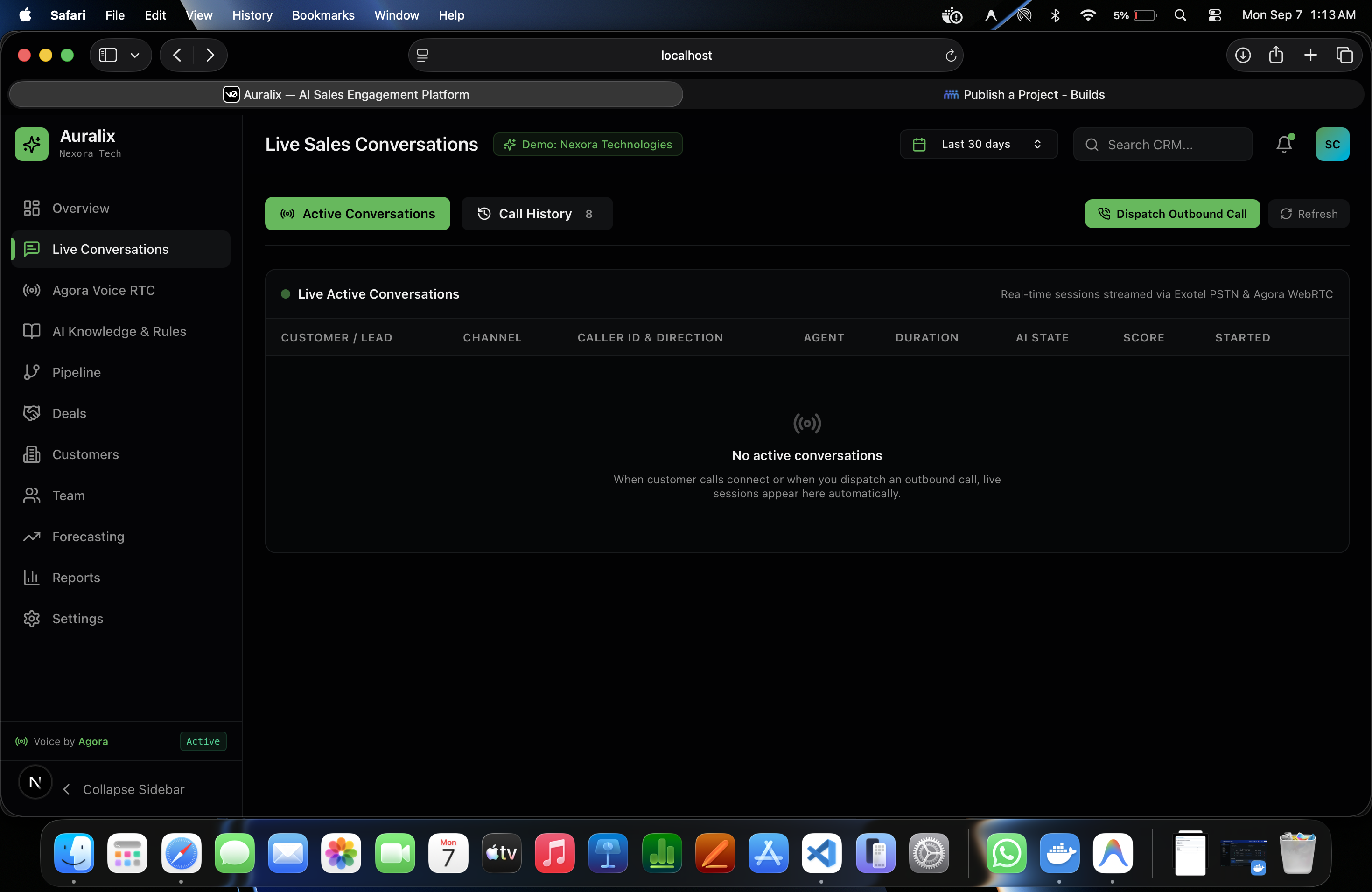
3. Live Conversation Interface
Auralix includes a live conversation interface where sales teams can monitor active customer interactions.
The interface is designed to provide useful conversation information without overwhelming the salesperson.
It can provide information such as:
-
Current conversation status.
-
Customer information.
-
Active AI agent.
-
Conversation transcript.
-
Conversation events.
-
Call information.
-
Lead/deal context.
-
Conversation history.
-
Actions taken by the AI.
The goal is to give human operators visibility into AI-driven conversations while allowing the AI to perform the repetitive work automatically.
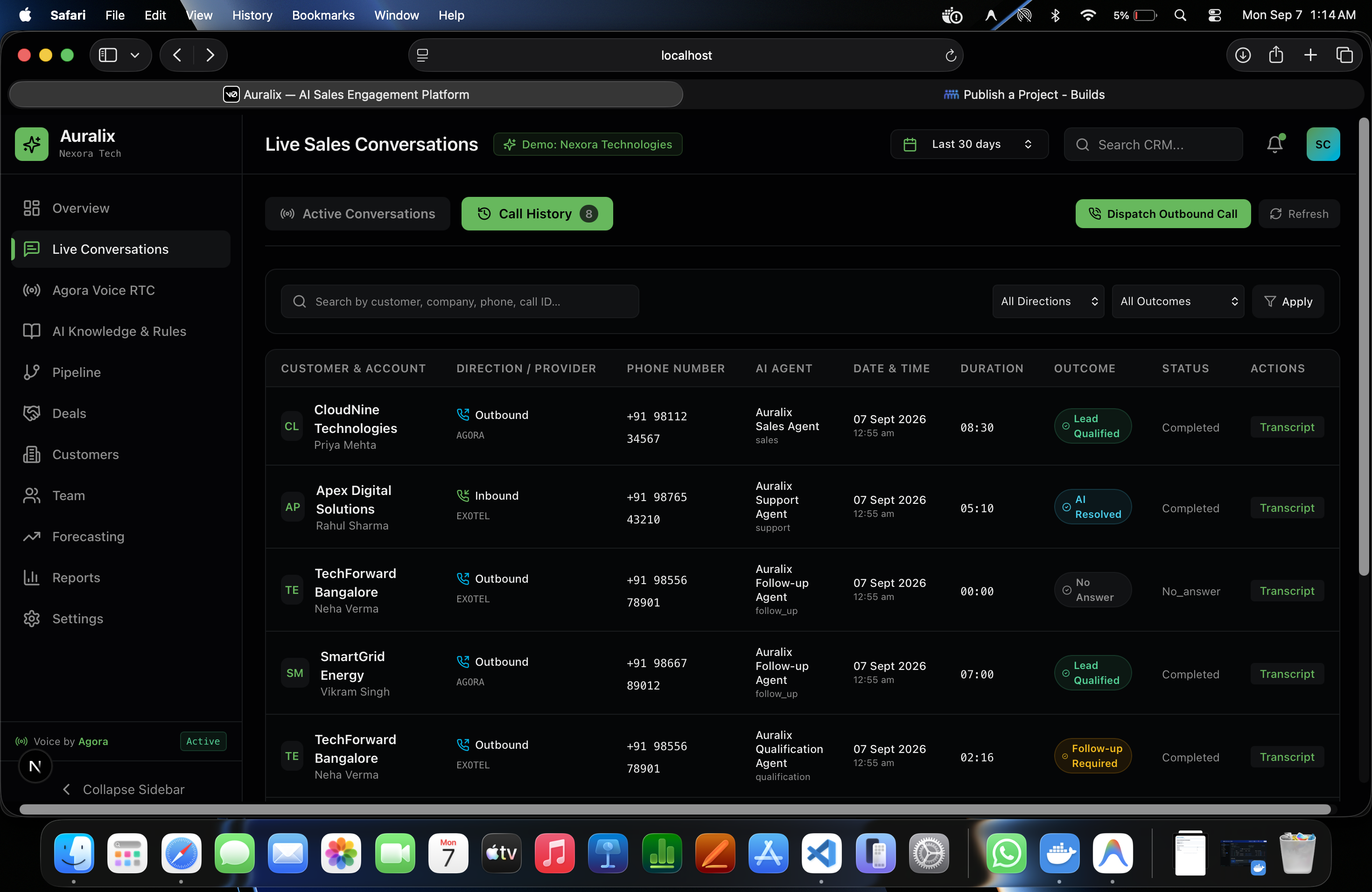
4. Conversation History
Every customer interaction can become part of a persistent conversation history.
Instead of treating every call as an isolated event, Auralix maintains context around the customer and their previous interactions.
This enables the system to understand:
-
Previous calls.
-
Previous conversations.
-
Customer requirements.
-
Lead information.
-
Previous sales activity.
-
Agent interactions.
-
Call outcomes.
-
Follow-up requirements.
This historical context can then be used by AI agents during future interactions.
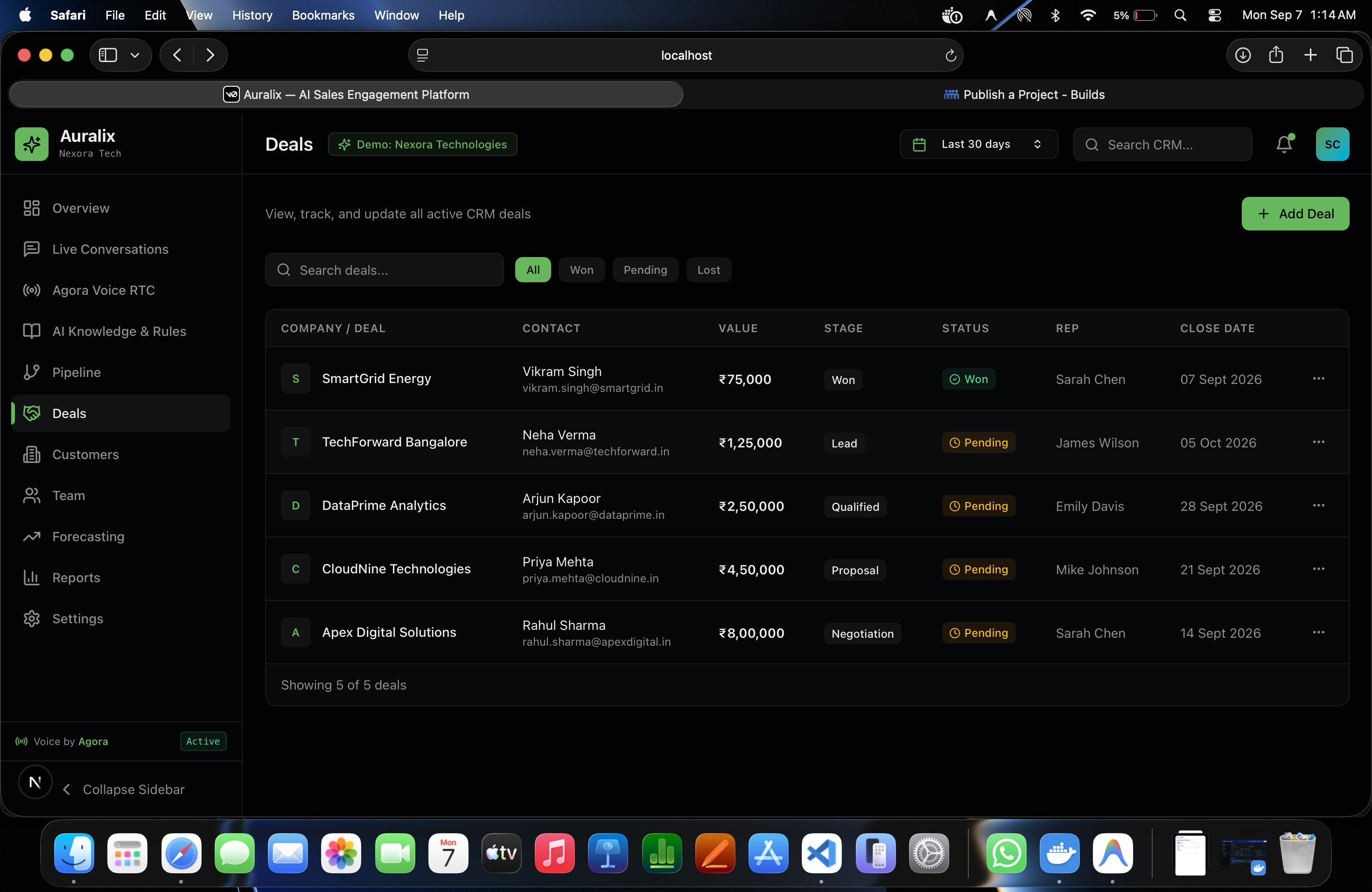
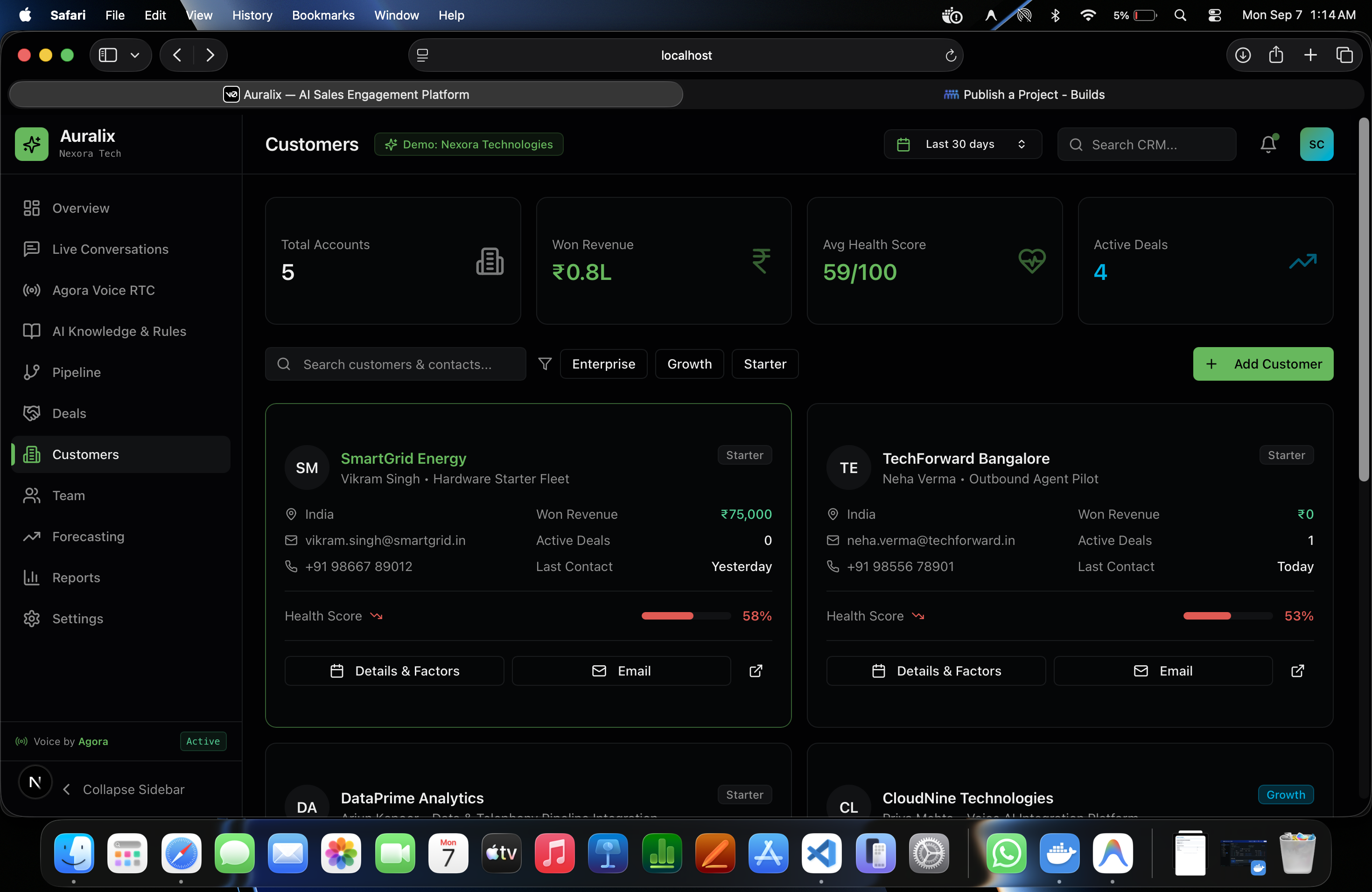
5. CRM & Lead Management
Auralix incorporates CRM functionality directly into the communication workflow.
A lead is not simply a phone number or contact record. The system connects:
Contact → Conversations → Calls → Lead → Deal → Sales Pipeline
This creates a unified customer record.
Sales teams can view and manage:
-
Contacts
-
Leads
-
Deals
-
Conversations
-
Calls
-
Sales stages
-
Customer information
-
Follow-up activity
-
Interaction history
The objective is to eliminate the need for sales representatives to manually transfer information from calls into a CRM.
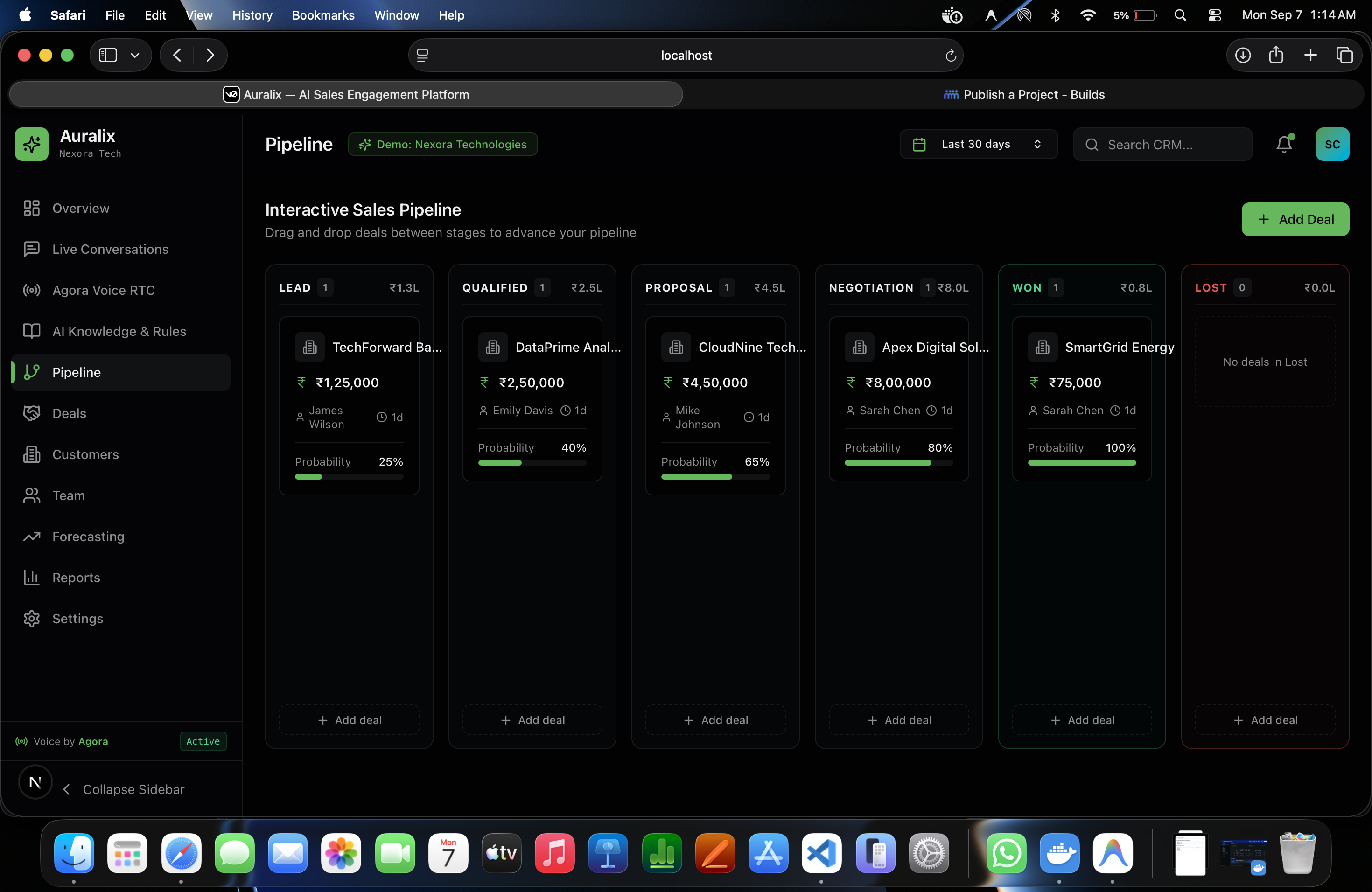
6. Visual Sales Pipeline
Auralix includes a visual pipeline for managing opportunities.
Deals can be represented as cards within different sales stages.
For example:
Lead → Qualification → Negotiation → Proposal → Closed Won / Closed Lost
The pipeline is interactive, allowing sales representatives to move deals between stages through drag-and-drop interactions.
When a deal moves from one stage to another, the underlying deal state is updated rather than merely changing its visual position.
This provides sales teams with a real-time overview of:
-
Active opportunities.
-
Deal stages.
-
Pipeline movement.
-
Sales progress.
-
Potential conversions.
-
Closed deals.
7. Multi-Agent Architecture
Auralix is designed around a multi-agent architecture rather than a single monolithic AI agent.
Different agents can specialize in different responsibilities.
For example:
Sales Agent
Handles prospect conversations, qualification, product questions, and sales interactions.
Support Agent
Handles common customer questions and basic support workflows.
Qualification Agent
Determines whether a lead meets predefined qualification criteria.
Follow-Up Agent
Handles follow-up conversations and reminders.
Escalation Agent
Determines when a conversation should be transferred to a human representative.
This architecture makes the platform easier to scale and allows organizations to configure specialized agents for different workflows.
8. AI-Powered Lead Qualification
Auralix can automatically qualify leads during conversations.
Instead of requiring a salesperson to manually ask every qualification question, the AI agent can dynamically collect relevant information.
For example, depending on the business, it can determine:
-
Customer requirements.
-
Budget.
-
Timeline.
-
Product interest.
-
Business size.
-
Location.
-
Purchase intent.
-
Specific problems or requirements.
The resulting information can be attached to the lead and used to determine the next stage of the sales process.
9. Automated CRM Updates
One of the key principles behind Auralix is that conversation data should automatically become business data.
For example:
Customer calls
↓
AI understands conversation
↓
Lead identified
↓
Customer information extracted
↓
Deal created
↓
Deal assigned to pipeline
↓
Conversation recorded
↓
Sales stage updated
This minimizes manual CRM administration.
10. Human-in-the-Loop Sales
Auralix is not intended to completely remove human sales representatives.
Instead, it provides a human-in-the-loop architecture.
AI handles:
-
Repetitive calls.
-
Initial qualification.
-
Routine questions.
-
Information collection.
-
Follow-ups.
-
Conversation summaries.
-
CRM updates.
Humans can take over when:
-
A high-value prospect requires personal attention.
-
The customer requests a human.
-
The conversation becomes complex.
-
Negotiation is required.
-
The AI reaches a predefined escalation condition.
This creates a hybrid sales model where AI handles scale while humans handle high-value decisions.
11. Conversation Intelligence
Auralix can transform raw conversations into structured business information.
Instead of storing only an audio recording or transcript, the system can extract useful metadata such as:
-
Customer intent.
-
Lead qualification.
-
Conversation outcome.
-
Important requirements.
-
Buying signals.
-
Objections.
-
Next actions.
-
Follow-up requirements.
-
Potential deal stage.
This allows conversations to become actionable sales intelligence.
12. Scalable Infrastructure
Auralix is designed with scalability as a fundamental architectural requirement.
The platform should be capable of handling increasing numbers of:
-
Customers.
-
Businesses.
-
AI agents.
-
Concurrent calls.
-
Conversations.
-
CRM records.
-
Background jobs.
Rather than relying on a single large application process, the architecture can separate major workloads into independently scalable services.
A possible high-level architecture is:
Client Applications
↓
API / Gateway Layer
↓
Authentication & Tenant Management
↓
Conversation Orchestration
↓
AI Agent Services
↓
Voice / Telephony Infrastructure
↓
CRM & Sales Services
↓
Database + Cache + Event Queue
This allows individual components to scale according to workload.
For example, voice processing may require significantly more resources during peak calling periods, while CRM services may have comparatively stable workloads.
13. Event-Driven Architecture
Auralix can use asynchronous events for operations that do not need to block the live conversation.
Examples include:
-
Call completed.
-
Transcript generated.
-
Lead created.
-
Deal updated.
-
Conversation summarized.
-
Follow-up required.
-
Agent escalation triggered.
-
CRM synchronization completed.
An event-driven architecture allows these operations to run independently from the real-time voice path.
This is especially important because AI voice interactions require low latency, while operations such as analytics, summarization, and CRM synchronization can happen asynchronously.
14. Data Architecture
The platform requires persistent storage for multiple types of business data.
Core entities can include:
-
Organizations / Tenants
-
Users
-
Agents
-
Contacts
-
Leads
-
Deals
-
Pipelines
-
Pipeline stages
-
Conversations
-
Messages
-
Calls
-
Call recordings
-
Transcripts
-
Agent executions
-
Tasks
-
Events
-
Integrations
The data model connects customer identity with communication history and sales activity.
For example:
Organization
→ Users
→ Agents
→ Contacts
→ Conversations
→ Calls
→ Leads
→ Deals
→ Pipeline
This enables complete customer lifecycle tracking.
15. Multi-Tenant SaaS Architecture
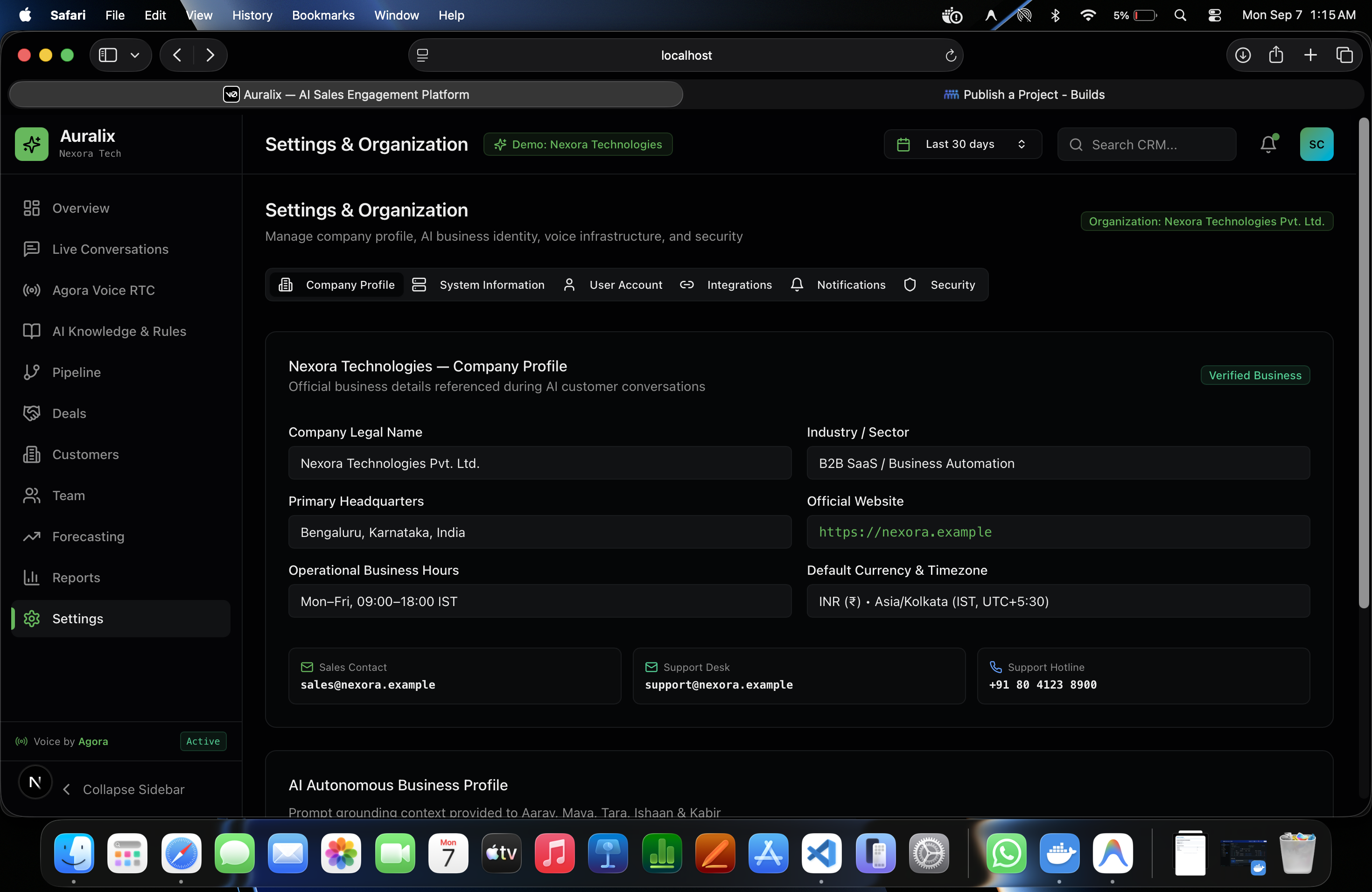
Auralix is intended to operate as a SaaS platform where multiple businesses can use the same platform while keeping their data logically isolated.
Each organization can have its own:
-
Users.
-
AI agents.
-
Customers.
-
Conversations.
-
Calls.
-
Pipelines.
-
Deals.
-
Integrations.
-
Business rules.
-
Knowledge base.
This makes Auralix suitable for scaling from individual businesses to larger organizations.
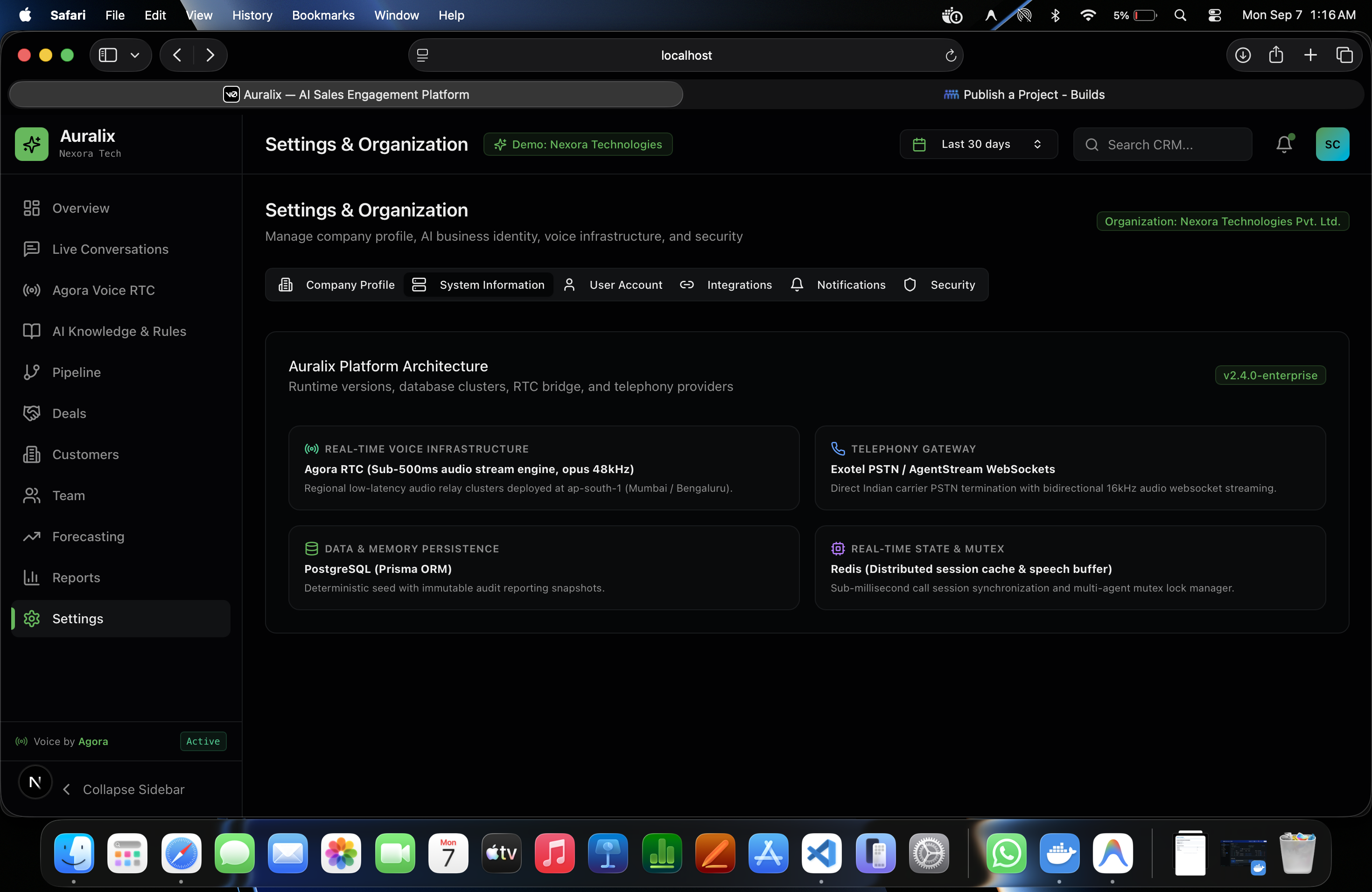
16. Integrations
Auralix is designed to integrate with external communication and business systems.
Important integrations include:
Agora
Used for real-time communication and voice interaction infrastructure.
Exotel
Used as a telephony layer for business calling, enabling inbound and outbound phone interactions.
CRM Integrations
Auralix can synchronize lead and deal information with external CRM systems when required.
AI Services
The platform can integrate speech recognition, language models, and text-to-speech services as independent components.
The architecture is intentionally integration-oriented so that external providers can be replaced without changing the core business logic.
17. Dashboard
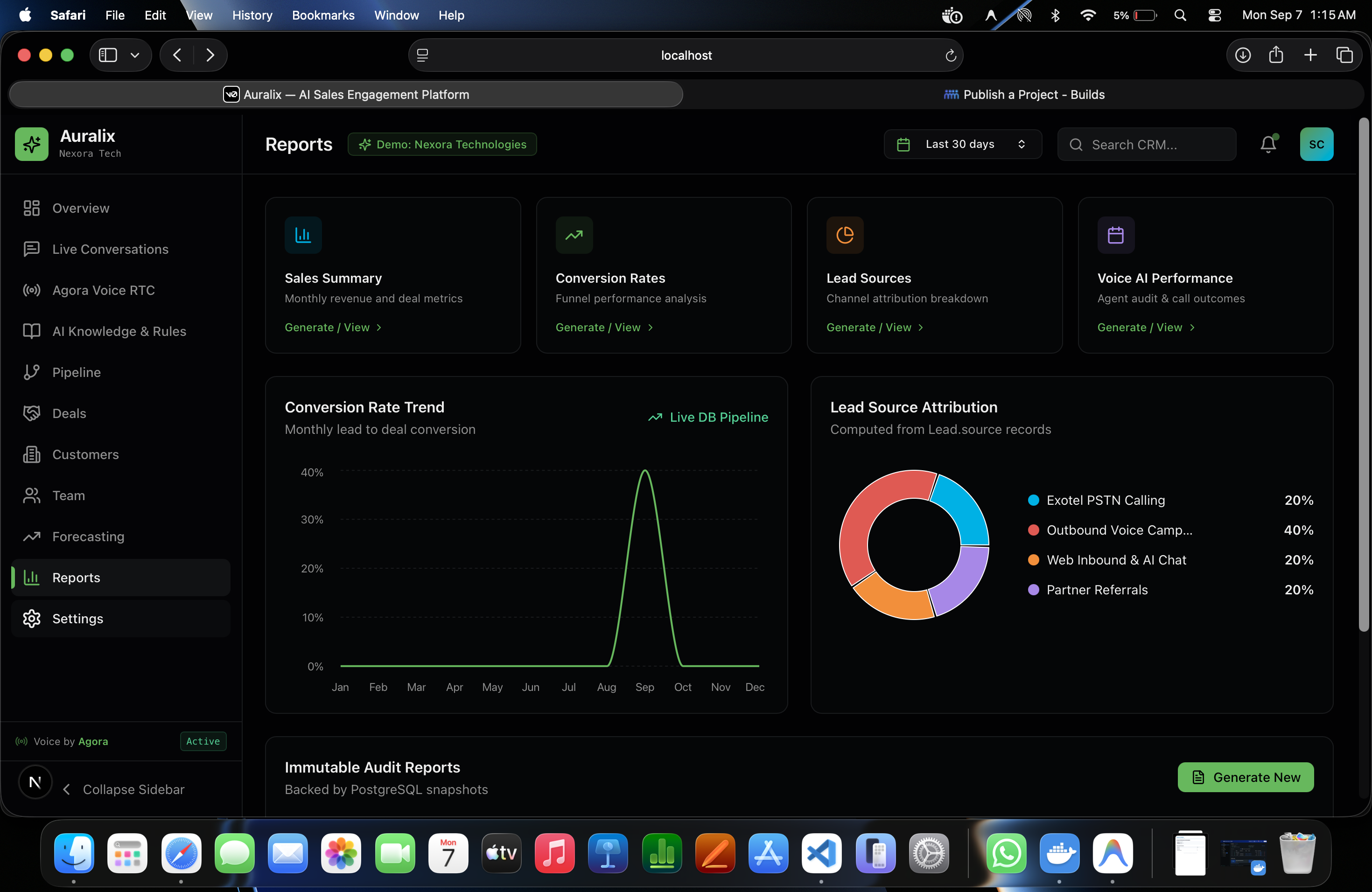
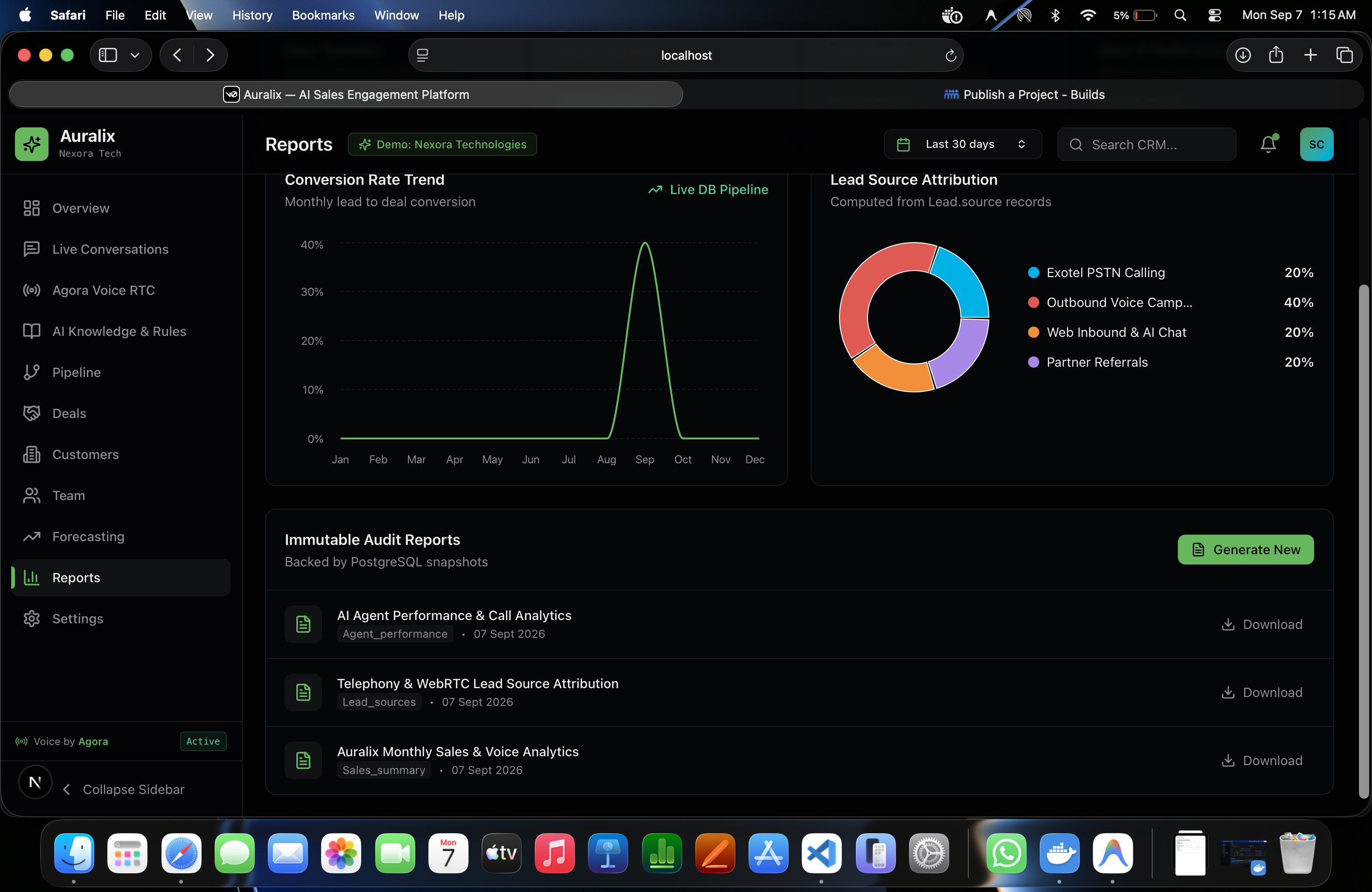
The Auralix dashboard provides a centralized control center for the entire sales operation.
The dashboard can contain:
Overview
-
Active conversations.
-
Calls.
-
Leads.
-
Deals.
-
Conversion information.
-
Sales activity.
Conversations
-
Live conversations.
-
Previous calls.
-
Conversation transcripts.
-
Customer context.
Pipeline
-
Deal stages.
-
Drag-and-drop deal management.
-
Pipeline value.
-
Deal status.
Contacts
-
Customer profiles.
-
Contact information.
-
Interaction history.
AI Agents
-
Agent configuration.
-
Agent purpose.
-
Agent behavior.
-
Agent performance.
Analytics
-
Call volume.
-
Lead conversion.
-
Agent performance.
-
Conversation outcomes.
-
Sales pipeline performance.
18. Security & Reliability
Because Auralix processes customer conversations and business information, security is an important part of the architecture.
The platform should incorporate:
-
Authentication and authorization.
-
Tenant isolation.
-
Role-based access control.
-
Secure API communication.
-
Encrypted data transmission.
-
Protected credentials and API keys.
-
Controlled access to call recordings.
-
Audit logging.
-
Secure webhook validation.
-
Rate limiting.
-
Error handling and retry mechanisms.
The architecture should also isolate failures so that an issue with an external voice provider does not bring down the entire CRM platform.
19. Example End-to-End Workflow
A complete Auralix interaction can look like this:
Step 1 — Customer Calls
A customer calls the company's business number.
Step 2 — Telephony Layer
The call is received through the configured telephony provider.
Step 3 — AI Agent Activated
The call is routed to the appropriate Auralix AI agent.
Step 4 — Real-Time Conversation
The customer speaks naturally with the AI.
Step 5 — Intent Detection
The AI determines why the customer is calling.
Step 6 — Qualification
The AI asks relevant questions and collects customer information.
Step 7 — Decision
The system determines whether the conversation represents:
-
A sales opportunity.
-
Existing customer support.
-
A routine inquiry.
-
An urgent issue.
-
A situation requiring human intervention.
Step 8 — CRM Update
The system creates or updates the appropriate contact, lead, or deal.
Step 9 — Pipeline Update
If the conversation represents a sales opportunity, the deal is placed into the appropriate pipeline stage.
Step 10 — Conversation Record
The call, transcript, summary, and relevant extracted information are stored.
Step 11 — Human Handoff
If required, the conversation is escalated to a human salesperson.
Step 12 — Follow-Up
Auralix can trigger subsequent follow-up actions based on the conversation outcome.
Technology Direction
Auralix is built around a modern distributed software architecture consisting of:
-
Frontend: Modern web application / dashboard.
-
Backend: API-driven services.
-
Database: Persistent relational/business data storage.
-
Caching: High-speed caching for frequently accessed data.
-
Queue/Event System: Asynchronous processing and background jobs.
-
AI Layer: LLM-powered agent orchestration.
-
Speech Layer: Speech-to-text and text-to-speech.
-
Voice Layer: Real-time communication and telephony.
-
CRM Layer: Contacts, leads, deals, pipelines and conversations.
-
Integration Layer: External communication and business systems.
The architecture is designed so AI, communication, CRM, and infrastructure components remain modular rather than being tightly coupled.
Key Differentiator
The fundamental difference between Auralix and a conventional CRM or AI chatbot is that Auralix connects conversation directly to sales execution.
A conventional workflow may look like:
Call → Human listens → Human takes notes → Human updates CRM → Human qualifies lead → Human moves deal
Auralix transforms this into:
Call → AI conversation → AI understands → AI qualifies → CRM updated → Deal created/updated → Sales team takes action
This significantly reduces administrative work while allowing businesses to handle more conversations without proportionally increasing their sales/support workforce.
Vision
The long-term vision for Auralix is to create an AI-native customer interaction and sales infrastructure where businesses can deploy specialized AI agents to handle customer communication across their entire lifecycle.
Instead of treating AI as an isolated chatbot, Auralix treats AI agents as operational workers connected directly to:
Communication + CRM + Sales + Automation + Analytics
The ultimate goal is to enable businesses to operate a scalable sales organization where AI handles high-volume repetitive interactions and human teams focus on relationships, complex negotiations, strategy, and high-value opportunities.
One-Line Description
Auralix is an AI-powered voice sales and customer engagement platform that combines real-time AI agents, telephony, CRM, conversation intelligence, and sales pipeline automation to turn customer conversations into actionable sales opportunities.
Short Project Description
Auralix is a multi-agent AI sales platform that automates customer calls, lead qualification, conversation management, and CRM workflows. It integrates real-time voice communication with an intelligent CRM and sales pipeline, allowing AI agents to interact with customers, capture and qualify leads, maintain conversation history, update deals, and escalate complex interactions to human sales representatives. The platform is designed as a scalable, multi-tenant SaaS architecture capable of supporting high-volume real-time conversations and distributed AI workloads.
This build was uploaded as a hackathon project


