Best RAG Architecture for your company's next project.
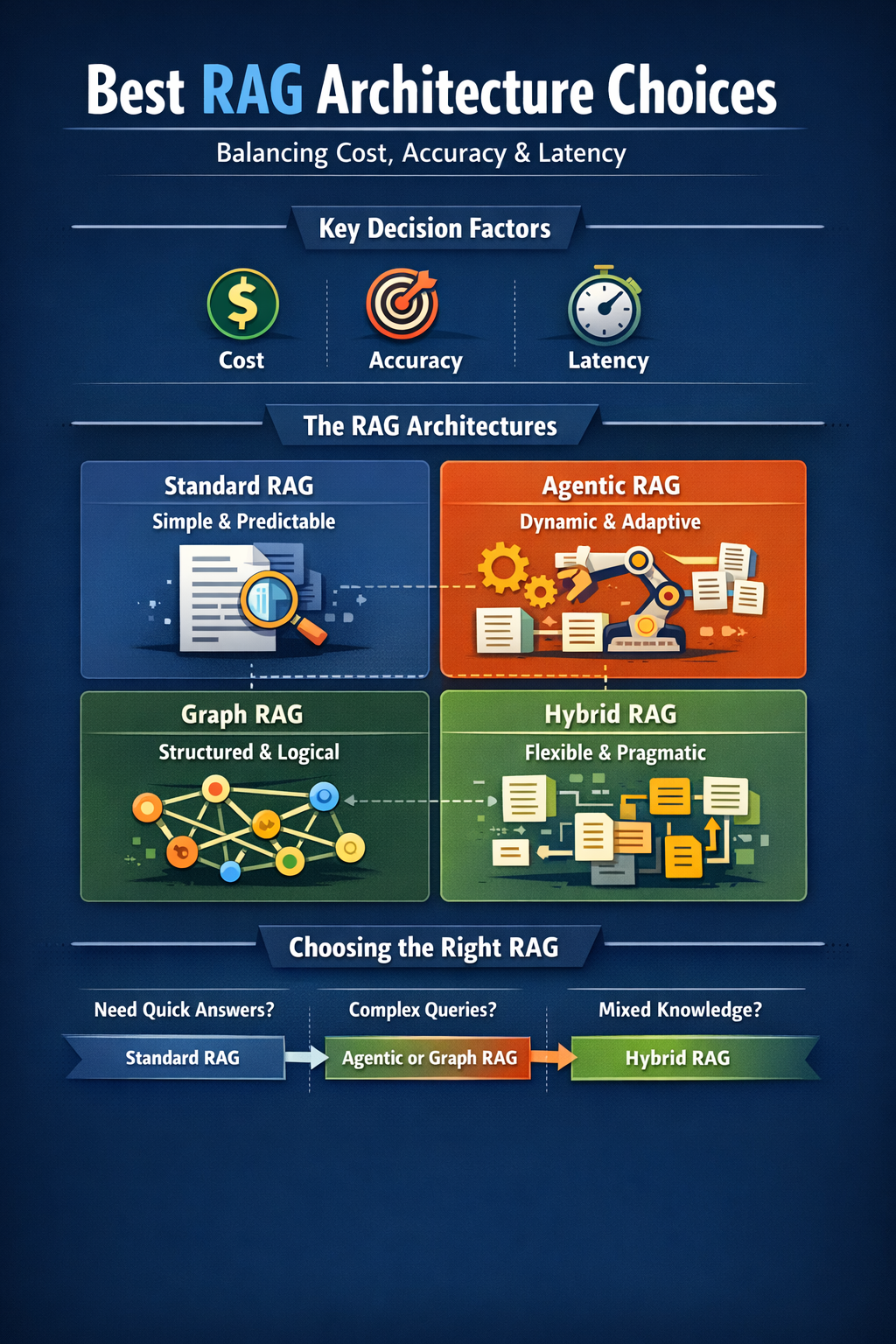
Link to open source: https://medium.com/@genaishaktesh/best-rag-architecture-for-your-companys-next-project-e86f0dcbea01
High-Level Overview: “Best RAG Architecture for Your Company’s Next Project”
1) Core Thesis of the Blog
The blog argues that RAG failures are architectural, not model-related.
Most teams build RAG emotionally (trend-driven), not structurally (constraint-driven), leading to:
-
High latency
-
Unpredictable costs
-
Hallucinations
-
Scaling failures
Main takeaway:
RAG architecture is a business systems decision, not a tooling choice.
2) Why Companies Actually Use RAG
The blog clarifies real enterprise motivations:
-
Hallucination control via grounding
-
Private/proprietary knowledge injection
-
Fresh knowledge without retraining
-
Compliance & auditability (source traceability)
3) The Three Core Tradeoff Axes
Every RAG system must balance:
| Axis | Meaning |
|---|---|
| Cost | Retrieval, tokens, infra overhead |
| Accuracy | Retrieval precision, synthesis correctness |
| Latency | Retrieval + generation delay |
Key insight: You can optimize 2, the 3rd will suffer.
4) RAG Architectures Explained (Consultant-Level View)
A. Standard RAG (Baseline)
Purpose: Document-based grounded QA
Pipeline: Query → Retrieve → Context → Generate
Strengths
-
Predictable cost
-
Low latency
-
Simple and production-friendly
Limitations
-
No reasoning
-
No adaptive retrieval
-
Fails for multi-doc synthesis
Mental model:
Standard RAG = Search engine + LLM interface
B. Agentic RAG (Decision-Based Retrieval)
Core shift: Retrieval becomes a reasoning loop
Capabilities
-
Multi-hop queries
-
Conditional retrieval
-
Heterogeneous data sources
Tradeoffs
-
Variable cost & latency
-
Hard debugging
-
Tail latency spikes
-
Requires monitoring discipline
Mental model:
Agentic RAG = Retrieval orchestration system
C. Graph RAG (Structured Knowledge Navigation)
Core shift: Knowledge as relationships, not text
Best for
-
Legal/compliance
-
Policy engines
-
System dependencies
-
Regulated domains
Strengths
-
Highest accuracy
-
Explicit reasoning paths
-
Explainability
Costs
-
Knowledge modeling overhead
-
Higher latency
-
Organizational discipline needed
Mental model:
Graph RAG = Knowledge graph traversal + LLM
D. Hybrid RAG (Enterprise Reality)
Philosophy: Use structure where possible, retrieval where not
When it works
-
Partially structured knowledge
-
Gradual maturity
-
Budget constraints
Challenges
-
Routing decisions
-
Context fusion conflicts
-
Ownership ambiguity
Mental model:
Hybrid RAG = Pragmatic enterprise architecture
5) Consultant Decision Framework
The blog provides a practical decision tree:
-
If answer in one doc → Standard RAG
-
If structured relationships matter → Graph RAG
-
If retrieval strategy varies → Agentic RAG
-
If knowledge is mixed → Hybrid RAG
6) Executive-Level Strategic Insights
RAG Architecture = Business Constraint Optimization
Constraints include:
-
Cost ceilings
-
SLA latency
-
Trust and explainability
-
Team maturity
Common Leadership Mistakes
-
Starting with advanced architectures
-
Ignoring accuracy until post-launch
-
One architecture for all queries
-
Treating architecture problems as prompt problems
7) Recommended Maturity Roadmap
Phase 1: Standard RAG (foundation)
Phase 2: Hybrid / selective Agentic
Phase 3: Structured Graph + monitoring
Key insight:
Complexity must be earned, not assumed.
8) Core Consultant Mental Models
-
Standard RAG = Search
-
Agentic RAG = Decision-making retrieval
-
Graph RAG = Structured knowledge reasoning
-
Hybrid RAG = Enterprise pragmatism
9) Final Message of the Blog
Strong RAG systems are not defined by intelligence, but by:
-
Predictability
-
Clear failure modes
-
Controlled cost
-
Continuous improvement
Advanced ≠ Better. Aligned architecture = Better.
Summary
This blog provides a consultant-level framework to select RAG architectures based on business constraints (cost, accuracy, latency). It analyzes Standard, Agentic, Graph, and Hybrid RAG, highlighting real-world tradeoffs, failure modes, and enterprise maturity paths. The key message is that RAG architecture is a systems and business decision, not a tooling choice.
