book recommendation website
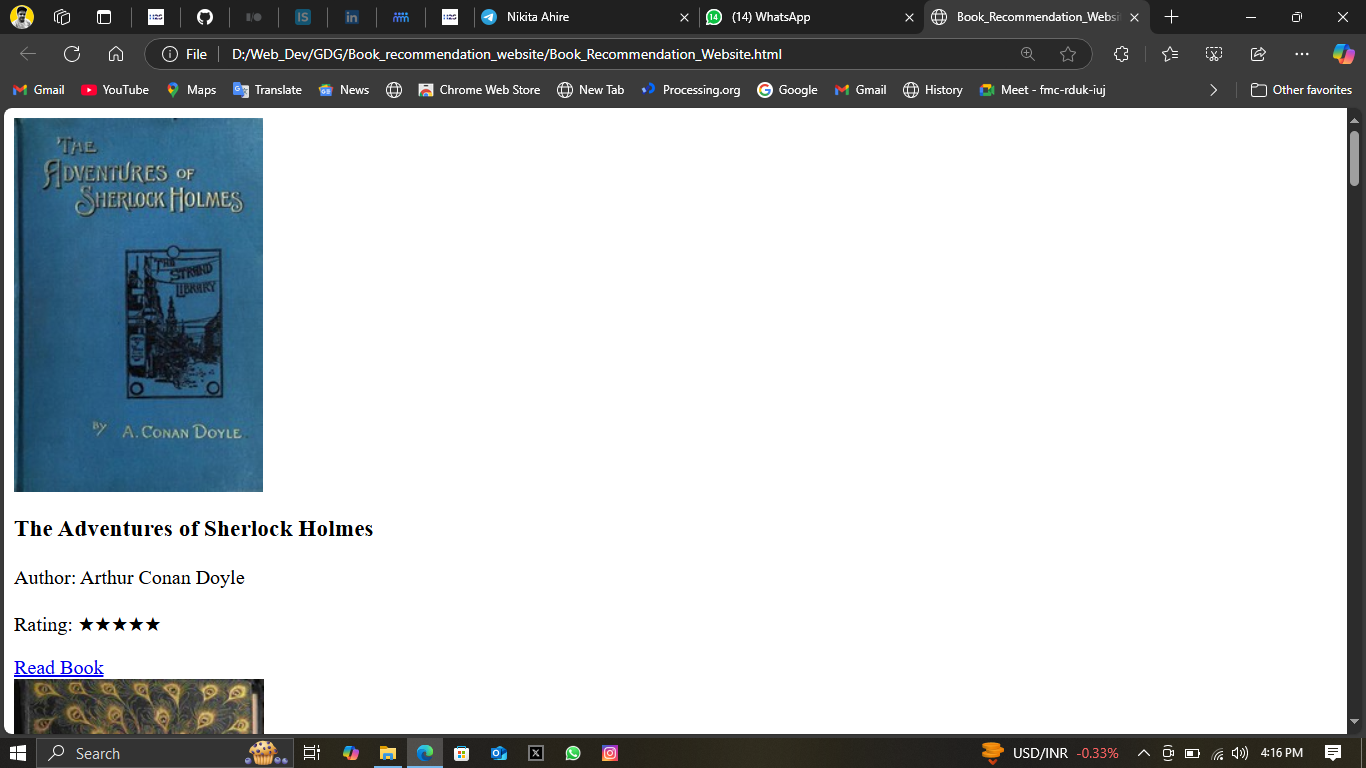
Link to open source: https://github.com/sameer538-cyber/Book_recommendation_website.git
Link to Live Project: https://github.com/sameer538-cyber/Book_recommendation_website.git
Absolutely, there's a whole spectrum of cutting-edge technologies poised to revolutionize the way we experience reading. It's not just about words on a page anymore; it's about immersing yourself in a story in ways that were pure science fiction not too long ago.
Augmented Reality (AR) is one of the most exciting developments. Imagine pointing your phone or AR glasses at a page and watching illustrations leap to life in 3D. Characters could step out of the book and into your living room, or you could explore a map from a fantasy novel as if it were laid out before you. It's like blending the physical and digital worlds to create a layered storytelling experience.
Then there's Virtual Reality (VR), taking immersion to another level. Instead of reading about a distant planet or a medieval kingdom, you could virtually walk its streets, interact with its inhabitants, and become part of the narrative. For genres like science fiction and fantasy, VR could transform passive reading into active exploration.
Artificial Intelligence (AI) is also reshaping reading experiences. Beyond just recommending books, AI can generate personalized content. Think interactive stories that adapt to your choices, almost like a modern take on "choose your own adventure" books but infinitely more complex and tailored. AI could analyze your emotional responses in real-time—through biometric sensors or even subtle cues like reading speed—and adjust the storyline accordingly to keep you engaged.
Speaking of engagement, haptic feedback technology adds a tactile dimension to digital reading. Imagine feeling the rumble of thunder as you read a stormy scene or the gentle vibrations of a purring cat in a cozy mystery novel. These subtle physical sensations can make the story world feel much more real and emotionally resonant.
Eye-tracking technology offers another layer of interactivity. Devices equipped with this can detect where your gaze lingers, providing instant definitions or background information on words or characters without you having to look them up. It keeps the flow uninterrupted and makes learning new things seamless.
Looking even further ahead, Brain-Computer Interfaces (BCIs) could revolutionize reading in ways we can hardly imagine. By interpreting neural signals, BCIs might allow you to navigate stories or control elements within them using just your thoughts. It's a bit out there, but the potential for creating deeply personal and immersive experiences is huge.
On the social side, interactive reading platforms are becoming more sophisticated. These allow readers to share annotations, engage in live discussions, or even participate in collaborative storytelling.
It's like turning the solitary act of reading into a communal experience, connecting people across the globe through shared narratives.
Immersive audio technologies are also enhancing how we consume stories. Spatial audio can make audiobook experiences more dynamic, with sound effects and directional cues that make you feel like you're inside the story. It's particularly effective in genres like thrillers or adventures, where atmosphere is key.
Advancements in e-paper and flexible displays are making e-readers more like traditional books. Foldable, rolable screens could mimic the tactile experience of flipping through pages, combining the nostalgia of print with the convenience of digital.
Moreover, adaptive learning technologies can adjust the complexity of the text in real-time, which is especially beneficial for educational contexts or language learning. Imagine a book that simplifies or elaborates based on your comprehension level, ensuring you stay both challenged and engaged
Have you ever considered how voice recognition could play a role? You might discuss themes or ask questions aloud, and the book could respond, providing deeper insights or guiding the narrative based on your curiosity. It's like having a conversation with the story itself.
All these technologies are not just enhancing how we read but also expanding what "reading" even means. They're blurring the lines between different forms of media—literature, gaming, cinema—and creating hybrid experiences that cater to diverse preferences.
By the way, if you're intrigued by these possibilities, there are already some projects experimenting with AR-enhanced books and AI-driven narratives. Exploring these could give you a taste of how technology is reshaping storytelling. It's an exciting time to be a reader, don't you think?
This build was uploaded as a hackathon project
