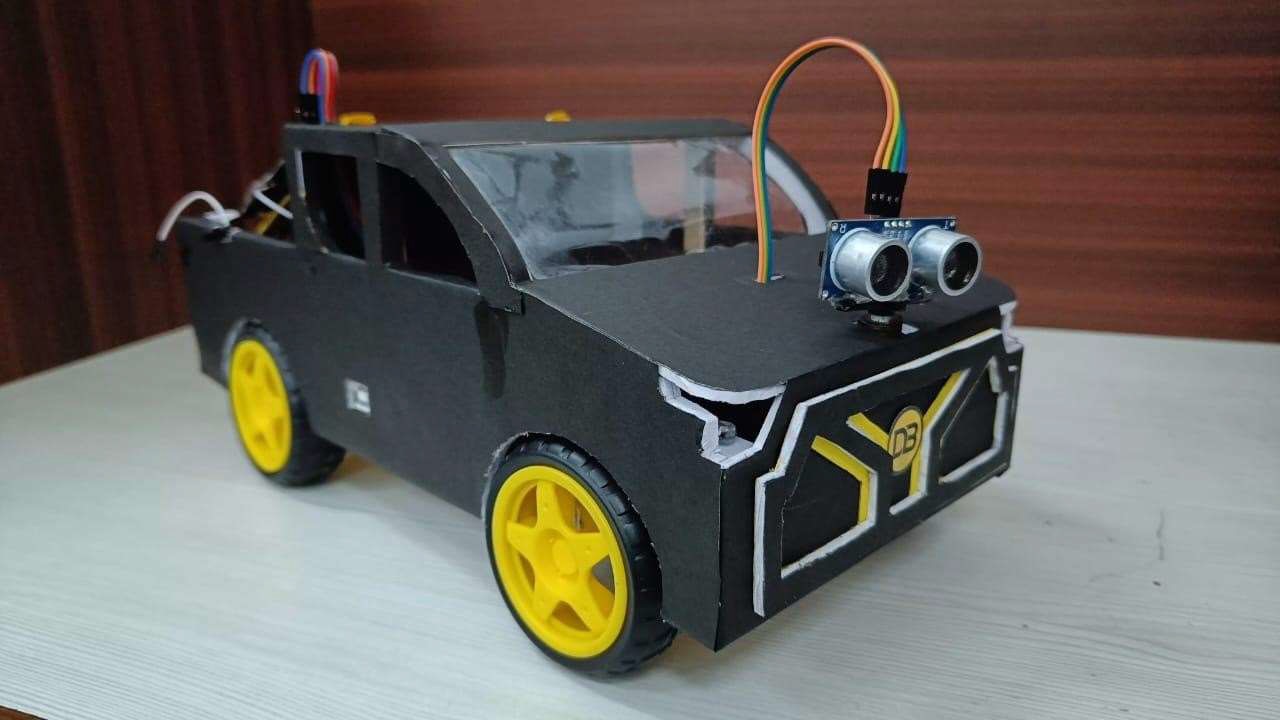
Drive Bot: Self Drive Car Based On IOT
Link to open source: https://github.com/subhambisht/DRIVEBOT.git
Link to Live Project: https://drive.google.com/file/d/1eUPA4gRWsmzOtYaNOE7QS7reYJpaLcf7/view?usp=sharing
Introduction
This project focuses on the development of an autonomous robotic car that can detect and avoid obstacles using IoT (Internet of Things) technology. The car is designed with Arduino Uno as the primary microcontroller and uses ultrasonic sensors for obstacle detection. It can operate in two modes:
Autonomous Mode – The car navigates on its own, avoiding obstacles.
Manual Mode – The car is controlled via an Android app over Bluetooth communication.
The main goal of this project is to create a cost-effective and scalable robotic vehicle that can be further enhanced for real-world applications like smart transport systems, surveillance, and industrial automation.
Key Features
Obstacle Detection & Avoidance:
Uses ultrasonic sensors (HC-SR04) to detect obstacles and steer away from them.
Dual Control Mode:
Autonomous Mode: The car navigates automatically, avoiding obstacles.
Manual Mode: Controlled via Android mobile app using Bluetooth module (HC-05).
Arduino-Based Microcontroller:
Arduino Uno R3 processes sensor data and controls motors.
Uses L293D motor driver to regulate motor movement.
Solar-Powered System:
Mini solar panels (6V-100mAh) recharge the lithium-ion batteries, ensuring an eco-friendly power source.
Includes TP4056 charging module for efficient battery management.
Wireless Connectivity:
Bluetooth communication allows remote control via a mobile app.
Future scope includes WiFi connectivity for better range and security.
Energy-Efficient & Safe Design:
Designed to be modular, allowing for easy expansion and customization.
Components are chosen to ensure low power consumption and reliable performance.
Affordable & Scalable:
Uses low-cost Arduino components to make the project accessible to students and researchers.
Can be modified for industrial automation, delivery systems, or smart transport applications.
Conclusion & Future Work
This project demonstrates the feasibility of using Arduino and IoT for developing a self-driving car with obstacle detection and avoidance capabilities. The use of solar panels ensures energy efficiency, making it a step towards sustainable autonomous vehicles.
Future enhancements include:
Upgrading to WiFi-based communication for longer-range control.
Integration of GPS for location tracking.
Machine Learning implementation to improve navigation and decision-making.
Better obstacle detection sensors like LiDAR for enhanced accuracy.
This project serves as a foundation for further research in autonomous vehicle technology, smart mobility, and IoT-based robotics.
This build was uploaded as a hackathon project


