EchoWard — Voice-native AI Incident Commander
Link to open source: https://github.com/ayushHardeniya/EchoWard
Link to Live Project: https://echoward.vercel.app/
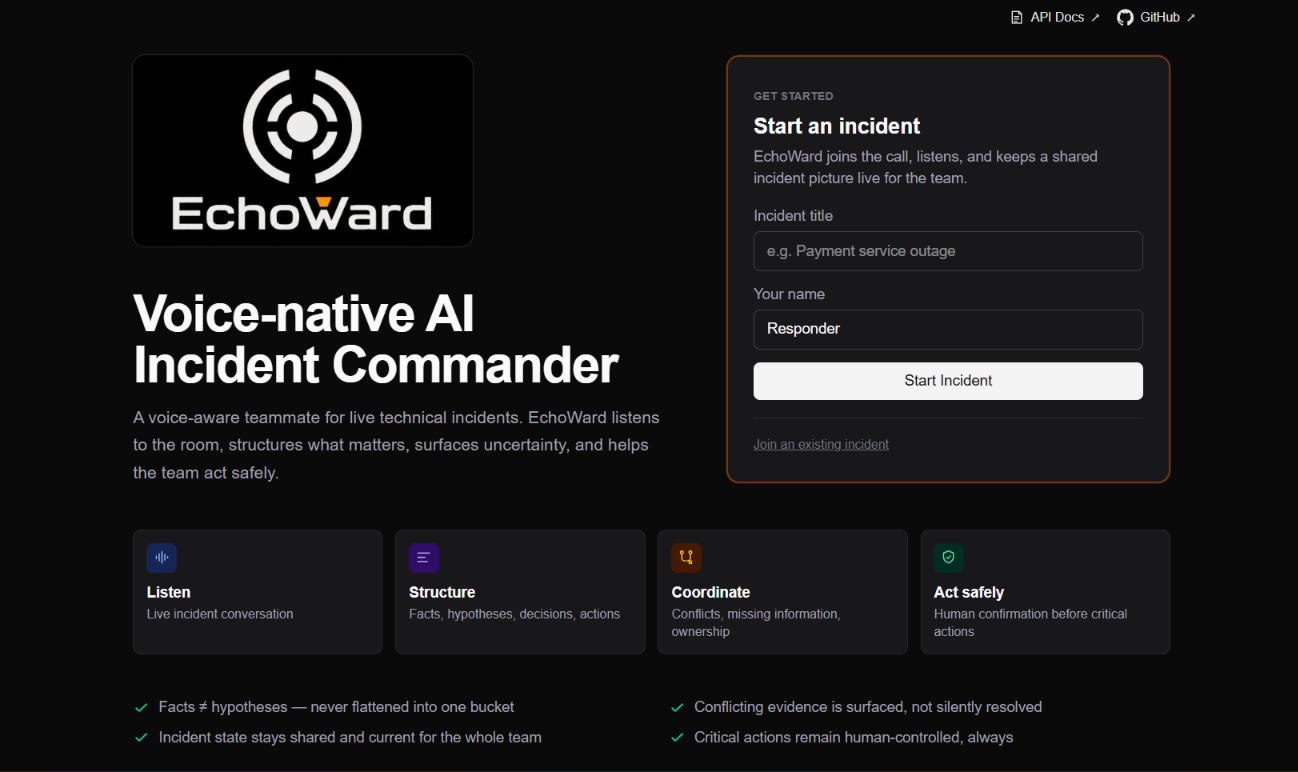
EchoWard
Voice-native AI Incident Commander
Technical incidents rarely happen with all the information neatly in one place.
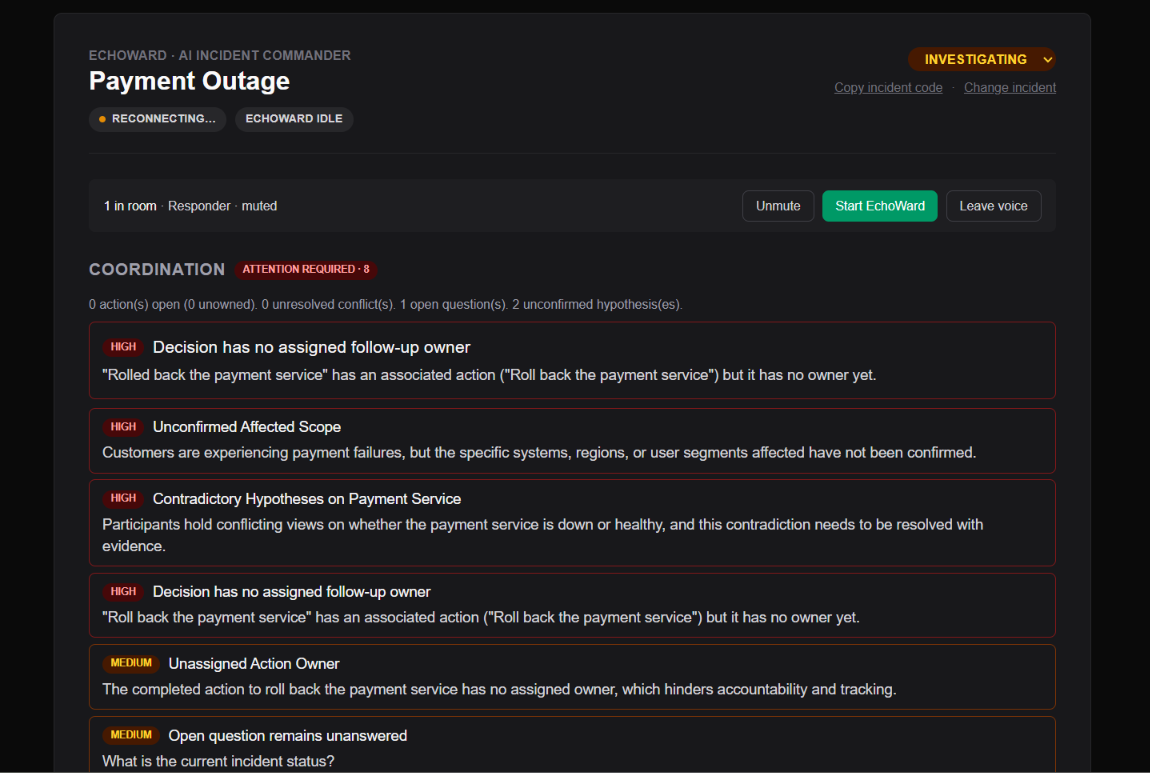
Someone sees customers failing payments. Someone thinks the payment service is down. Another person says the service looks healthy. A decision gets made, someone is supposed to follow up, and ten minutes later the team is trying to remember what was actually agreed on.
EchoWard is built for that messy middle.
It joins a live incident room as a voice-aware teammate, listens to the conversation, and continuously turns what the team is saying into a shared incident picture.
What EchoWard does
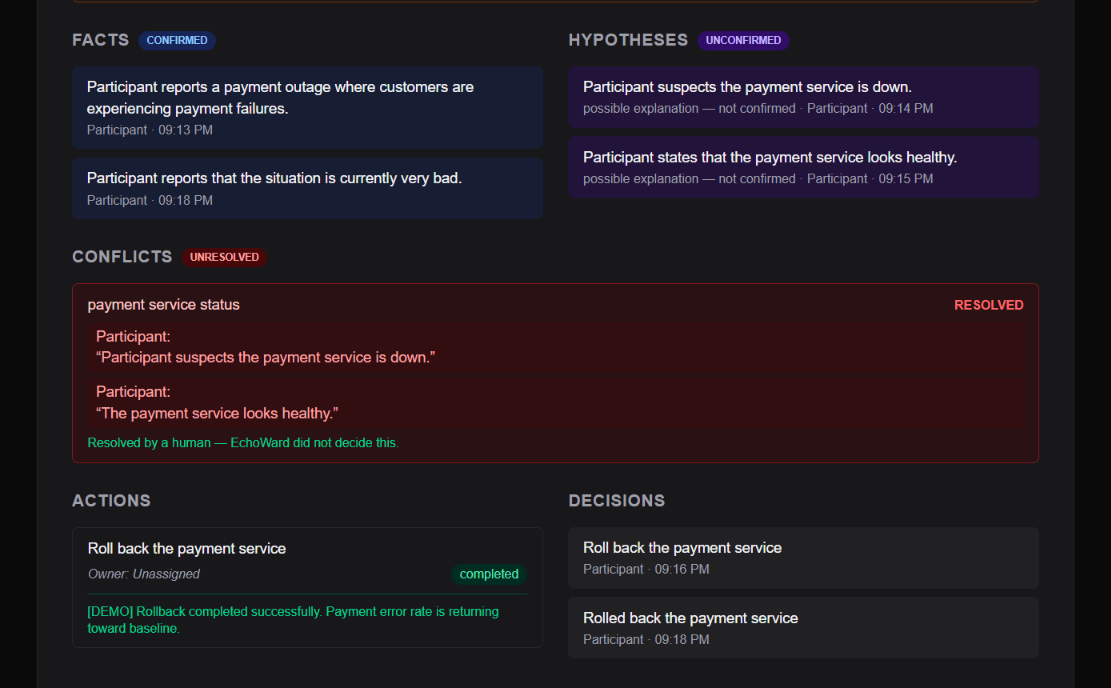
EchoWard listens to the live conversation and organizes it into:
- Facts : information the team has confirmed
- Hypotheses : things the team believes might be happening
- Decisions : what the team has agreed to do
- Actions : follow-ups and operational tasks with ownership
- Conflicts : contradictory information that needs human attention
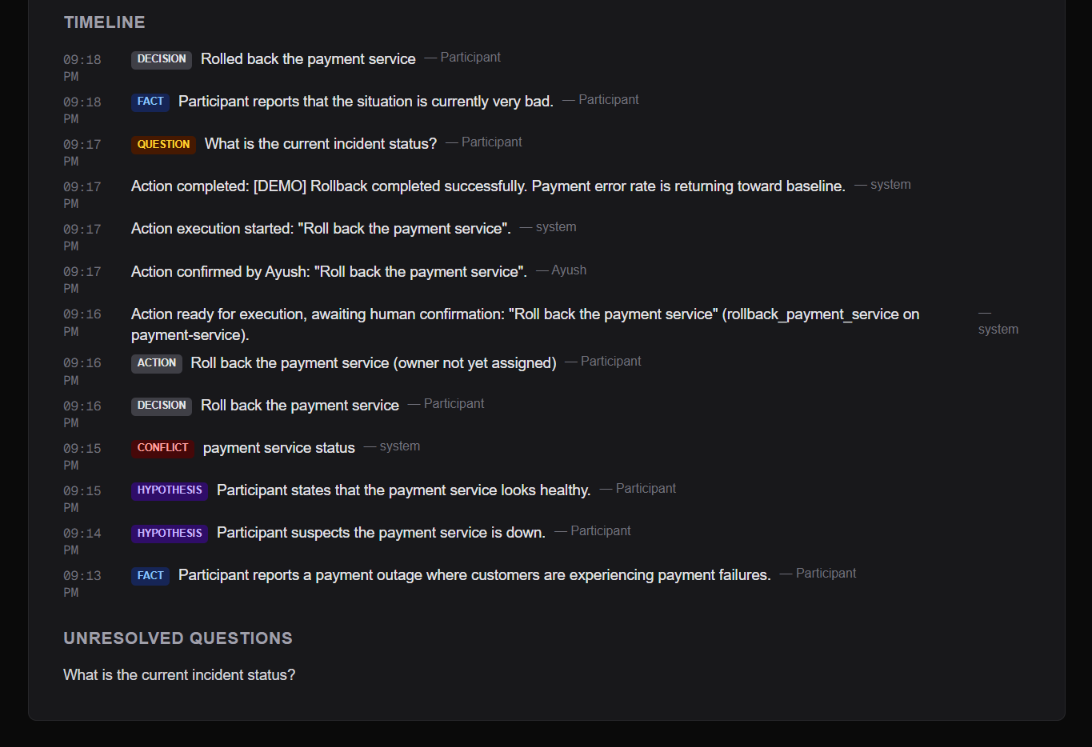
- Unresolved questions : things the team still needs to figure out
- Timeline : a continuously updated history of the incident
It also identifies coordination gaps such as missing information, unclear ownership, and actions that need follow-up.
The important part: EchoWard does not guess
During an incident, conflicting information is normal.
If one responder says "the payment service is down" while another says "the payment service looks healthy", EchoWard doesn't pick a side just to make the incident state look clean.
It preserves the uncertainty and surfaces the conflict for the team to resolve.
That distinction is central to EchoWard:
It doesn't pretend to know what's true. It helps the team see what needs attention.
From conversation to action
EchoWard isn't only an incident note-taker.
When the team decides to take an operational action, EchoWard can prepare that action and show exactly what is about to happen.
Critical actions always require explicit human confirmation before execution.
The flow is:
Prepare -> Human Confirmation -> Execute -> Record Result
This keeps the AI useful during high-pressure situations without giving it unchecked control.
Built for real-time voice
Agora Conversational AI provides EchoWard's real-time conversational voice layer, allowing it to participate directly in the incident room rather than simply processing a transcript after the fact.
The system combines the voice layer with an incident intelligence and coordination layer that continuously maintains the shared incident state.
Core loop
Listen => Structure => Understand => Coordinate => Act Safely
Why it matters
Incident response is already cognitively expensive. Engineers and incident leads shouldn't have to simultaneously listen to everyone, remember decisions, track ownership, reconcile conflicting reports, and keep dashboards updated.
EchoWard takes on that coordination overhead so the team can focus on resolving the incident.
---
Built by Team ZenYukti
For the EcoSphere: Agora Conversational AI Hackathon 2026 by KNOTiC.
This build was uploaded as a hackathon project

