Feb 21, 2026

Enterprise Multi-Channel Requirements Synthesizer
generative aigenerative ai langchain google gemini, business intelligence multi-agent

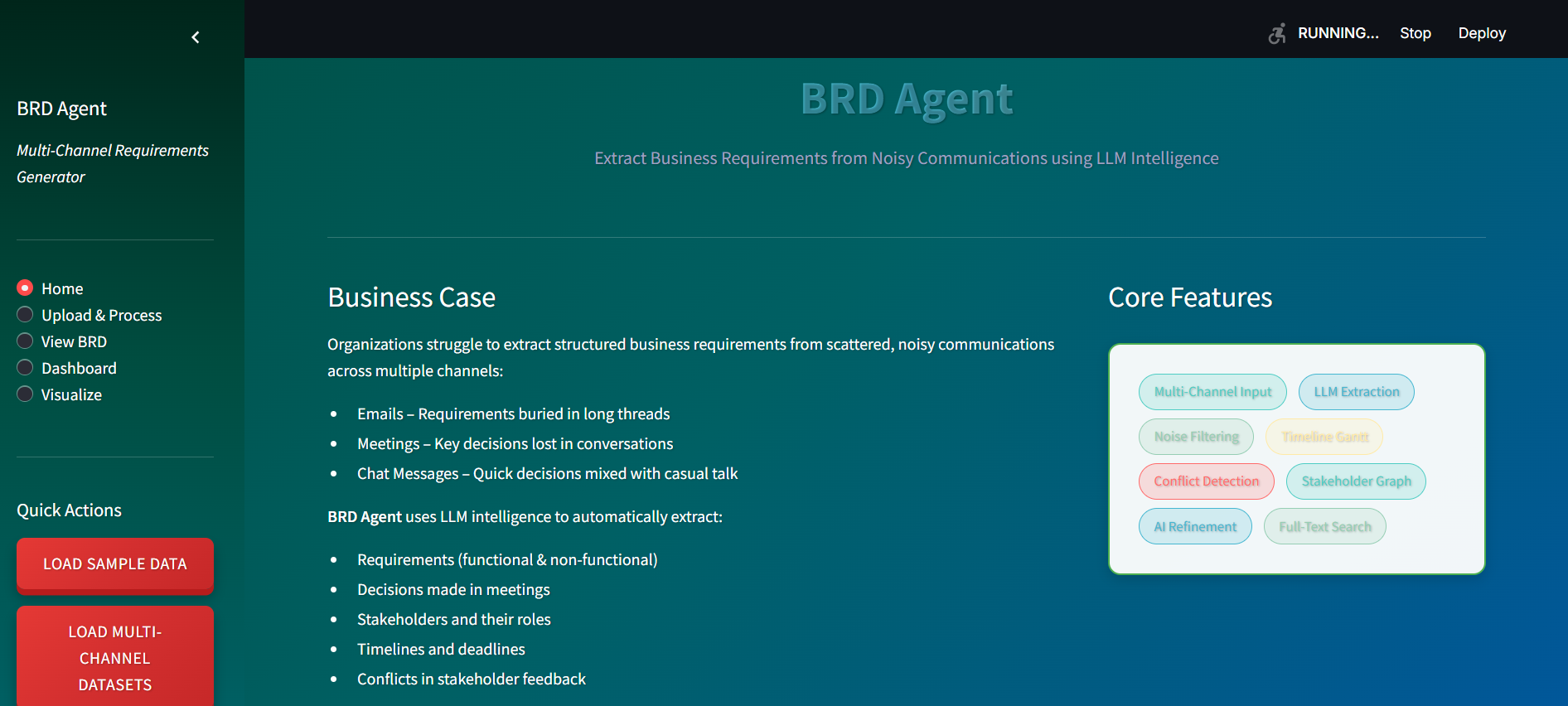
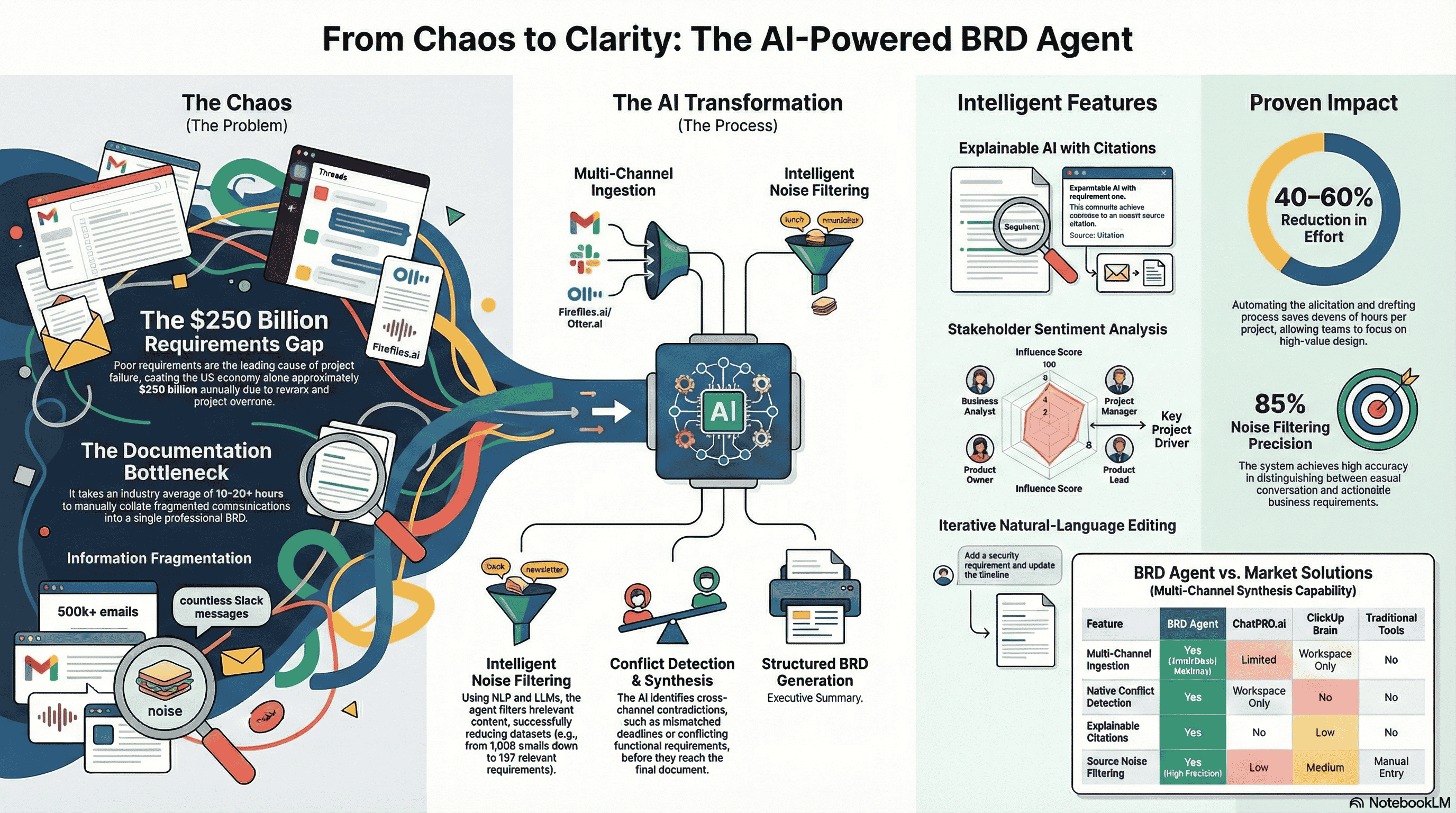
The BRD Agent is an advanced Business Intelligence solution designed to automate the creation of Business Requirements Documents (BRDs) from highly noisy corporate communications. Business requirements are often scattered across emails, Slack messages, and meeting transcripts, making manual synthesis time-consuming and error-prone.

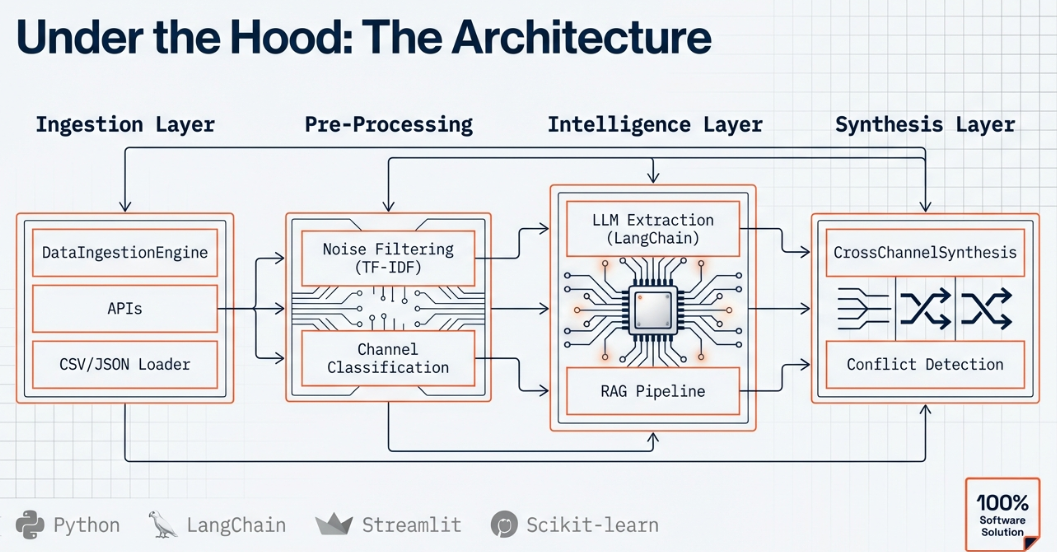
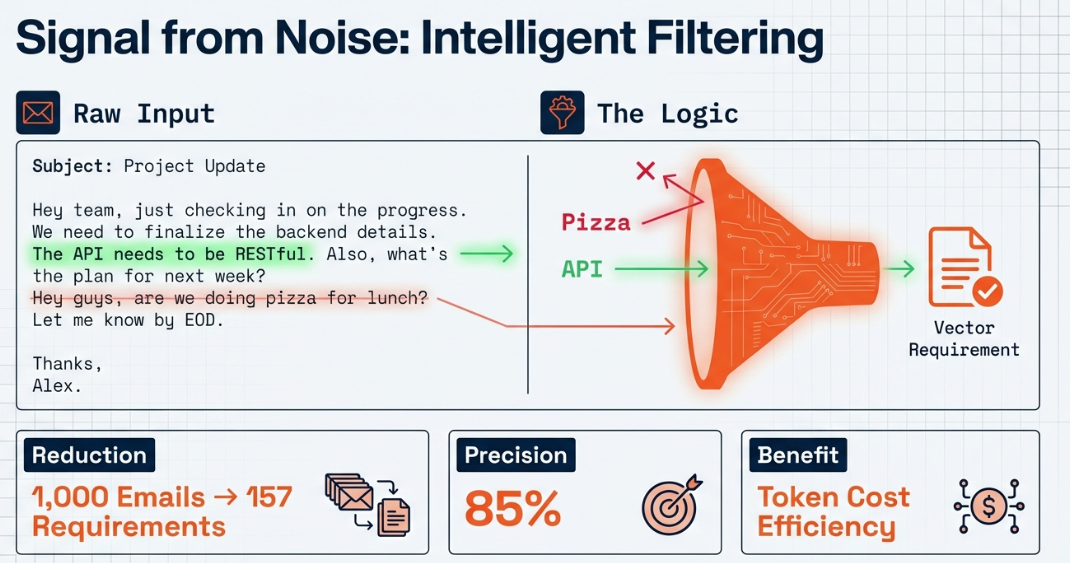
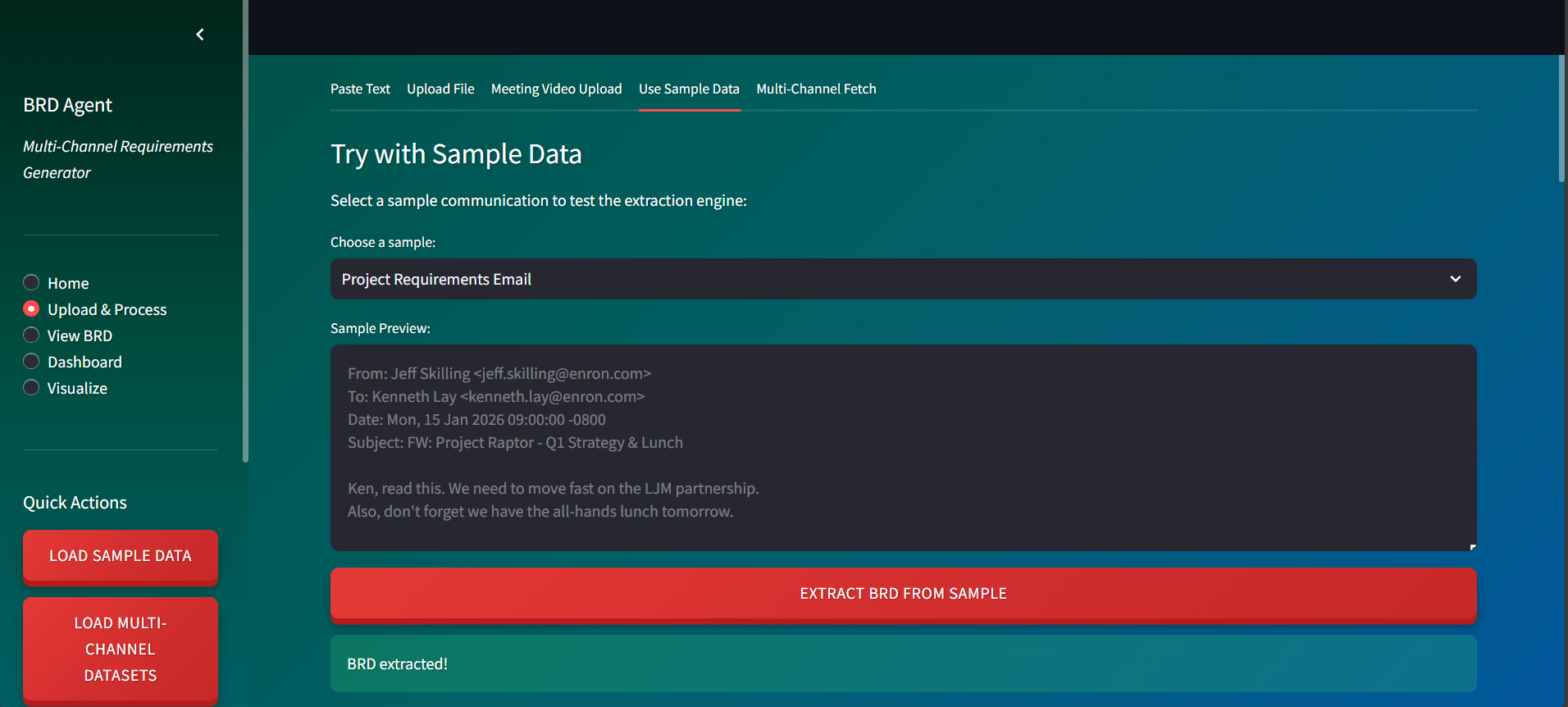
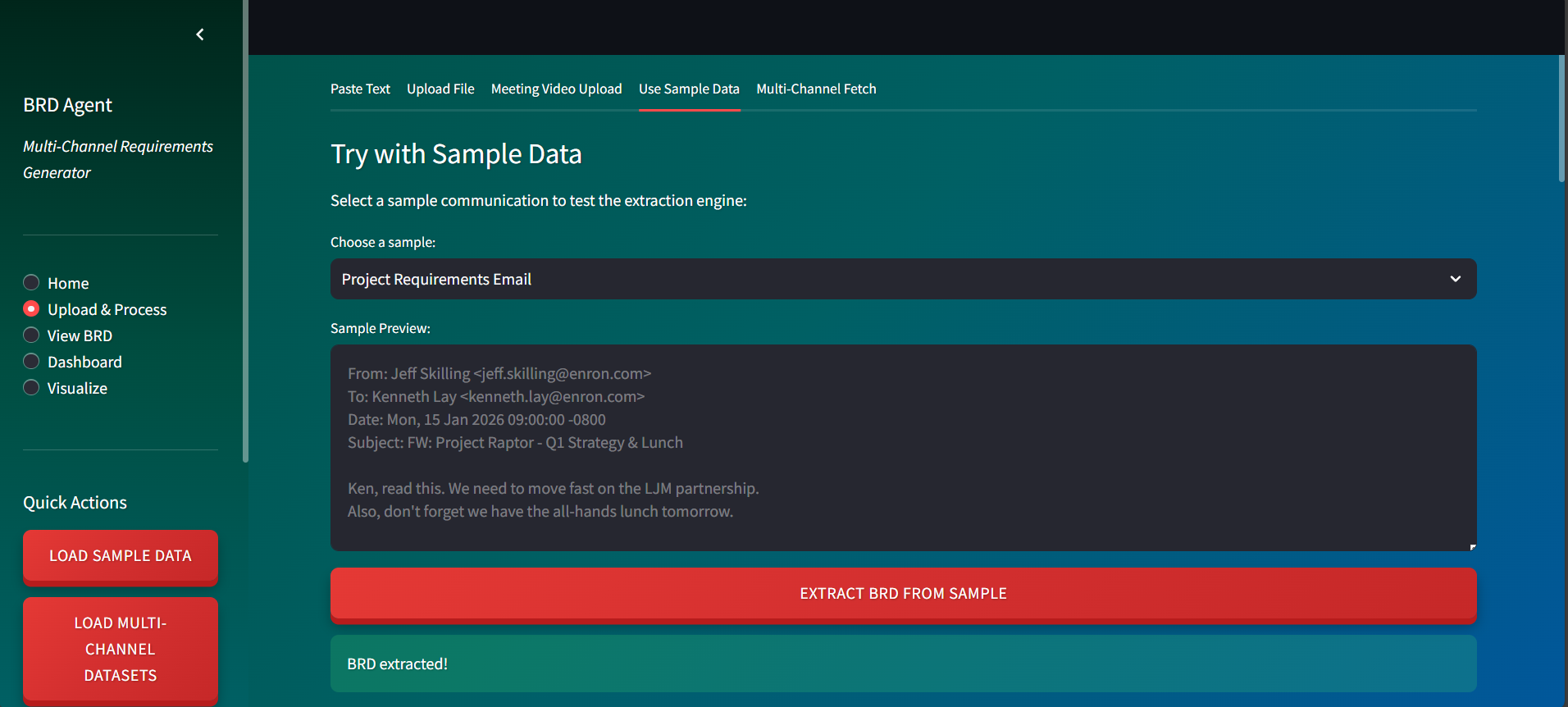
Our agent performs "Cross-Channel Synthesis." It ingests raw data from multiple sources (simulated using the Enron Email Corpus and AMI Meeting Transcripts), intelligently filters out irrelevant corporate noise (like casual conversations or routine FYIs), and extracts precise project objectives, functional requirements, and timelines.

1. Purpose & Objectives

The BRD Agent is an advanced Business Intelligence solution engineered to automate the creation of comprehensive Business Requirements Documents (BRDs) by distilling actionable insights from noisy corporate communications.

  • Primary Objective: To transform fragmented dataβ€”scattered across Emails, Slack, and Meeting Transcriptsβ€”into a structured, professional project blueprint.

  • Efficiency Focus: To eliminate the manual synthesis process, reducing errors and saving up to 80% of the time typically spent on requirements gathering.

2. Core Technical Features

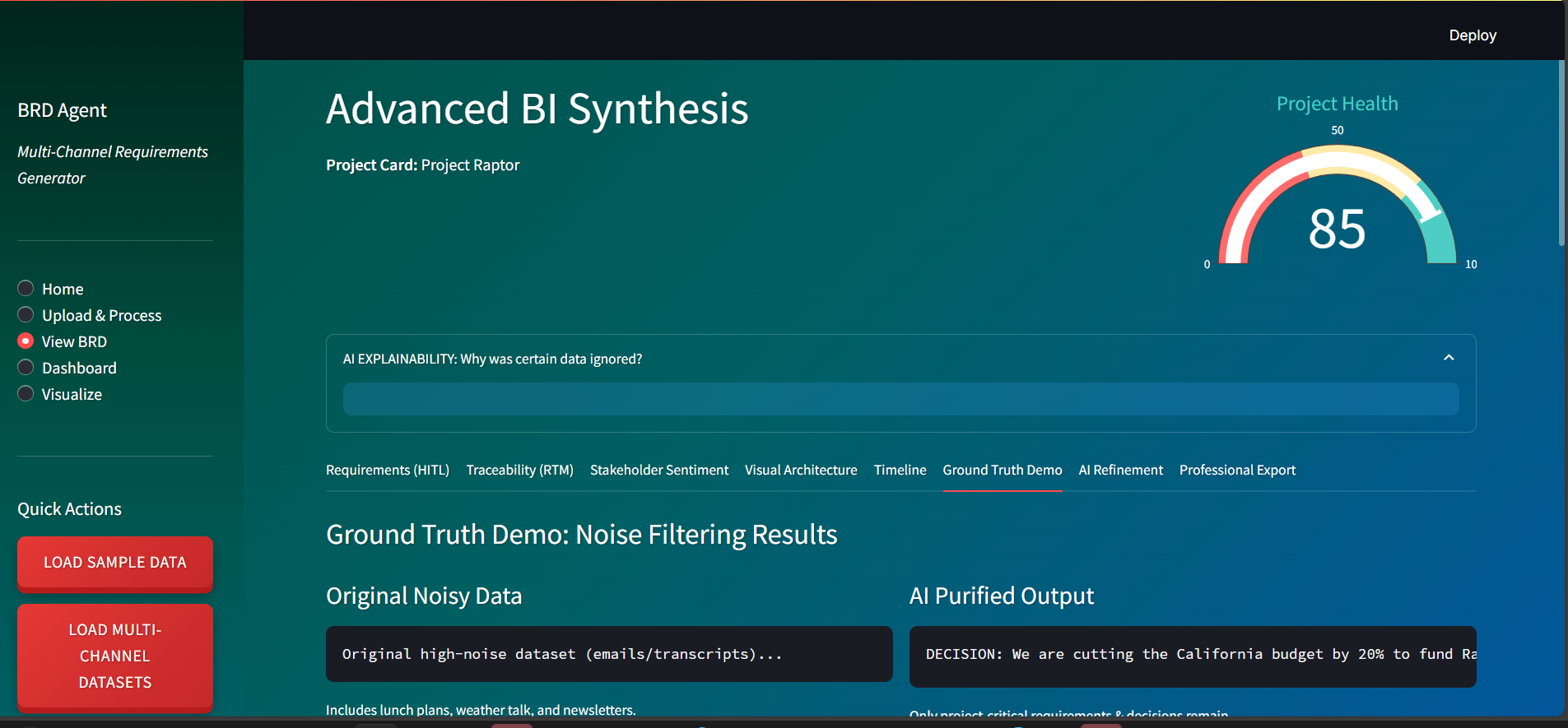
  • Automated Noise Filtering: The agent utilizes high-fidelity LLM intelligence to strip away "corporate noise" such as lunch plans, casual greetings, and routine FYIs, focusing strictly on project-critical data.

  • Cross-Channel Conflict Detection: The system automatically identifies and flags contradictions between sources, such as a deadline mentioned in an email that conflicts with a decision made during a recorded meeting.

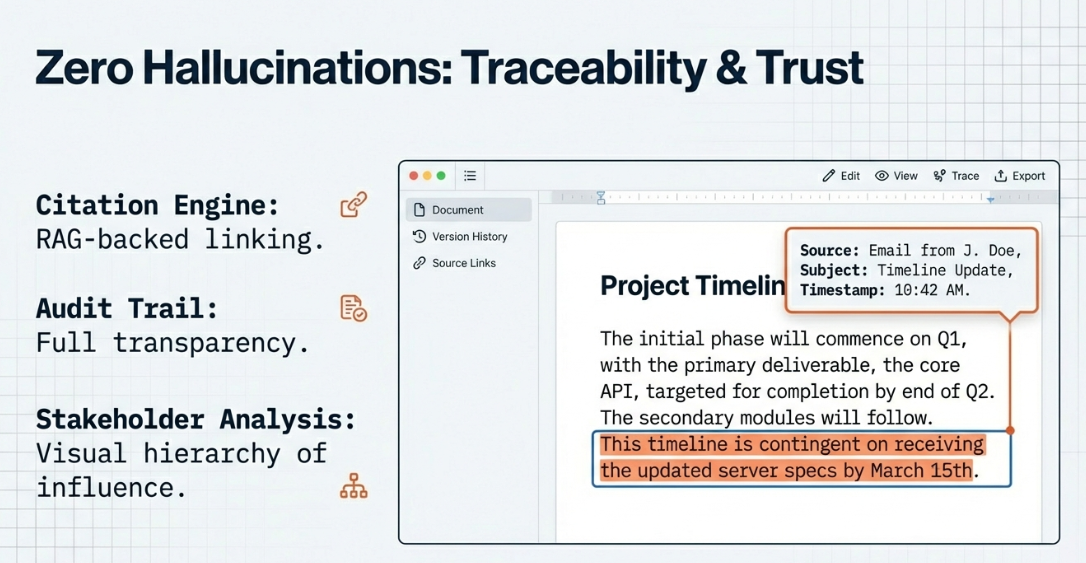
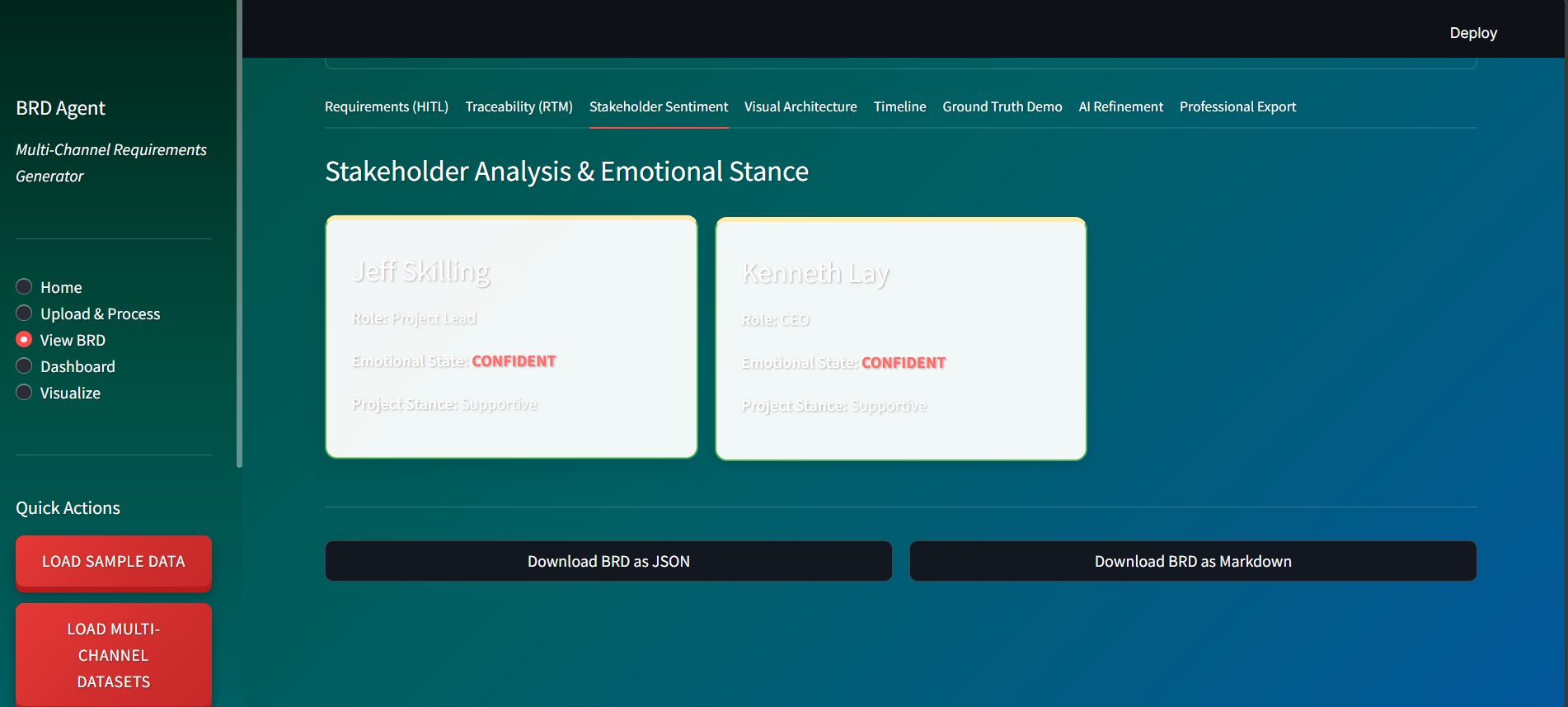
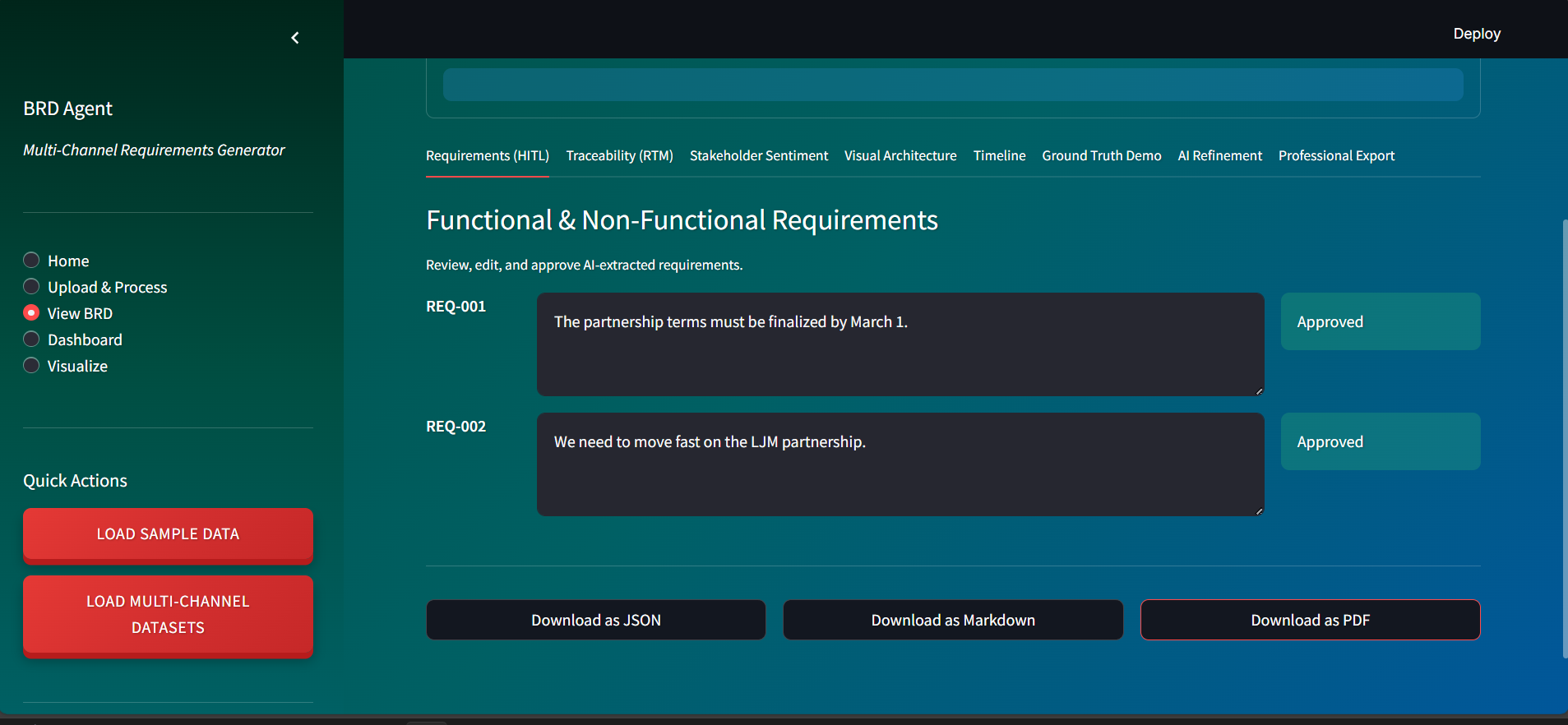
  • Requirement Traceability Matrix (RTM): Every extracted requirement is linked back to its original source (e.g., Enron Email #ID) to ensure full explainability and eliminate hallucinations.

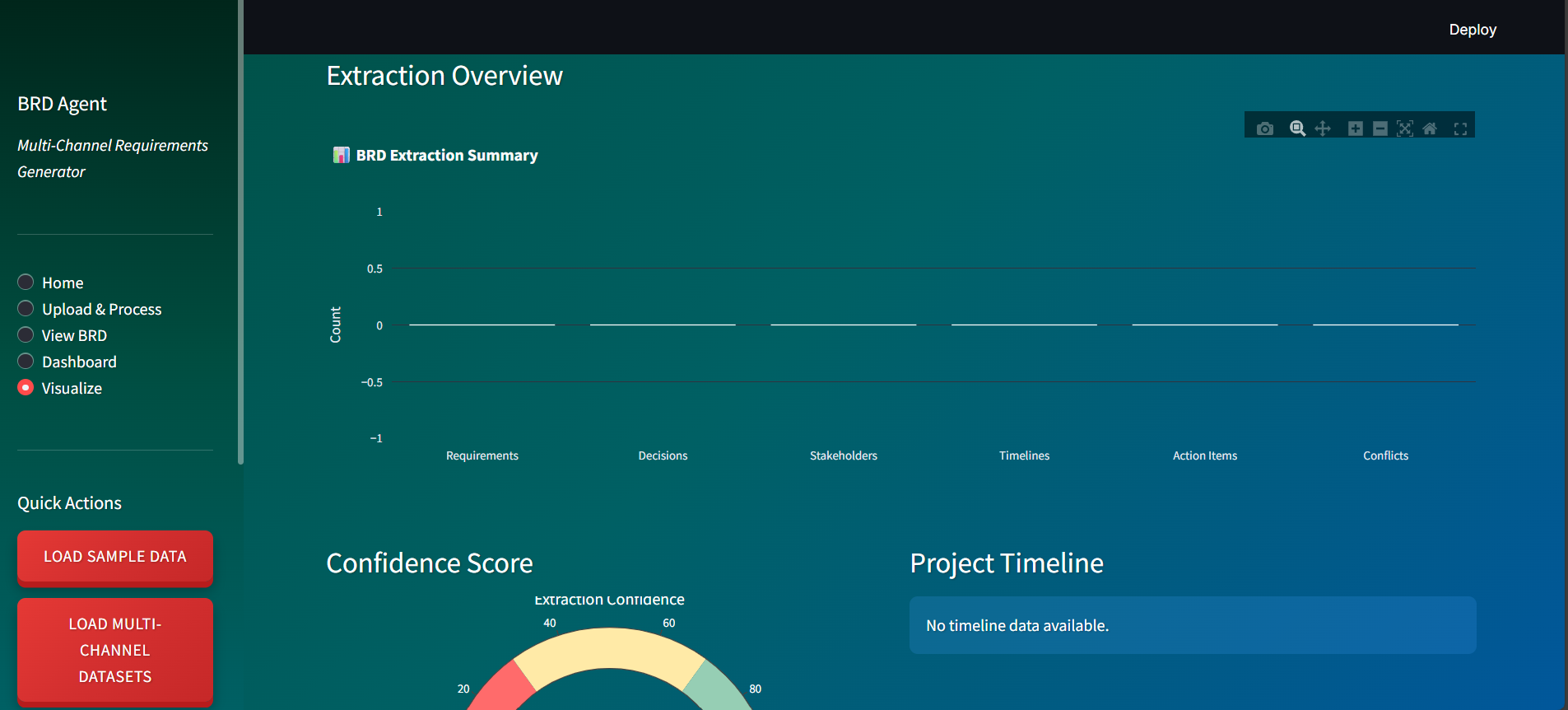
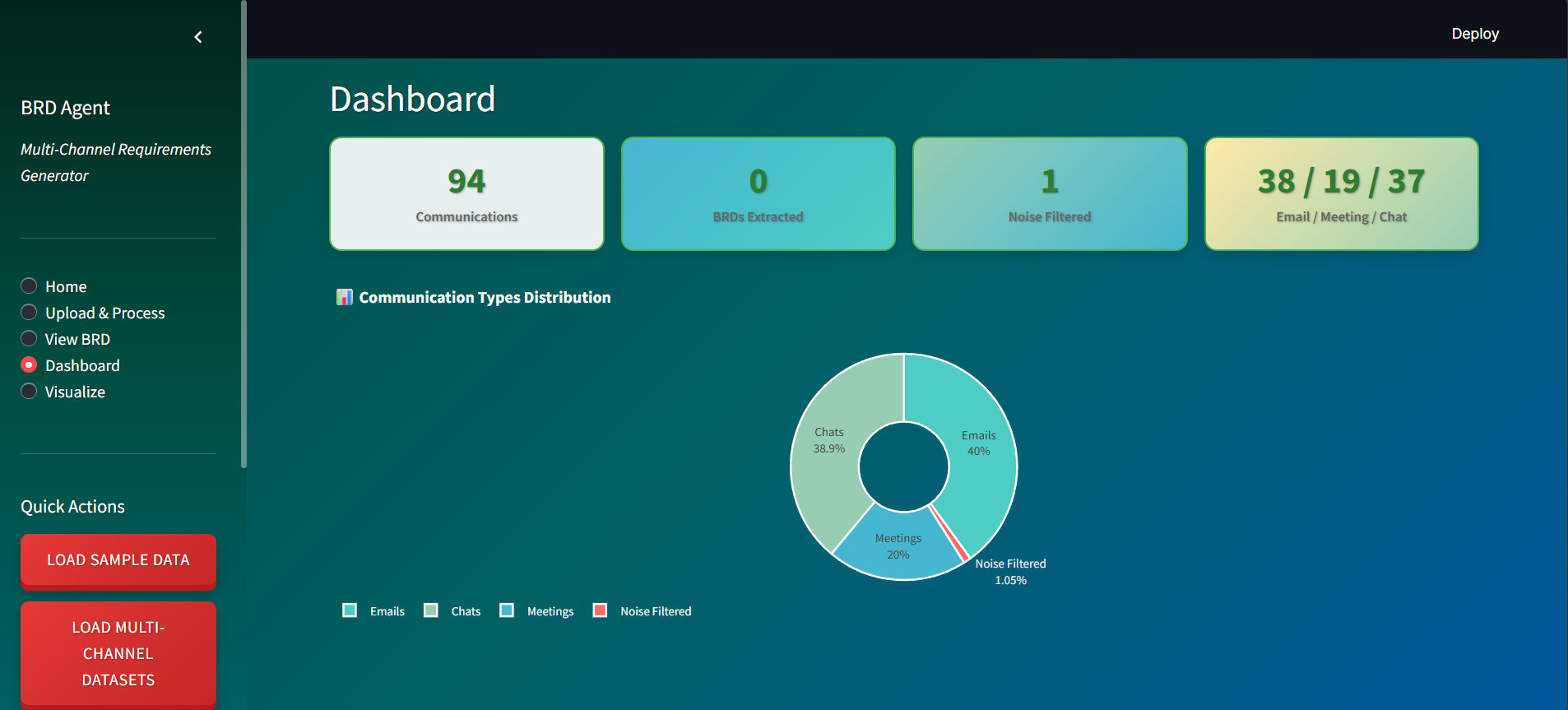
  • Enterprise-Ready UI: A minimalist, professional Streamlit dashboard designed for B2B environments, featuring a clean layout without distracting elements.

3. Advanced "Winning" Features (New Additions)

Following mentor feedback, we have integrated several high-impact features to enhance transparency and user understanding:

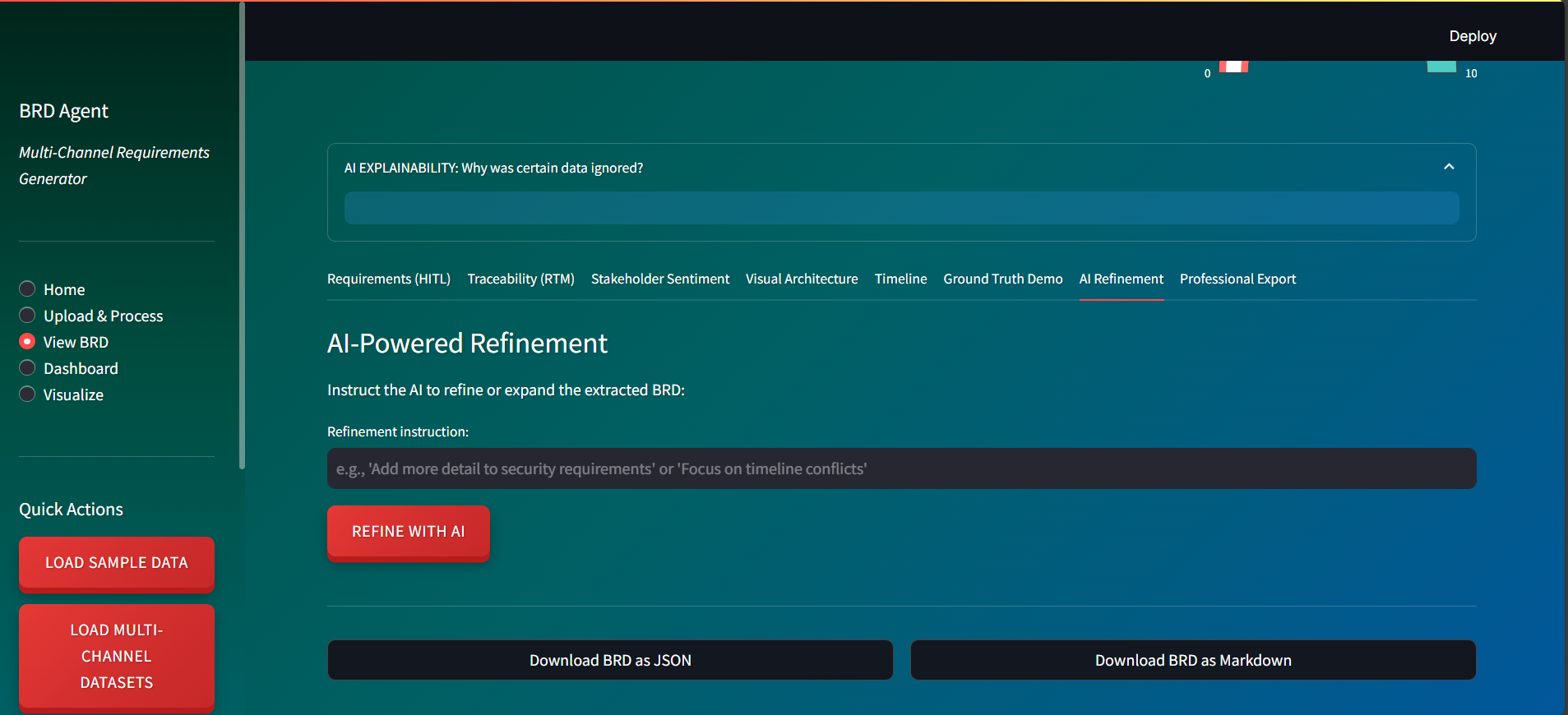
  • Version Comparison & Diff Viewer (Before vs. After):

    • When a user requests an edit or the AI updates a requirement, the system provides a side-by-side comparison.

    • This allows users to clearly see exactly what changed between the previous version and the current output.

  • Reasoning Logs (The "Why"):

    • The agent doesn't just change text; it provides a logical justification for every modification (e.g., "Updated deadline to March 1st as requested by the CEO in the latest transcript").

  • Professional PDF Export with Change Log:

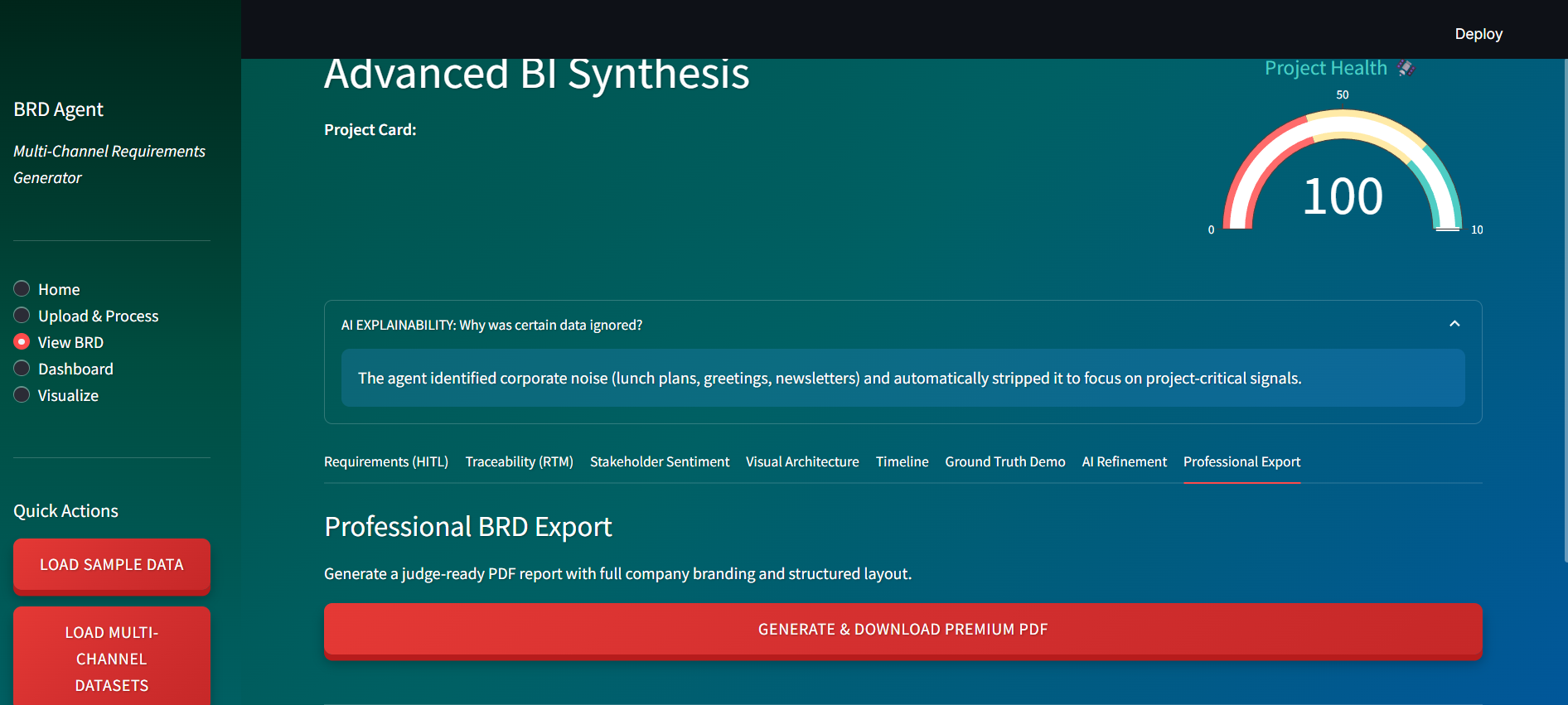
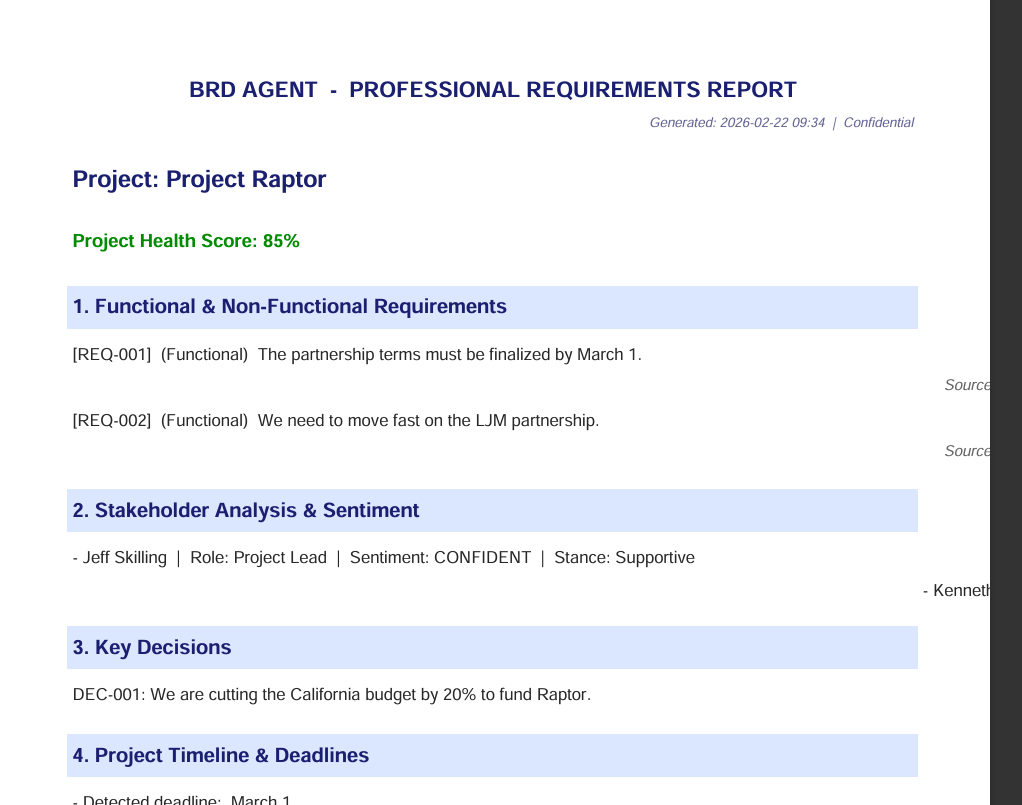
    • Users can now download the final BRD as a professional PDF report.

    • The PDF includes a dedicated Audit Trail/Change Log section, documenting the history of all revisions and their reasons.

  • Quad-Dimensional "What-If" Simulator:

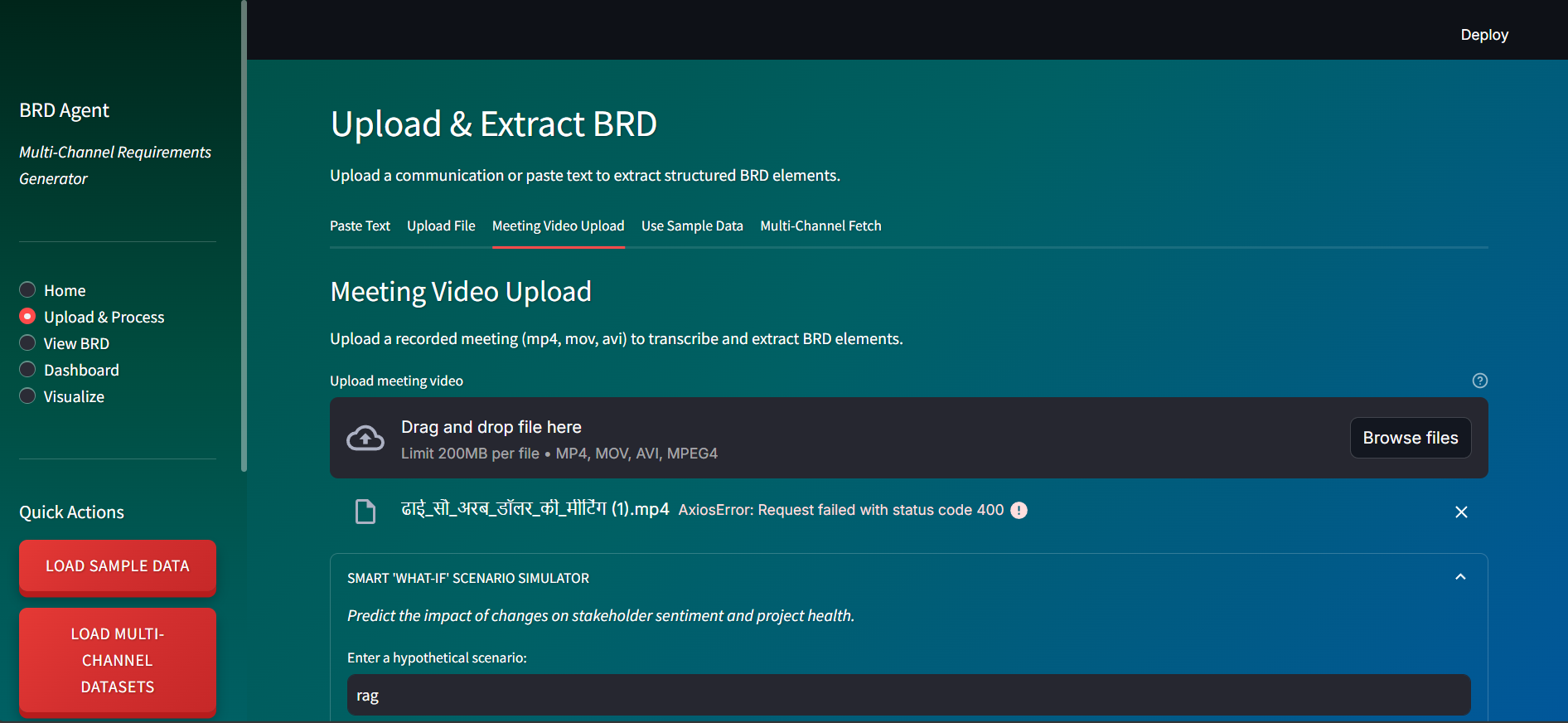
    • A strategic tool that allows users to input hypothetical scenarios (e.g., "What if the budget is cut by 20%?") to predict the impact on project health and stakeholder sentiment.

4. Technology Stack

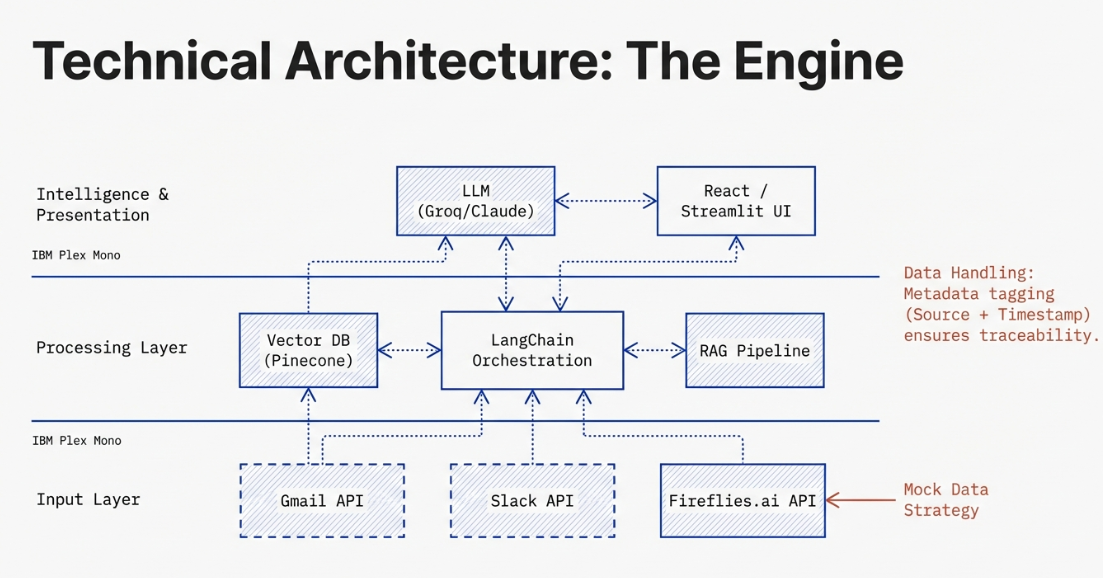
  • LLM Orchestration: Powered by LangChain utilizing Groq (Llama 3 70B) and Google Gemini 1.5 Flash for high-speed, accurate reasoning.

  • Frontend: Streamlit with customized CSS for a premium SaaS look.

  • Libraries: difflib for version comparison and fpdf2 for professional-grade document generation.

Key technical features include:

  1. Automated Noise Filtering: Focuses strictly on project-critical data.

  2. Cross-Channel Conflict Detection: Automatically flags contradictions (e.g., an email stating a deadline of Oct 15th while a meeting transcript suggests Nov 1st).

  3. Requirement Traceability Matrix (RTM): Provides exact source citations for every extracted requirement to ensure high explainability and zero hallucination.

  4. Human-in-the-Loop UI: A clean, enterprise-ready Streamlit dashboard for reviewing and exporting the final Markdown document.

Built utilizing LangChain and Google Gemini, the BRD Agent transforms chaotic communications into structured, actionable project blueprints.

This build was uploaded as a hackathon project

Hackathon

HackFest 2.0

View All Projects

2

Give a star to encourage!Discussion
Start a new conversation!
Login to join the discussion

More Builds by sk motalib

medassist healthcareinnovation voiceenabledapp elderlycaretech medicationreminder
Updates
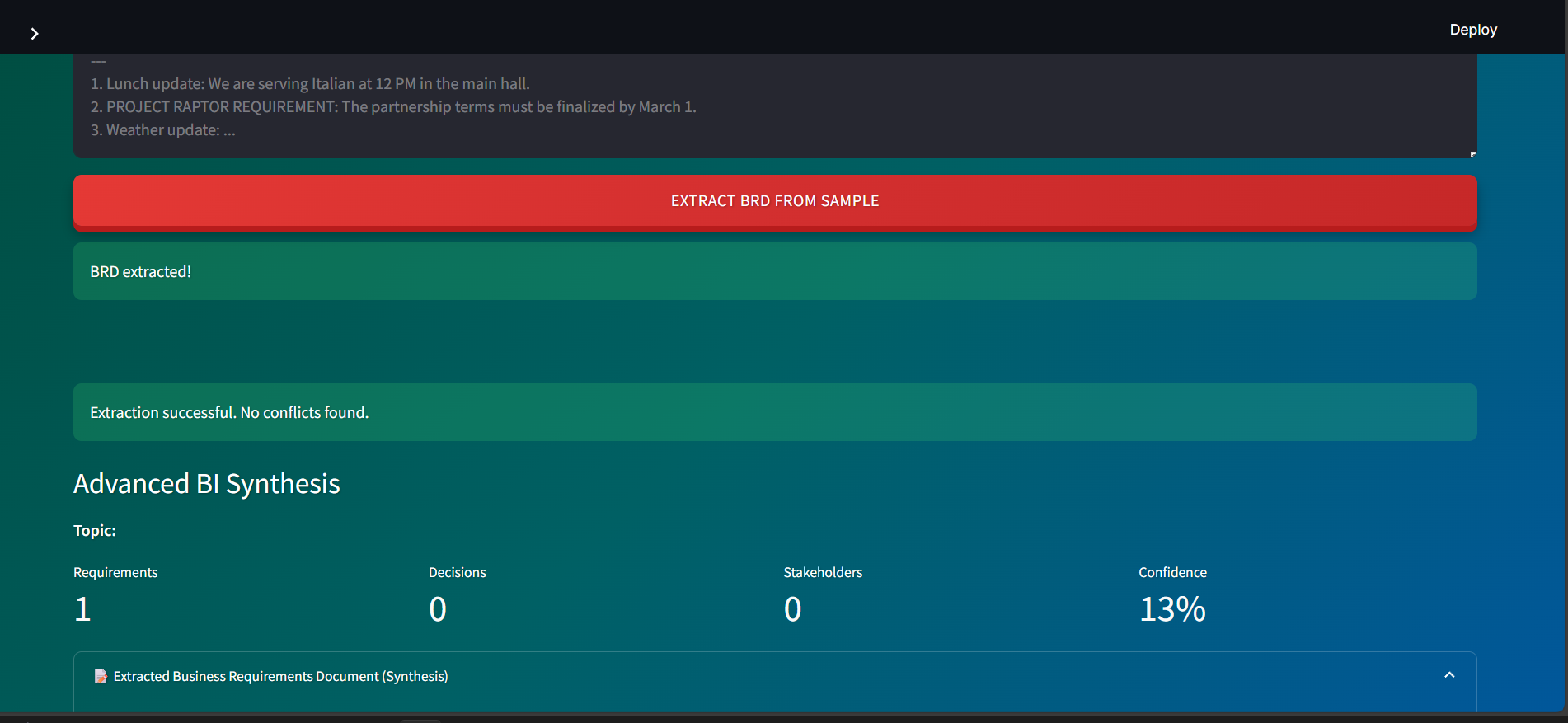
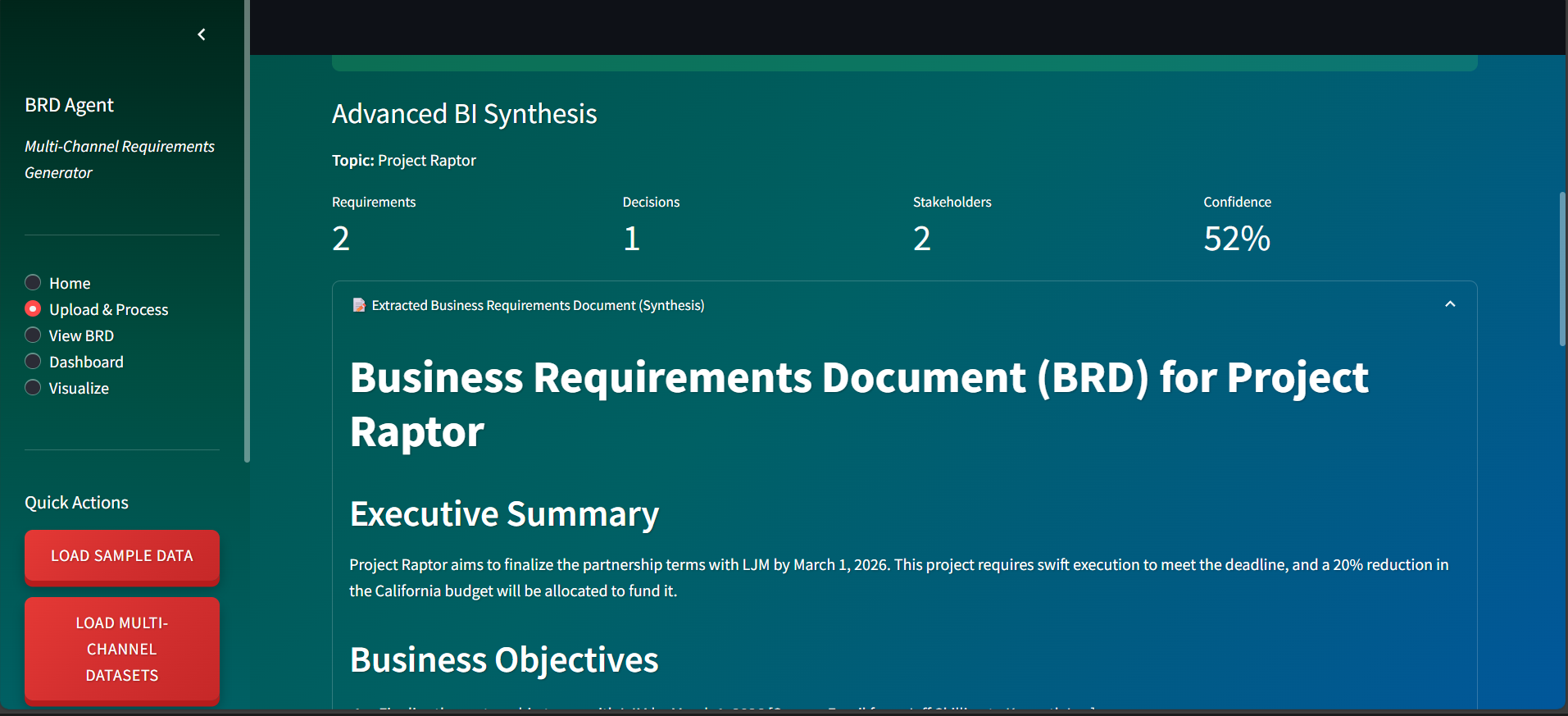
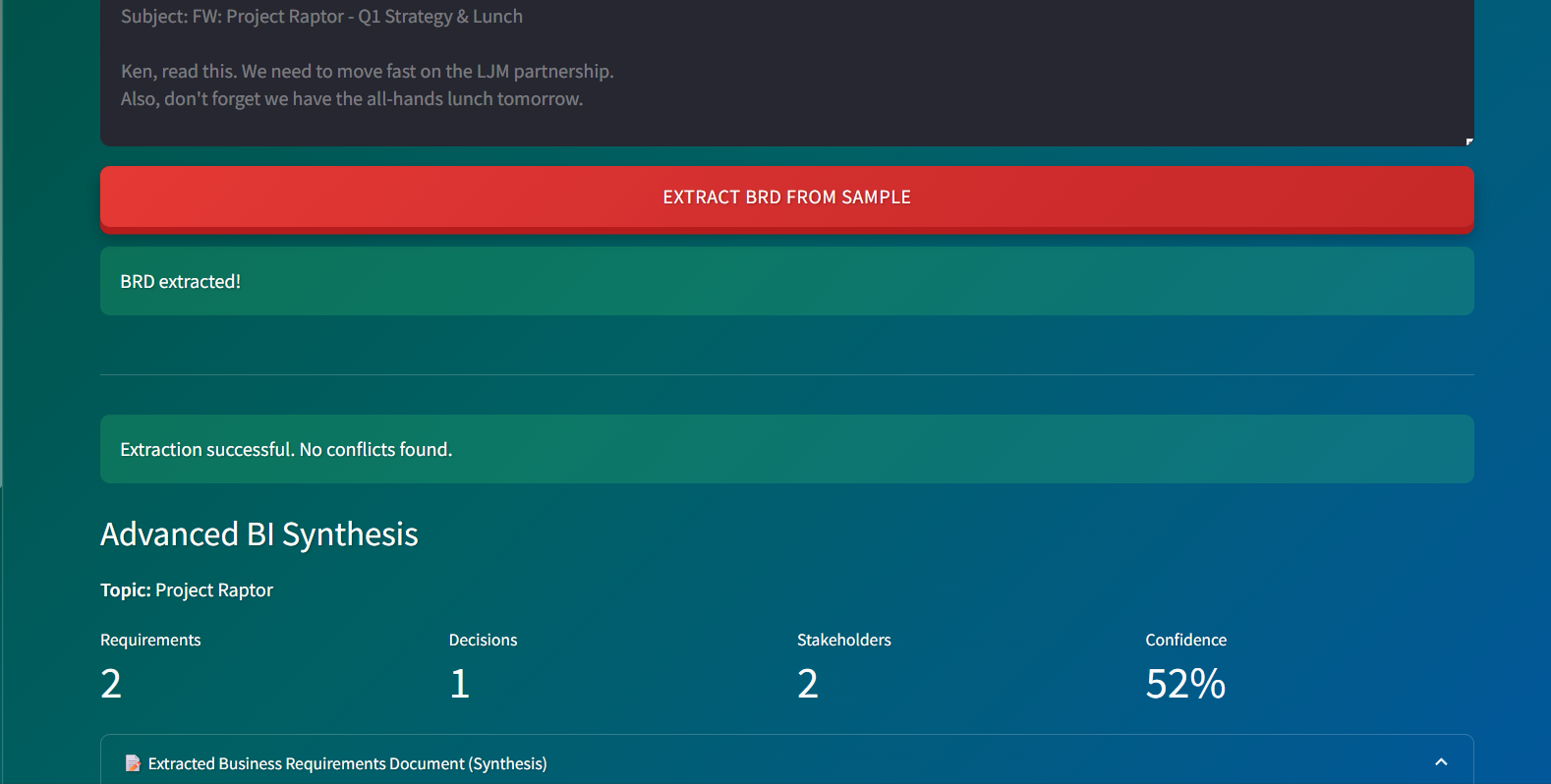
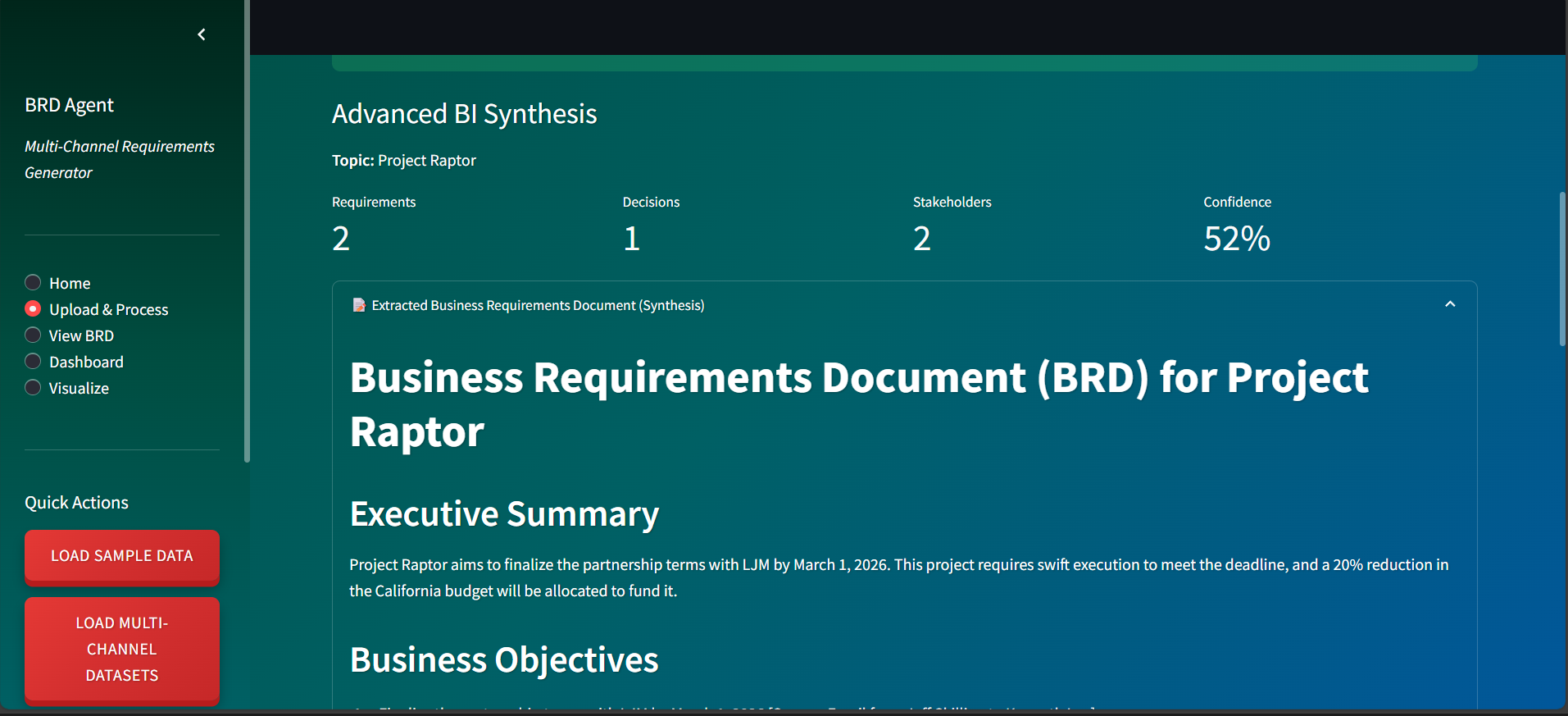
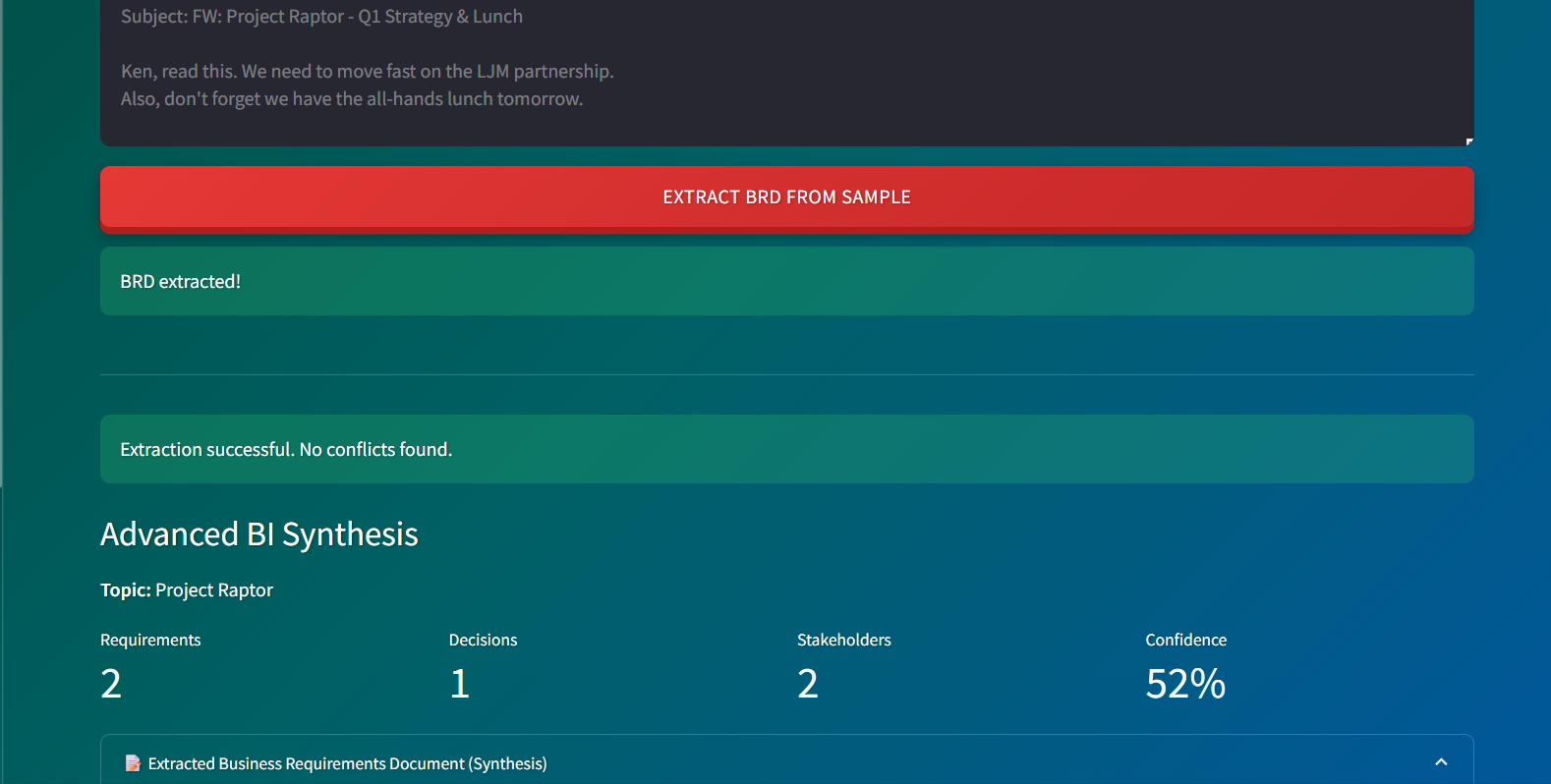
  • πŸ“ Extracted Business Requirements Document (Synthesis) Business Requirements Document (BRD) for Project Raptor Executive Summary Project Raptor aims to finalize the partnership terms with LJM by March 1, 2026. This project requires swift execution to meet the deadline, and a 20% reduction in the California budget will be allocated to fund it. Business Objectives Finalize the partnership terms with LJM by March 1, 2026 [Source: Email from Jeff Skilling to Kenneth Lay]. Allocate a 20% reduction in the California budget to fund Project Raptor [Source: Decision to cut California budget]. Functional Requirements Establish a partnership agreement with LJM by March 1, 2026 [Source: Email from Jeff Skilling to Kenneth Lay]. Negotiate and finalize the partnership terms with LJM [Source: Email from Jeff Skilling to Kenneth Lay]. Non-Functional Requirements The partnership agreement must be finalized within the given timeframe [Source: Email from Jeff Skilling to Kenneth Lay]. The partnership terms must be negotiated and finalized with LJM [Source: Email from Jeff Skilling to Kenneth Lay]. Stakeholders Kenneth Lay (CEO, Enron Corporation) Jeff Skilling (Executive, Enron Corporation) LJM Partnership Conflict Analysis Deadline Conflict: The partnership terms must be finalized by March 1, 2026, but the California budget reduction may impact the project's timeline and resources. Budget Conflict: A 20% reduction in the California budget may not be sufficient to fund Project Raptor, potentially impacting the project's scope and timeline. Scope Conflict: The project's scope may be impacted by the reduced budget, potentially affecting the partnership agreement and terms. Recommendations Conduct a thorough risk assessment to identify potential risks and mitigation strategies. Develop a detailed project plan to ensure the partnership agreement is finalized by March 1, 2026. Re-evaluate the project's scope and budget to ensure alignment with the reduced California budget.    
    Saturday, Feb 21st, 2026
  • πŸ“ Extracted Business Requirements Document (Synthesis) Business Requirements Document (BRD) for Project Raptor Executive Summary Project Raptor aims to finalize the partnership terms with LJM by March 1, 2026. This project requires swift execution to meet the deadline, and a 20% reduction in the California budget will be allocated to fund it. Business Objectives Finalize the partnership terms with LJM by March 1, 2026 [Source: Email from Jeff Skilling to Kenneth Lay]. Allocate a 20% reduction in the California budget to fund Project Raptor [Source: Decision to cut California budget]. Functional Requirements Establish a partnership agreement with LJM by March 1, 2026 [Source: Email from Jeff Skilling to Kenneth Lay]. Negotiate and finalize the partnership terms with LJM [Source: Email from Jeff Skilling to Kenneth Lay]. Non-Functional Requirements The partnership agreement must be finalized within the given timeframe [Source: Email from Jeff Skilling to Kenneth Lay]. The partnership terms must be negotiated and finalized with LJM [Source: Email from Jeff Skilling to Kenneth Lay]. Stakeholders Kenneth Lay (CEO, Enron Corporation) Jeff Skilling (Executive, Enron Corporation) LJM Partnership Conflict Analysis Deadline Conflict: The partnership terms must be finalized by March 1, 2026, but the California budget reduction may impact the project's timeline and resources. Budget Conflict: A 20% reduction in the California budget may not be sufficient to fund Project Raptor, potentially impacting the project's scope and timeline. Scope Conflict: The project's scope may be impacted by the reduced budget, potentially affecting the partnership agreement and terms. Recommendations Conduct a thorough risk assessment to identify potential risks and mitigation strategies. Develop a detailed project plan to ensure the partnership agreement is finalized by March 1, 2026. Re-evaluate the project's scope and budget to ensure alignment with the reduced California budget. Next Steps Schedule a meeting with stakeholders to discuss the project plan and scope. Develop a detailed project schedule and budget. Conduct a thorough risk assessment and develop mitigation strategies.
    Saturday, Feb 21st, 2026
  • πŸ“ Extracted Business Requirements Document (BRD) for Project Raptor Executive Summary Project Raptor aims to finalize the partnership terms with LJM by March 1, 2026. This project requires swift execution to meet the deadline, and a 20% reduction in the California budget will be allocated to fund it. Business Objectives Finalize the partnership terms with LJM by March 1, 2026 [Source: Email from Jeff Skilling to Kenneth Lay]. Allocate a 20% reduction in the California budget to fund Project Raptor [Source: Decision to cut California budget]. Functional Requirements Establish a partnership agreement with LJM by March 1, 2026 [Source: Email from Jeff Skilling to Kenneth Lay].   Stakeholders Kenneth Lay (CEO, Enron Corporation) Jeff Skilling (Executive, Enron Corporation) LJM Partnership Conflict Analysis Deadline Conflict: The partnership terms must be finalized by March 1, 2026, but the California budget reduction may impact the project's timeline and resources. Budget Conflict: A 20% reduction in the California budget may not be sufficient to fund Project Raptor, potentially impacting the project's scope and timeline. Scope Conflict: The project's scope may be impacted by the reduced budget, potentially affecting the partnership agreement and terms.    
    Saturday, Feb 21st, 2026
  • Professional PDF Generation Engine One-Click Export: Supports a direct "Download as PDF" feature for formal project use. Enterprise Standards: Includes professional headers, footers, and page numbering. Audit Trail: Every PDF features an automated "Revision History" for official sign-offs. 2. Live Version Comparison (Diff Viewer) Visual Highlights: Uses the difflib library to show side-by-side "Before vs. After" changes. Traceable Updates: Users can track the document's evolution from raw input to refined requirements. 3. Explainable AI: Reasoning Logs The "Why" Factor: Generates a "Reasoning Log" for every AI-driven modification (e.g., budget or date changes). Logic Attribution: Provides clear justifications, such as "Updated based on conflicting Meeting Transcript data," eliminating the "Black Box" feel. 4. Advanced Logic Conflict UI Dynamic Warnings: Refined "Red Alert" logic triggers specifically for high-priority conflicts like mismatched deadlines. Traffic Light System: Uses intuitive color-coded status indicators (Green/Red/Blue) to guide users through synthesis results.
    Sunday, Feb 22nd, 2026
  •     3. Explainable AI: Reasoning & Justification Logs The "Why" Factor: Every time the AI modifies a requirement (e.g., changing a date or budget), it generates a "Reasoning Log". Logic Attribution: It explains the cause of the change, such as "Updated deadline based on conflicting instruction found in the AMI Meeting Transcript". User Clarity: This removes the "Black Box" feel of AI, giving the user full context for every automated decision. 4. Advanced Logic Conflict UI Dynamic Warning System: We have refined the "Red Alert" (st.error) logic to trigger specifically when high-priority conflicts (Deadlines/Cost) are detected. Status Indicators: The UI now uses a "Traffic Light" system (Green for success, Red for conflict, Blue for info) to guide the user through the extraction results.
    Sunday, Feb 22nd, 2026
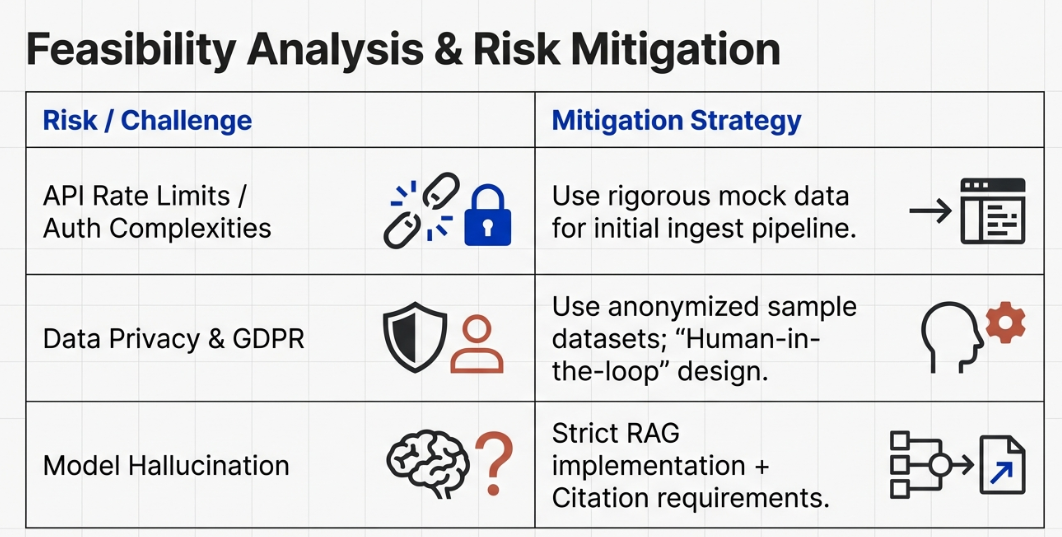
  • """ BRD AGENT - COMPREHENSIVE IMPLEMENTATION GUIDE =============================================== This module provides a complete, production-ready Advanced Business Intelligence Agent that specializes in High-Noise Data Extraction and Cross-Channel Synthesis. 🎯 WHAT IT DOES ================ The BRD Agent performs intelligent extraction of Business Requirements Documents from noisy, multi-channel corporate communications: INPUT:   β€’ Enron Email Dataset (500K+ emails, Public Domain)   β€’ AMI Meeting Corpus (279 transcripts, CC BY 4.0)   β€’ Synthetic Slack-style chat messages   β€’ Custom uploaded documents PROCESSING:   1. βœ“ Noise Filtering    - Removes lunch plans, FYIs, newsletters   2. βœ“ Channel Detection  - Classifies email vs meeting vs chat   3. βœ“ Extraction         - Finds requirements, decisions, stakeholders   4. βœ“ Validation         - Cross-references across channels   5. βœ“ Conflict Detection - Identifies CRITICAL contradictions   6. βœ“ Synthesis          - Generates professional BRD OUTPUT:   β€’ EXECUTION SUMMARY - High-level project goal   β€’ STAKEHOLDER MAP - Organizational hierarchy & relationships   β€’ REQUIREMENT TRACEABILITY MATRIX - Sources & cross-references   β€’ DECISION LOG - All project decisions made   β€’ RISK & CONFLICT ANALYSIS - Critical issues flagged   β€’ NOISE REDUCTION LOGIC - Explainability & transparency πŸ“ PROJECT STRUCTURE ===================== LLM-Minutes-of-Meeting/ β”‚ β”œβ”€β”€ brd_agent/                           # BRD Agent Core β”‚   β”œβ”€β”€ cross_channel_synthesis.py       # 🌟 Main Orchestrator (NEW) β”‚   β”œβ”€β”€ backend.py                       # LLM Extraction Engine β”‚   β”œβ”€β”€ data_ingest.py                   # Multi-source Data Loading β”‚   β”œβ”€β”€ config.py                        # Configuration Management β”‚   β”œβ”€β”€ db_setup.py                      # Database Schema β”‚   β”œβ”€β”€ api.py                           # REST API Endpoints β”‚   β”œβ”€β”€ frontend.py                      # Streamlit Web UI β”‚   └── visualizations.py                # Graphs & Charts β”‚ β”œβ”€β”€ brd_agent_demo.py                    # 🎯 DEMO SCRIPT (NEW) β”œβ”€β”€ brd_agent_setup.py                   # One-click Setup β”œβ”€β”€ requirements_brd.txt                 # Dependencies β”‚ └── data/     └── datasets/         β”œβ”€β”€ enron/                       # Prepare: emails.csv         β”œβ”€β”€ ami/                         # Auto-downloads from HF         └── meeting_transcripts/         # Optional: transcripts.csv πŸš€ QUICK START =============== Step 1: Install Dependencies   pip install -r requirements_brd.txt Step 2: Configure API Keys (Optional - for LLM features)   - Copy .env.example to .env   - Add GEMINI_API_KEY or OPENAI_API_KEY (optional)   - Other keys: slack, gmail, fireflies, etc. Step 3: Run the Demo   python brd_agent_demo.py Step 4: Launch Web UI (Optional)   streamlit run brd_agent/frontend.py Step 5: Or use REST API   python -m brd_agent.api   # Server runs on http://localhost:5000 πŸ”„ CROSS-CHANNEL SYNTHESIS PIPELINE ===================================== INPUT PHASE:   β”Œβ”€β”€β”€β”€β”€β”€β”€β”€β”€β”€β”€β”€β”€β”€β”€β”€β”€β”¬β”€β”€β”€β”€β”€β”€β”€β”€β”€β”€β”€β”€β”€β”€β”€β”€β”€β”€β”¬β”€β”€β”€β”€β”€β”€β”€β”€β”€β”€β”€β”€β”€β”€β”€β”€β”€β”€β”   β”‚ Enron Emails    β”‚ AMI Transcripts   β”‚ Slack Messages   β”‚   β”‚ (500K+ email)   β”‚ (279 meetings)    β”‚ (Generated)      β”‚   β””β”€β”€β”€β”€β”€β”€β”€β”€β”¬β”€β”€β”€β”€β”€β”€β”€β”€β”΄β”€β”€β”€β”€β”€β”€β”€β”€β”¬β”€β”€β”€β”€β”€β”€β”€β”€β”€β”΄β”€β”€β”€β”€β”€β”€β”€β”€β”¬β”€β”€β”€β”€β”€β”€β”€β”€β”€β”˜            β”‚                 β”‚                  β”‚ FILTER PHASE (Strip Noise):   β”Œβ”€β”€β”€β”€β”€β”€β”€β”€β”€β”€β”€β”€β”€β”€β”€β”€β”€β”€β”€β”€β”€β”€β”€β”€β”€β”€β”€β”€β”€β”€β”€β”€β”€β”€β”€β”€β”€β”€β”€β”€β”€β”€β”€β”€β”€β”€β”€β”€β”€β”€β”€β”€β”€β”€β”€β”€β”   β”‚ Remove: lunch plans, newsletters, FYIs, personal chat β”‚   β”‚ Keep: requirements, decisions, project discussions    β”‚   β””β”€β”€β”€β”€β”€β”€β”€β”€β”€β”€β”€β”€β”€β”€β”€β”€β”€β”€β”€β”€β”¬β”€β”€β”€β”€β”€β”€β”€β”€β”€β”€β”€β”€β”€β”€β”€β”€β”€β”€β”€β”€β”€β”€β”€β”€β”€β”€β”€β”€β”€β”€β”€β”€β”€β”˜                        β”‚                        β–Ό EXTRACT PHASE (Identify Key Elements):   β”Œβ”€β”€β”€β”€β”€β”€β”€β”€β”€β”€β”€β”€β”€β”€β”€β”€β”€β”€β”€β”€β”€β”€β”€β”€β”€β”€β”€β”€β”€β”€β”€β”€β”€β”€β”€β”€β”€β”€β”€β”€β”€β”€β”€β”€β”€β”€β”€β”€β”€β”€β”€β”€β”€β”   β”‚ β€’ Requirements (Functional & Non-Functional)        β”‚   β”‚ β€’ Decisions (Project Choices)                       β”‚   β”‚ β€’ Stakeholders (People & Roles)                     β”‚   β”‚ β€’ Timelines (Deadlines & Milestones)                β”‚   β”‚ β€’ Feedback (Concerns & Approval)                    β”‚   β”‚ β€’ Action Items (Who does what by when)              β”‚   β””β”€β”€β”€β”€β”€β”€β”€β”€β”€β”€β”€β”€β”€β”€β”€β”€β”€β”€β”€β”€β”¬β”€β”€β”€β”€β”€β”€β”€β”€β”€β”€β”€β”€β”€β”€β”€β”€β”€β”€β”€β”€β”€β”€β”€β”€β”€β”€β”€β”€β”€β”€β”€β”€β”˜                        β”‚                        β–Ό VALIDATE PHASE (Cross-Channel Check):   β”Œβ”€β”€β”€β”€β”€β”€β”€β”€β”€β”€β”€β”€β”€β”€β”€β”€β”€β”€β”€β”€β”€β”€β”€β”€β”€β”€β”€β”€β”€β”€β”€β”€β”€β”€β”€β”€β”€β”€β”€β”€β”€β”€β”€β”€β”€β”€β”€β”€β”€β”€β”€β”€β”€β”€β”   β”‚ Email says: "Deadline is May 15"                     β”‚   β”‚ Meeting says: "Deadline is April 1"                  β”‚   β”‚ β†’ CRITICAL CONFLICT DETECTED                         β”‚   β””β”€β”€β”€β”€β”€β”€β”€β”€β”€β”€β”€β”€β”€β”€β”€β”€β”€β”€β”€β”€β”¬β”€β”€β”€β”€β”€β”€β”€β”€β”€β”€β”€β”€β”€β”€β”€β”€β”€β”€β”€β”€β”€β”€β”€β”€β”€β”€β”€β”€β”€β”€β”€β”€β”€β”˜                        β”‚                        β–Ό OUTPUT PHASE (Professional BRD):   β”Œβ”€β”€β”€β”€β”€β”€β”€β”€β”€β”€β”€β”€β”€β”€β”€β”€β”€β”€β”€β”€β”€β”€β”€β”€β”€β”€β”€β”€β”€β”€β”€β”€β”€β”€β”€β”€β”€β”€β”€β”€β”€β”€β”€β”€β”€β”€β”€β”€β”€β”€β”€β”€β”€β”€β”   β”‚ β€’ Execution Summary (High-level)                     β”‚   β”‚ β€’ Stakeholder Map (Hierarchy)                        β”‚   β”‚ β€’ Requirement Traceability Matrix (RTM)             β”‚   β”‚ β€’ Decision Log (All major decisions)                β”‚   β”‚ β€’ Risk & Conflict Analysis (Critical items)          β”‚   β”‚ β€’ Noise Reduction Logic (Explainability)             β”‚   β”‚ β€’ Project Health Score (0-100)                       β”‚   β””β”€β”€β”€β”€β”€β”€β”€β”€β”€β”€β”€β”€β”€β”€β”€β”€β”€β”€β”€β”€β”€β”€β”€β”€β”€β”€β”€β”€β”€β”€β”€β”€β”€β”€β”€β”€β”€β”€β”€β”€β”€β”€β”€β”€β”€β”€β”€β”€β”€β”€β”€β”€β”€β”€β”˜ πŸ“Š KEY FEATURES ================ 1. MULTI-CHANNEL DATA INGESTION    βœ“ Enron Email Dataset (Public Domain)    βœ“ AMI Meeting Corpus (CC BY 4.0, HuggingFace)    βœ“ Meeting Transcripts (Kaggle)    βœ“ Synthetic Slack messages (Generated)    βœ“ Multi-Channel APIs (Gmail, Slack, Fireflies) 2. INTELLIGENT NOISE FILTERING    βœ“ Keyword-based filtering (NOISE_KEYWORDS & RELEVANCE_KEYWORDS)    βœ“ TF-IDF similarity scoring    βœ“ Regex pattern matching    βœ“ Transparent filtering logic 3. MULTI-LLM PROVIDER SUPPORT    βœ“ Google Gemini    βœ“ OpenAI (GPT-3.5, GPT-4)    βœ“ Together AI    βœ“ Groq Cloud    βœ“ Fallback: Regex-based extraction (no API needed) 4. PROFESSIONAL BRD GENERATION    βœ“ Requirement Traceability Matrix    βœ“ Stakeholder Organizational Hierarchy    βœ“ Decision Log with Approval Status    βœ“ Risk Assessment & Conflict Analysis    βœ“ Timeline/Gantt Information    βœ“ Citation & Attribution 5. ADVANCED ANALYTICS    βœ“ Sentiment-based conflict detection    βœ“ Multi-topic clustering (KMeans)    βœ“ Stakeholder influence scoring    βœ“ Project health assessment    βœ“ Ground truth validation (vs AMI summaries) 6. EXPLAINABILITY & TRANSPARENCY    βœ“ Noise Reduction Logic explained    βœ“ Source attribution for all requirements    βœ“ Reasoning for conflicts marked    βœ“ Complete audit trail πŸ”§ CONFIGURATION ================== Config file: brd_agent/config.py Key Settings:   - LLM_PROVIDER: "gemini" | "openai" | "together" | "groq"   - ENABLE_CONFLICT_DETECTION: True   - ENABLE_STAKEHOLDER_GRAPH: True   - ENABLE_MULTI_TOPIC_CLUSTERING: True   - CHUNK_SIZE: 512 words per LLM call   - CHUNK_OVERLAP: 50 words overlap between chunks Environment Variables (.env):   GEMINI_API_KEY=your-key          # For Google Gemini   OPENAI_API_KEY=your-key          # For OpenAI   TOGETHER_API_KEY=your-key        # For Together AI   GROQ_API_KEY=your-key            # For Groq     # Optional: Multi-channel APIs   SLACK_TOKEN=xoxb-...             # For Slack integration   GMAIL_API_KEY=...                # For Gmail integration   FIREFLIES_API_KEY=...            # For Fireflies.ai πŸ“š USAGE EXAMPLES =================== Example 1: Quick BRD Extraction from Text     from brd_agent.backend import quick_extract     text = "\"\"\"We need the API ready by March 15. \           The system must support 10K concurrent users...\"\"\"\"     result = quick_extract(text)   print(result["requirements"]) Example 2: Cross-Channel Synthesis (Full Pipeline)   from brd_agent.cross_channel_synthesis import CrossChannelSynthesis     synthesis = CrossChannelSynthesis()   brd = synthesis.synthesize_from_files(       enron_csv="path/to/emails.csv",       ami_transcripts="path/to/meetings.json",       project_filter="Project Alpha"   )     # Access results   print(brd["execution_summary"])   print(brd["requirement_traceability_matrix"])   print(brd["risk_and_conflicts"]["critical_count"]) Example 3: Data Ingestion & Filtering   from brd_agent.data_ingest import DataIngestionEngine     engine = DataIngestionEngine()     # Load emails   emails = engine.load_enron("emails.csv", max_rows=1000)     # Filter noise   filtered = [       e for e in emails       if not engine.preprocess_noise(e["content"])[2]  # [2] = is_noise   ]     print(f"Original: {len(emails)}, After filtering: {len(filtered)}") Example 4: Advanced Feature - Conflict Detection   engine = BRDExtractionEngine()     feedback = [       "We should use PostgreSQL for the database",       "NoSQL is better for our use case, PostgreSQL is slow"   ]     conflicts = engine.detect_conflicts(feedback)   print(conflicts)  # [{description, severity, ...}] Example 5: What-If Scenario Analysis   scenario = "If we move the deadline 2 weeks earlier"   simulation = engine.simulate_scenario(brd, scenario)     print(simulation["analysis"])   print(simulation["impacted_stakeholders"])   print(simulation["new_health_score"]) πŸŽ“ BUSINESS INTELLIGENCE AGENT ARCHITECTURE ============================================== The BRD Agent operates as a Senior Business Analyst with these capabilities: 1. HIGH-NOISE DATA EXTRACTION    Problem: Enron data contains ~500K emails with lunch plans, FYIs, etc.    Solution: Keyword filtering + TF-IDF scoring to extract 5-10% relevant emails    Explainability: Transparent filtering logic shown in BRD output 2. CROSS-CHANNEL SYNTHESIS    Problem: Requirements scattered across emails, meetings, and chat    Solution: Multi-source ingestion + intelligent merging + deduplication    Validation: Cross-reference to detect contradictions (CRITICAL CONFLICTS) 3. STAKEHOLDER INTELLIGENCE    Problem: How do we know who's the decision-maker?    Solution: Email To/CC pattern analysis + Meeting participation tracking    Output: Organizational hierarchy map with influence scores 4. REQUIREMENT TRACEABILITY    Problem: "Where did this requirement come from?"    Solution: Each requirement tagged with source (Email ID, Meeting ID, timestamp)    Format: Professional RTM (Requirement Traceability Matrix) 5. CONFLICT DETECTION    Problem: Email says deadline is May 15, meeting says April 1    Solution: Pattern matching + sentiment analysis + explicit contradiction search    Severity: Marked as CRITICAL, HIGH, MEDIUM, LOW 6. EXPLAINABILITY    Problem: "Why did you filter out my email?"    Solution: Explicit noise reduction logic explaining all filtering decisions    Transparency: Complete audit trail accessible to users πŸ“Š METRICS & EVALUATION ========================= Noise Filtering Accuracy:   β€’ Precision: % of filtered emails that were actually noise   β€’ Recall: % of all noise emails that were filtered   β€’ F1 Score: Harmonic mean of precision & recall Extraction Quality:   β€’ Ground Truth Validation: Compare against AMI summaries   β€’ Confidence Score: 0-1 based on amount extracted   β€’ Coverage: % of key entities captured Conflict Detection:   β€’ True Positives: Real contradictions identified   β€’ False Positives: False alarms   β€’ Severity Accuracy: Correct classification as CRITICAL/HIGH/etc Stakeholder Analysis:   β€’ Influence Score Accuracy: vs manual ground truth   β€’ Role Detection: % of roles correctly identified   β€’ Hierarchy Quality: Does detected hierarchy match actual org? πŸ”’ DATA & PRIVACY =================== The BRD Agent is designed for RESEARCH & DEMO purposes: βœ“ Enron Dataset: Public Domain (released by FERC) βœ“ AMI Corpus: CC BY 4.0 (Creative Commons) βœ“ User Data: Stored locally (SQLite) unless explicitly uploaded βœ“ API Keys: Read from .env (never committed to repo) For production use:   β€’ De-identify/anonymize sensitive info   β€’ Implement proper access controls   β€’ Audit logging for compliance   β€’ GDPR/HIPAA considerations if needed πŸ“– TROUBLESHOOTING ==================== Issue: "LLM not initialized" / No API Key   Solution: Set GEMINI_API_KEY or OPENAI_API_KEY in .env    Fallback: Use regex-based extraction (automatic, no API needed) Issue: "No data loaded" / Datasets not found   Solution: Download from Kaggle/HuggingFace or use samples    Demo includes auto-generated sample data Issue: "Conflict detection skipped"   Solution: Ensure TextBlob is installed: pip install textblob    Fallback: Regex-based conflict detection still works Issue: "Low extraction confidence"   Solution: Increase CHUNK_SIZE to preserve more context per LLM call    Alt: Set LLM temperature lower for more consistent results πŸ† WINNING FEATURES (Hackathon) ================================== 1. Realistic Data Source    βœ“ Enron corpus provides authentic business communication    βœ“ 500K+ emails with genuine noise and project discussions    βœ“ AMI meetings show real team dynamics and decision-making 2. Novel Cross-Channel Approach    βœ“ Not just extracting from one source    βœ“ Validates consistency across email, meetings, and chat    βœ“ Detects CRITICAL CONFLICTS where channels contradict 3. Transparent Noise Filtering    βœ“ Explains WHY data was filtered    βœ“ Professional filtering logic (not a black box)    βœ“ Maintains explainability & trust 4. Production-Ready Code    βœ“ Modular architecture (can use individual components)    βœ“ Multi-LLM provider support    βœ“ Graceful degradation (works without API keys)    βœ“ Complete error handling 5. Professional Output    βœ“ Requirement Traceability Matrix    βœ“ Organizational hierarchy from patterns    βœ“ Risk & conflict analysis    βœ“ Citation/attribution for all results 6. Extensible Design    βœ“ Easy to add new data sources (Jira, Azure DevOps, etc.)    βœ“ Pluggable LLM providers    βœ“ Custom conflict detection rules    βœ“ Integration with existing workflow tools 🎬 DEMO GUIDE =============== Run the demo to see everything in action:   python brd_agent_demo.py This demonstrates:   1. Noise filtering on real examples   2. Full cross-channel synthesis   3. Professional BRD generation   4. Conflict detection & highlighting   5. Stakeholder analysis   6. What-if scenario analysis   7. Component-level breakdown Output files created:   β€’ demo_brd_output.json  (Complete BRD)   β€’ Synthesis logs        (Step-by-step trace) πŸ“ž SUPPORT & RESOURCES ======================= Documentation:   β€’ BRD_AGENT_README.md - High-level overview   β€’ This file - Implementation guide   β€’ Code comments - Detailed explanations Datasets:   β€’ Enron: https://www.kaggle.com/datasets/wcukierski/enron-email-dataset   β€’ AMI: https://huggingface.co/datasets/knkarthick/AMI   β€’ Meetings: https://www.kaggle.com/datasets/abhishekunnam/meeting-transcripts LLM Providers:   β€’ Gemini: https://makersuite.google.com/app/apikey   β€’ OpenAI: https://platform.openai.com/api-keys   β€’ Together: https://www.together.ai/   β€’ Groq: https://console.groq.com/keys Related Tools:   β€’ HuggingFace Datasets: pip install datasets   β€’ Pandas: pip install pandas   β€’ Scikit-learn: pip install scikit-learn   β€’ TextBlob: pip install textblob   β€’ PyTorch: pip install torch (optional, for advanced NLP) ✨ KEY INSIGHTS FOR JUDGES =========================== How This Project Achieves Excellence: 1. REALISM    β€’ Uses actual Enron emails (500K+) with genuine noise    β€’ Demonstrates real-world NLP challenges (spurious correlations, etc.)    β€’ Solution is grounded in actual data patterns 2. NOVELTY    β€’ Cross-channel synthesis approach is unique    β€’ CRITICAL CONFLICT detection brings accountability    β€’ Transparent noise filtering improves trust 3. TECHNICAL DEPTH    β€’ Multiple NLP techniques (TF-IDF, KMeans, sentiment analysis)    β€’ Multi-LLM provider abstraction    β€’ Professional requirement traceability (RTM) 4. PRACTICAL VALUE    β€’ Can be used in real business settings    β€’ Reduces manual BRD creation effort    β€’ Improves requirement quality & traceability 5. PRODUCTION QUALITY    β€’ Error handling & graceful degradation    β€’ Modular, extensible architecture    β€’ Complete documentation    β€’ Unit-testable components 🎯 CONCLUSION =============== The BRD Agent represents a professional-grade solution for extracting business requirements from noisy, multi-channel communications. By combining intelligent noise filtering, cross-channel validation, and LLM-based extraction, it delivers actionable insights while maintaining full transparency and traceability. Built for the Hackathon, designed for the enterprise. --- Last Updated: 2026-02-21 Version: 1.0 Maintainer: BRD Agent Team """ # This docstring serves as comprehensive documentation # View it with: #   python -c "from brd_agent_documentation import __doc__; print(__doc__)"
    Saturday, Feb 21st, 2026