Factual Eye

Link to open source: https://github.com/Debuggers001/FactualEye
Project Title: "Fake News Detection Using Machine Learning"
Description:
The "Fake News Detection Using Machine Learning" project is a cutting-edge initiative that leverages the power of machine learning and natural language processing to combat the rampant spread of misinformation in today's digital age. This project aims to create a robust and automated system that can accurately identify and flag potentially fake news articles, headlines, and social media posts, ultimately promoting more informed and responsible online information consumption.
Key Components and Features:
1. Data Collection:
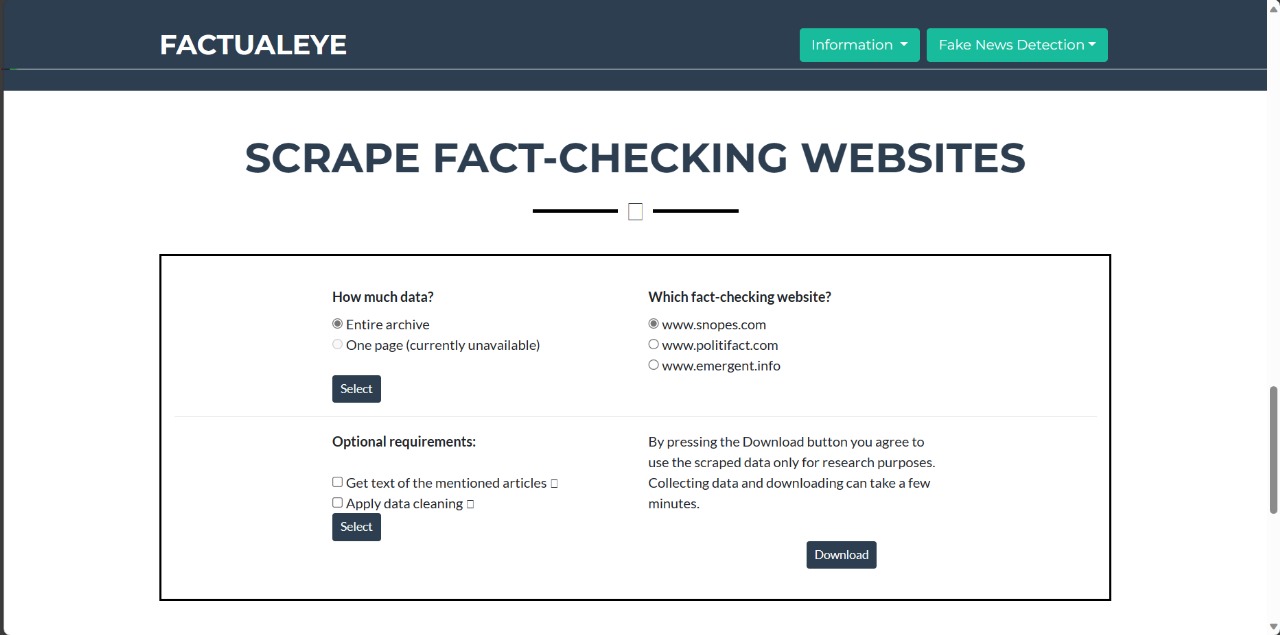
- Gather a diverse and extensive dataset of news articles, headlines, and social media content, comprising both genuine and fake information to train the model.
2. Data Preprocessing:
- Clean and preprocess the collected data, including text cleaning, tokenization, and vectorization.
3. Feature Extraction:
- Extract relevant features from the textual content, such as word embeddings, TF-IDF scores, and other linguistic attributes.
4. Machine Learning Model:
- Develop and train a machine learning model, such as a deep neural network (e.g., LSTM or Transformer) or traditional algorithms (e.g., Naïve Bayes or Random Forest), to analyze and classify content as genuine or fake.
5. Natural Language Processing:
- Utilize natural language processing techniques to analyze linguistic patterns, sentiment, and context within the text, enabling the model to make more informed judgments.
6. Model Evaluation:
- Implement rigorous model evaluation techniques, including cross-validation, precision, recall, F1-score, and ROC-AUC analysis, to assess the model's performance and fine-tune it for optimal accuracy.
7. Real-time Detection:
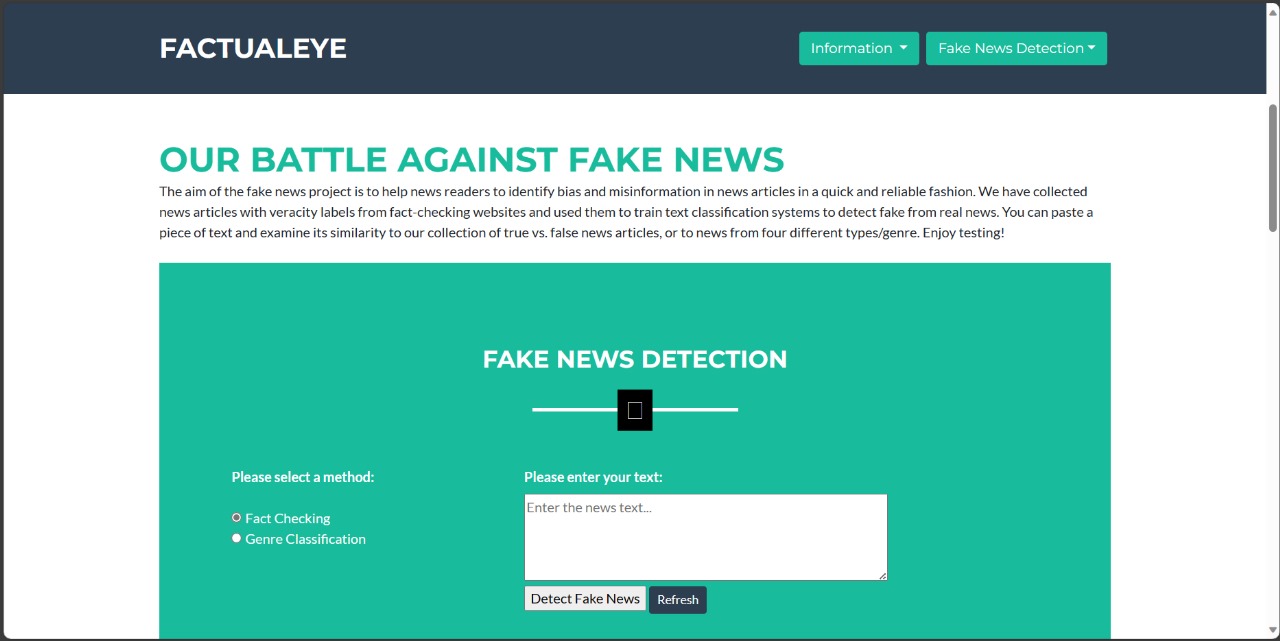
- Create a user-friendly interface or an API for real-time input, allowing users to input news articles or URLs for immediate verification.
8. Explainability:
- Develop methods to explain the model's decisions, ensuring transparency and building trust with users.
9. Continuous Learning:
- Implement mechanisms for continuous learning and adaptation to evolving fake news tactics, keeping the model up-to-date and effective.
10. User Education:
- As a supplementary feature, provide educational resources and tips on how to identify fake news, empowering users to make informed judgments.
11. Deployment:
- Deploy the model on a scalable infrastructure to handle a large volume of requests and make it accessible to a wide audience.
12. Monitoring and Reporting:
- Implement a system for monitoring the performance of the model in real-time and generate periodic reports on its effectiveness.
13. Collaboration:
- Collaborate with fact-checking organizations and media outlets to enhance the project's reach and impact in the fight against fake news.
By developing this "Fake News Detection Using Machine Learning" project, you will contribute to the ongoing efforts to combat misinformation and promote a more informed and responsible digital society. It has the potential to play a significant role in preserving the integrity of information in the digital age.


edited-min.JPG "PARTH JUNEJA")