IncidentPilot
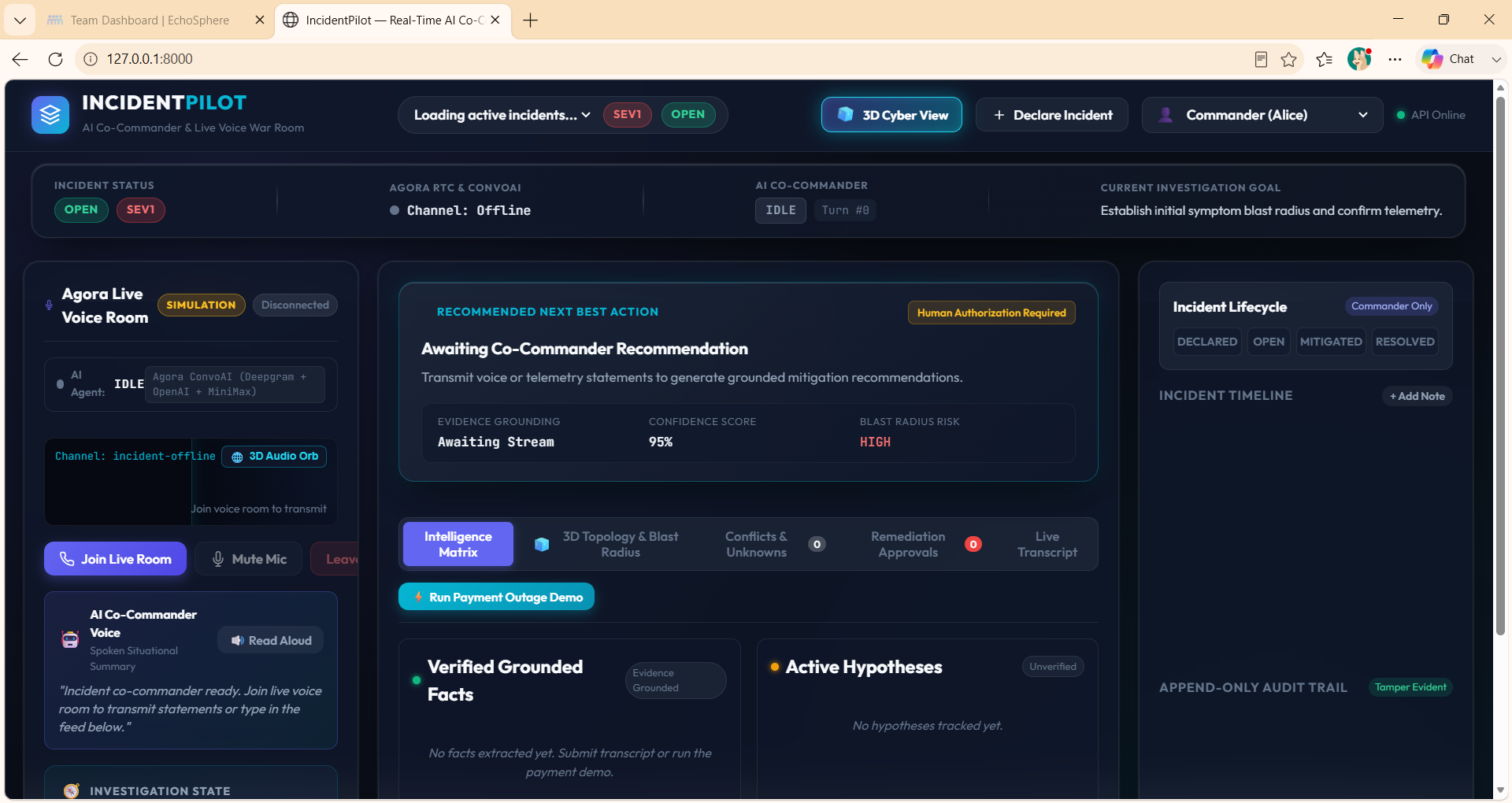
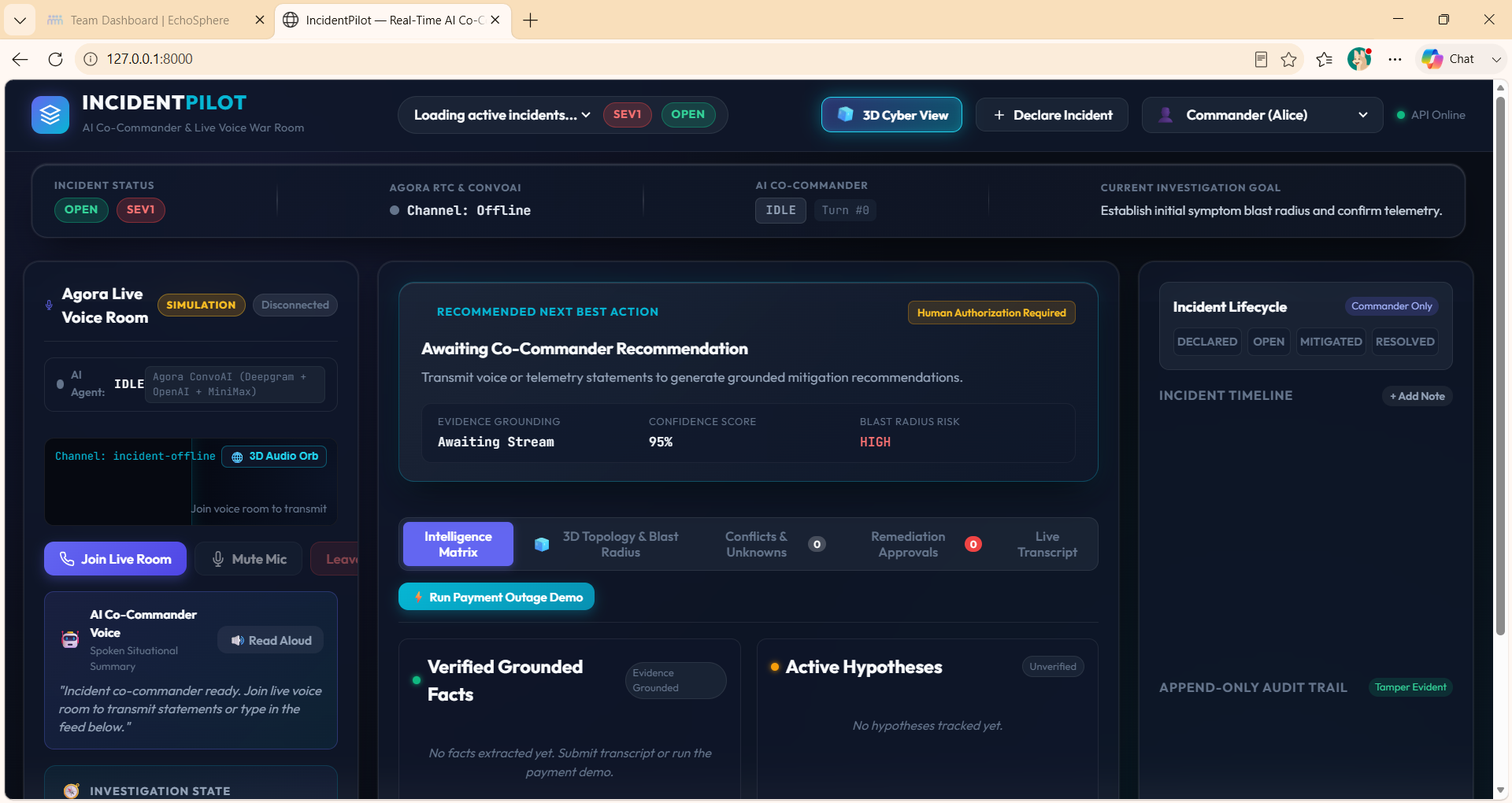
Link to open source: https://github.com/bharatshishodia345-maker/IncidentPilot
IncidentPilot
Real-Time AI Co-Commander for High-Stakes Incidents
IncidentPilot is an enterprise-minded incident response assistant designed to help engineering and operations teams build a shared, evidence-first view of an incident while keeping consequential actions under human control.
AI recommends. Humans authorize. System enforces.
What Problem Does It Solve?
hypotheses
conflicts
unknown or missing information
decisions
recommended actions
ownership
incident timeline
approval and audit history
The goal is not to replace the incident commander. The goal is to help the team understand what is known, what is uncertain, what should be verified next, and what action requires human authorization.
Core Capabilities
Evidence-First Incident Intelligence
Incident information is classified instead of being treated as one undifferentiated summary.
Fact — supported by available evidence
Hypothesis — possible explanation that still needs verification
Conflict — contradictory claims or signals that need investigation
Unknown — important information that is still missing
The system is designed to avoid presenting an unverified hypothesis as a confirmed root cause.
Real-Time Incident Room
IncidentPilot uses Agora RTC as the real-time communication layer for an incident room, allowing responders and the IncidentPilot agent to participate in the same voice environment.
The project also contains the foundation for Agora Conversational AI integration and server-side agent lifecycle management. Actual Conversational AI availability depends on valid Agora project configuration and credentials.
Human-Controlled Actions
Consequential actions are intentionally constrained by:
AI recommendation
↓
Policy check
↓
Permission / RBAC check
↓
Human approval
↓
Authorized execution
↓
Audit event
The AI should not receive unrestricted production-write privileges.
Conflict and Missing-Information Detection
The incident state can surface contradictions such as:
Engineer: “Database is healthy.”
Monitoring: “Latency is 4.8 seconds.”
IncidentPilot should surface:
🔴 CONFLICT DETECTED
Human report: Database healthy
Telemetry: 4.8s latency
Next step:
Verify current DB latency and saturation before treating DB health as confirmed.
It does not invent a root cause or silently choose one side.
🎙️ Real-Time Conversational AI
Agora Conversational AI is a core part of the intended runtime voice experience.
┌──────────────────────┐
│ Responder Mic │
└──────────┬───────────┘
↓
┌──────────────────────┐
│ Agora RTC │
└──────────┬───────────┘
↓
┌──────────────────────────────┐
│ Agora Conversational AI Agent│
└──────────┬───────────────────┘
↓
STT / ASR
↓
Managed LLM
↓
┌──────────────────────────────┐
│ IncidentPilot Reasoning │
│ Facts / Hypotheses / Risk │
│ Conflicts / Next Step │
└──────────┬───────────────────┘
↓
TTS
↓
┌──────────────────────┐
│ Agora RTC │
└──────────┬───────────┘
↓
Incident Room
Intended managed model stack
STT: Deepgram
LLM: OpenAI
TTS: MiniMax
Actual Conversational AI availability depends on valid Agora project configuration, credentials, and successful runtime verification.
🔄 How IncidentPilot Works
OBSERVE
↓
UNDERSTAND
↓
COORDINATE
↓
RECOMMEND
↓
VERIFY
↓
CONTROL
↓
LEARN
01 — Observe
Capture approved voice, chat, alerts, telemetry, and incident context.
02 — Understand
Structure incoming information into facts, hypotheses, conflicts, unknowns, decisions, and actions.
03 — Coordinate
Track responders, ownership, decisions, next steps, and an incident timeline.
04 — Recommend
Suggest the next useful question, verification step, or safe mitigation.
05 — Verify
Require evidence before promoting hypotheses into confirmed outcomes.
06 — Control
Apply RBAC, policies, allowlists, and human approval before consequential actions.
07 — Learn
Use only verified outcomes to improve future incident context.
🛡️ Human-Controlled Automation
IncidentPilot follows a policy-bounded execution model:
AI Recommendation
↓
Evidence + Risk
↓
Policy Check
↓
RBAC / Permission Check
↓
Human Approval
↓
Authorized Execution
↓
Audit Event
Critical actions should never receive unrestricted AI access.
Examples include:
deployment rollback
production service restart
routing changes
feature disablement
infrastructure changes
privileged remediation
external operational notifications
The AI can recommend an action. A named human authorizes it.
🔐 Security by Design
Security is treated as part of the architecture, not as a separate add-on.
Role-Based Access Control (RBAC)
Least-privilege execution
Organization / tenant isolation
Incident-scope authorization
Allowlisted tools and actions
Strict action parameter validation
Human approval for consequential actions
Audit logging and decision history
Secret redaction
Safe handling of untrusted transcript/chat content
Prompt-injection-aware boundaries
Replay and expiry protection for sensitive workflows
The AI is not an administrator.
📊 What the Operator Sees
The IncidentPilot command center is designed around one shared operational state:
┌────────────────────────────────────────────────────────┐
│ LIVE INCIDENT │
│ Status • Severity • Responders • Agora / AI status │
├────────────────────────────────────────────────────────┤
│ EVIDENCE │
│ ✅ Facts ⚠️ Hypotheses 🔴 Conflicts ❓ Unknowns │
├────────────────────────────────────────────────────────┤
│ NEXT BEST STEP │
│ Recommendation • Evidence • Risk • Approval required │
├────────────────────────────────────────────────────────┤
│ ACTIONS │
│ Owner • Status • Approval • Execution result │
├────────────────────────────────────────────────────────┤
│ INCIDENT TIMELINE │
│ Signal → Fact → Hypothesis → Conflict → Approval → │
│ Verified Recovery │
└────────────────────────────────────────────────────────┘
🧪 Example Incident Flow
Payment outage demonstration
10:02 SIGNAL Payment failures spike
10:06 FACT Customer impact confirmed
10:08 HYPOTHESIS DB latency may contribute
10:12 ACTION Investigation assigned
10:15 CONFLICT “DB healthy” vs 4.8s latency
10:18 AI UPDATE Next verification step suggested
10:21 APPROVAL Human authorizes mitigation
10:26 VERIFIED Recovery confirmed and logged
The same reasoning model is intended for incidents such as:
API outages · database failures · deployment regressions · authentication failures · network issues · cache/queue failures · service crashes · storage/dependency failures · security incidents · unknown technical incidents
🏗️ Architecture
INCIDENTPILOT
│
┌─────────────────────────┼─────────────────────────┐
│ │ │
LIVE ENGAGEMENT INCIDENT INTELLIGENCE CONTROL PLANE
│ │ │
Agora RTC STT / ASR RBAC
Agora Chat Evidence model Policy engine
Conversational AI Conflict detection Human approval
Voice events Runbook context Allowlisted tools
│ │ │
└─────────────────────────┼─────────────────────────┘
│
TRUSTED MEMORY
│
Timeline • Audit • Knowledge
│
Verified Learning
Repository structure
IncidentPilot/
├── apps/
│ └── api/
│ ├── app/
│ │ ├── actions/
│ │ ├── ai/
│ │ ├── api/
│ │ ├── auth/
│ │ ├── core/
│ │ ├── db/
│ │ ├── integrations/
│ │ ├── learning/
│ │ ├── services/
│ │ └── static/
│ ├── alembic/
│ └── tests/
├── .agents/
│ └── skills/
│ └── agora/
├── Dockerfile
├── docker-compose.yml
├── DEPLOYMENT.md
├── pyproject.toml
└── README.md
⚙️ Technology Stack
Layer
Technology
Backend
Python, FastAPI
Database
SQLAlchemy, SQLite (local), PostgreSQL (production)
Migrations
Alembic
Validation / Config
Pydantic Settings
Authentication
JWT-based auth
Real-Time
Agora RTC
Voice AI
Agora Conversational AI
AI Pipeline
STT → LLM → TTS
Frontend
HTML, CSS, JavaScript
Testing
Pytest, HTTPX
Deployment
Docker / Docker Compose
🚀 Run Locally
1. Create a virtual environment
Windows PowerShell
python -m venv .venv
.\.venv\Scripts\Activate.ps1
Linux / macOS
python3 -m venv .venv
source .venv/bin/activate
2. Install dependencies
python -m pip install --upgrade pip
pip install -e ".[dev]"
3. Configure environment
Windows PowerShell
Copy-Item .env.example .env
Linux / macOS
cp .env.example .env
Never commit .env or real credentials.
4. Run database migrations
alembic upgrade head
5. Start the application
uvicorn app.main:app --app-dir apps/api --reload
Open:
http://127.0.0.1:8000/
Important: open the application through FastAPI. Do not open index.html directly with file://.
❤️ Health Checks
GET /health/live
GET /health/ready
GET /health
🧪 Testing
Run the test suite:
pytest -v
The project contains tests around authentication, incidents, actions, intelligence, learning, integrations, room APIs, Agora-related services, and multilingual behavior.
Automated tests are not a substitute for a real voice-room validation. For a live Agora deployment, verify the complete voice path with valid Agora configuration.
🎙️ Agora Configuration
Create and configure an Agora project, then provide the required server-side configuration through environment variables.
Example:
AGORA_APP_ID=your_app_id
AGORA_APP_CERTIFICATE=your_app_certificate
AGORA_TOKEN_EXPIRE_SECONDS=3600
Keep credentials server-side and never commit them.
Agora reference material used by the project is available under:
.agents/skills/agora/
For real deployment, validate the Agora project configuration and run the official diagnostic tooling available for the installed project/CLI setup.
🔌 Real vs Simulation
IncidentPilot may include demo/simulation behavior for environments where external credentials are unavailable.
Status
Meaning
🟢 REAL
Actual configured external service
🟡 SIMULATION
Controlled demonstration behavior
⚪ NOT CONFIGURED
Credentials/service configuration is missing
🔵 PLANNED
Architecture defined, implementation not active
A failed external operation must never be represented as a successful production action.
📚 Verified Learning Loop
IncidentPilot is designed to learn from verified outcomes without turning historical assumptions into current facts.
Incident
↓
Investigation
↓
Verified Outcome
↓
Validation
↓
Knowledge Base
↓
Future Incident Context
Historical patterns can inform an investigation, but they do not automatically become current incident facts.
📦 Deployment
For containerized local deployment:
docker compose up -d --build
See DEPLOYMENT.md for the deployment configuration and production checklist.
For production, use:
strong secrets
explicit CORS origins
PostgreSQL or another supported production database
secure networking
real Agora credentials
appropriate observability
retention/privacy controls
🎬 Demo Flow
A simple judge/demo flow:
Create Incident
↓
Join Agora Incident Room
↓
Start AI Co‑Commander
↓
Speak the Incident
↓
Facts / Hypotheses / Conflicts / Unknowns
↓
Next Best Verification Step
↓
Recommended Mitigation
↓
Human Approval
↓
Controlled Action
↓
Audit Event
↓
Verified Recovery
The strongest demonstration is not a long summary. It is showing that the AI understands the changing incident state, asks useful questions, detects conflicting evidence, and recommends the next step without taking uncontrolled production actions.
👥 Team DataDynamos
Member
Focus
Bharat Shishodia
Team Lead · Product & Security
Madan Mohan Mishra
Problem & Solution · Engineering
Preetam Gupta
Architecture
Prince Raj
AI · Presentation & Delivery
🏆 Why IncidentPilot?
Evidence-first
Facts, hypotheses, conflicts, and unknowns are explicitly separated.
Voice-native
The co-commander is designed to participate in the same real-time incident room as responders.
Human-controlled
Consequential actions remain behind policy, permissions, and explicit approval.
Enterprise-minded
Tenant isolation, auditability, runbook grounding, controlled integrations, and verified learning are part of the design.
Built for the room, not after the incident
IncidentPilot is designed to help responders make sense of an incident while it is happening, not only summarize it afterward.
📌 Current Project Status
IncidentPilot is an active hackathon project with a strong incident-intelligence and control-plane foundation. The final runtime status of external services, including Agora Conversational AI, depends on valid project configuration and successful end-to-end verification in the deployment environment.
This build was uploaded as a hackathon project


