Orbit
Link to open source: https://orbit-nine-theta.vercel.app/
Project Title
ORBIT — Operational Response and Briefing Intelligence Team
Project Description
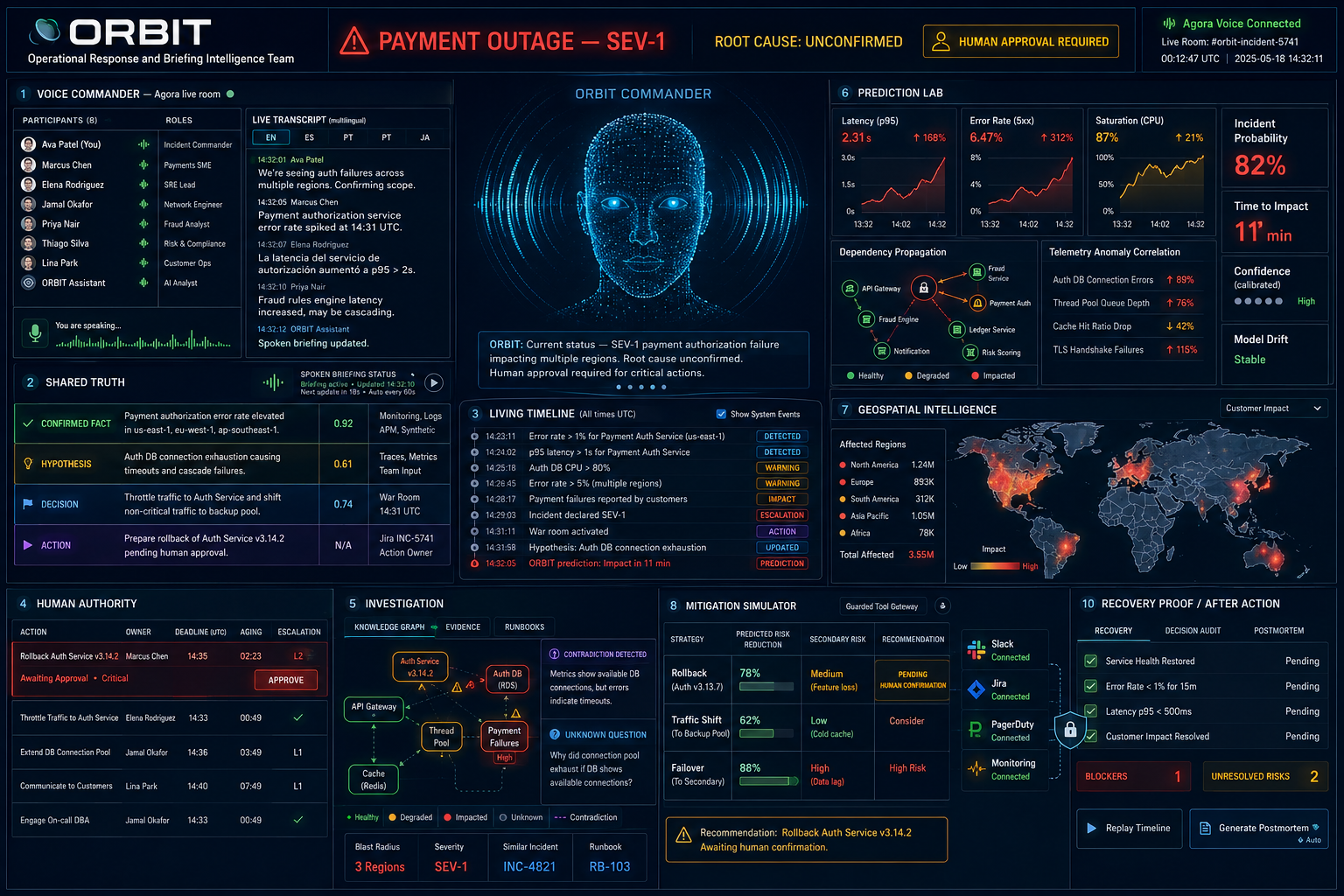
ORBIT is a production-oriented, real-time AI incident commander that helps technical, operational, support, and business teams coordinate during critical incidents. Using Agora Conversational AI as its core voice layer, ORBIT joins a live incident room, recognizes participant roles, supports multilingual conversations, and converts unstructured discussions into a continuously updated shared operational picture.
ORBIT classifies statements as confirmed facts, hypotheses, decisions, or action items. It maintains an incident timeline, assigns and follows up on tasks, records evidence provenance and confidence, detects contradictory or missing information, and tracks unresolved risks. Its multi-agent architecture includes Commander, Listener, Evidence, Conflict, Timeline, Action, Investigation, Integration, Prediction, and Recovery agents working over an Incident Digital Twin and Evidence Knowledge Graph.
ORBIT integrates with tools such as Jira, Slack, PagerDuty, monitoring systems, runbooks, and historical incident databases. It provides spoken status summaries, role-specific briefings, similar-incident retrieval through RAG, anomaly correlation, severity estimation, action escalation, recovery verification, incident replay, analytics, and automatic postmortem generation. Every critical action—including rollback, failover, production restart, or infrastructure modification—requires explicit human approval.
Following feedback from our first mentorship round, ORBIT evolved from a reactive assistant into a predictive operational-intelligence engine. Its Prediction Engine correlates telemetry such as latency, errors, traffic, saturation, deployments, dependencies, and customer reports to estimate incident probability and time-to-impact. Dependency-graph intelligence predicts failure propagation and blast radius, while geospatial intelligence identifies affected regions and expanding customer impact.
An Incident Simulator allows teams to compare mitigation strategies—such as rollback, traffic rerouting, failover, and capacity scaling—before execution. ORBIT presents expected outcomes and secondary risks for human confirmation. A learning layer evaluates forecast accuracy, detects model drift, uses historical incident knowledge, and improves future recommendations.
Our payment-system outage prototype demonstrates live voice participation, evidence organization, contradiction detection, predictive graphs, regional impact analysis, mitigation simulation, human-controlled execution, recovery verification, and final incident reporting.
ORBIT does not claim to independently determine root cause. It organizes evidence, highlights uncertainty, predicts emerging risks, and recommends informed actions—while the human incident commander always makes the final decision.
Vision and Impact
Our vision is to transform incident response from fragmented, reactive firefighting into predictive, coordinated, explainable, and human-controlled operations. ORBIT can reduce confusion, accelerate detection and recovery, preserve organizational knowledge, minimize customer impact, and help teams make safer decisions during high-pressure incidents.
This build was uploaded as a hackathon project


