Pragya AI
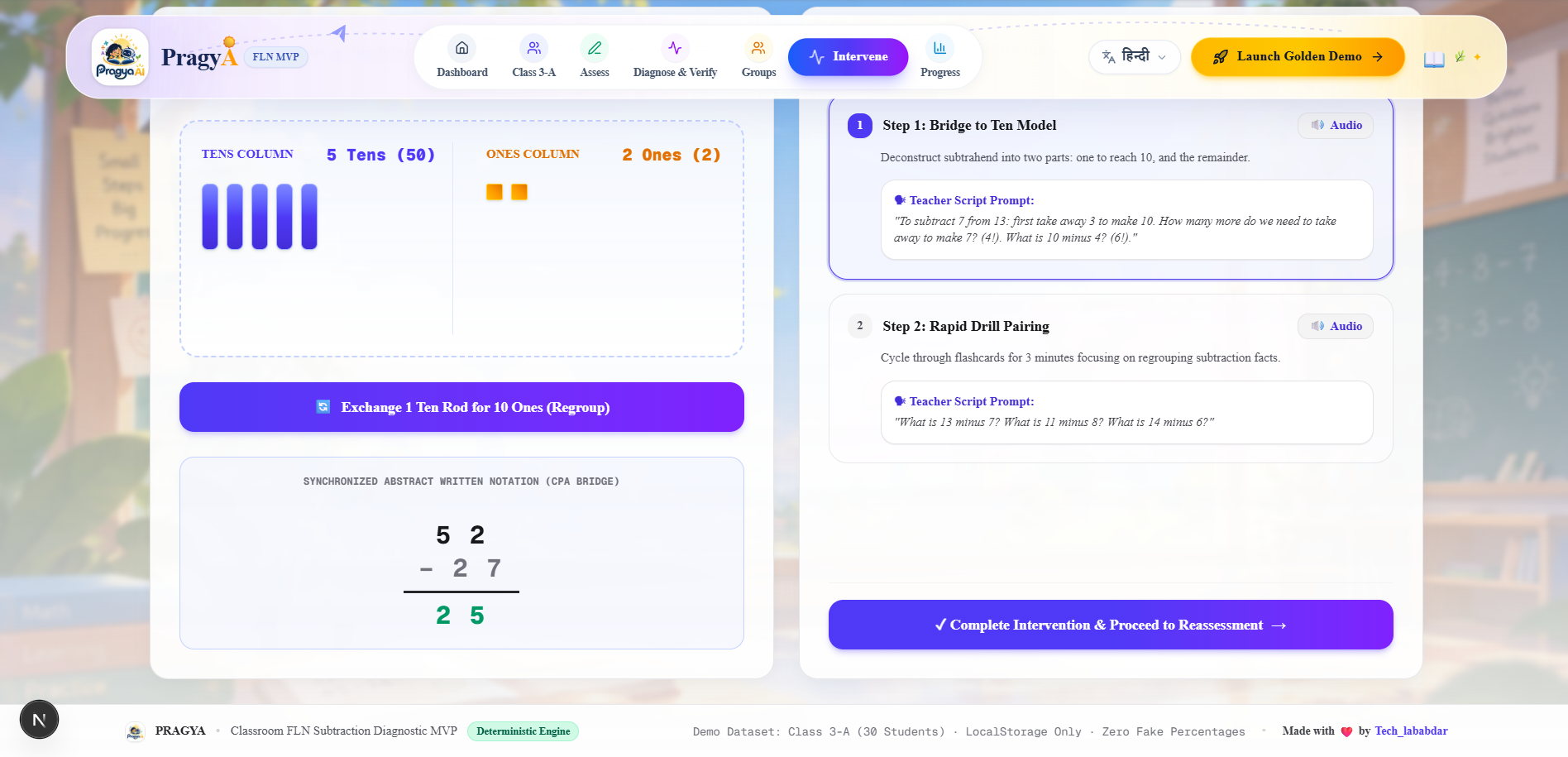
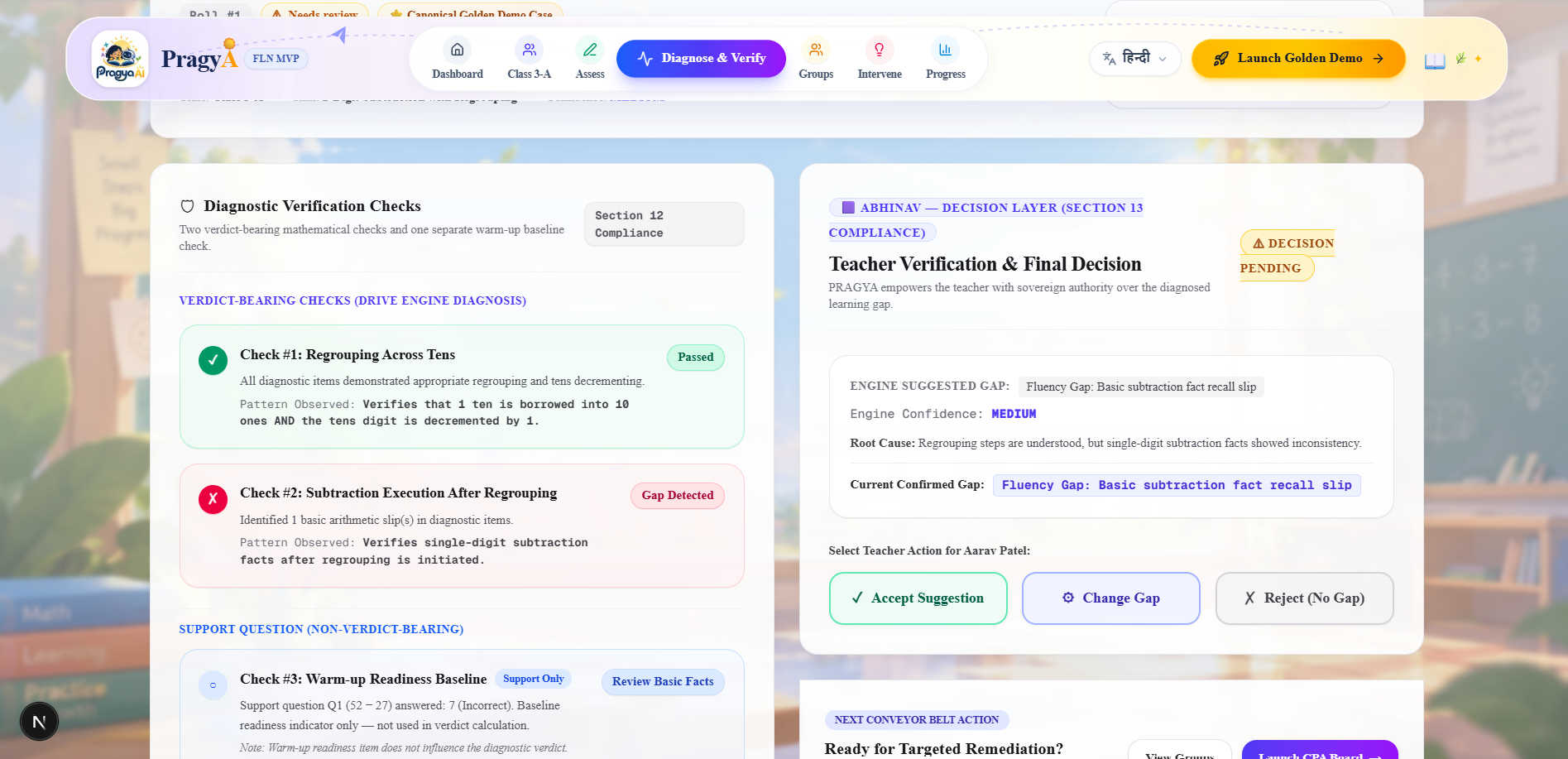
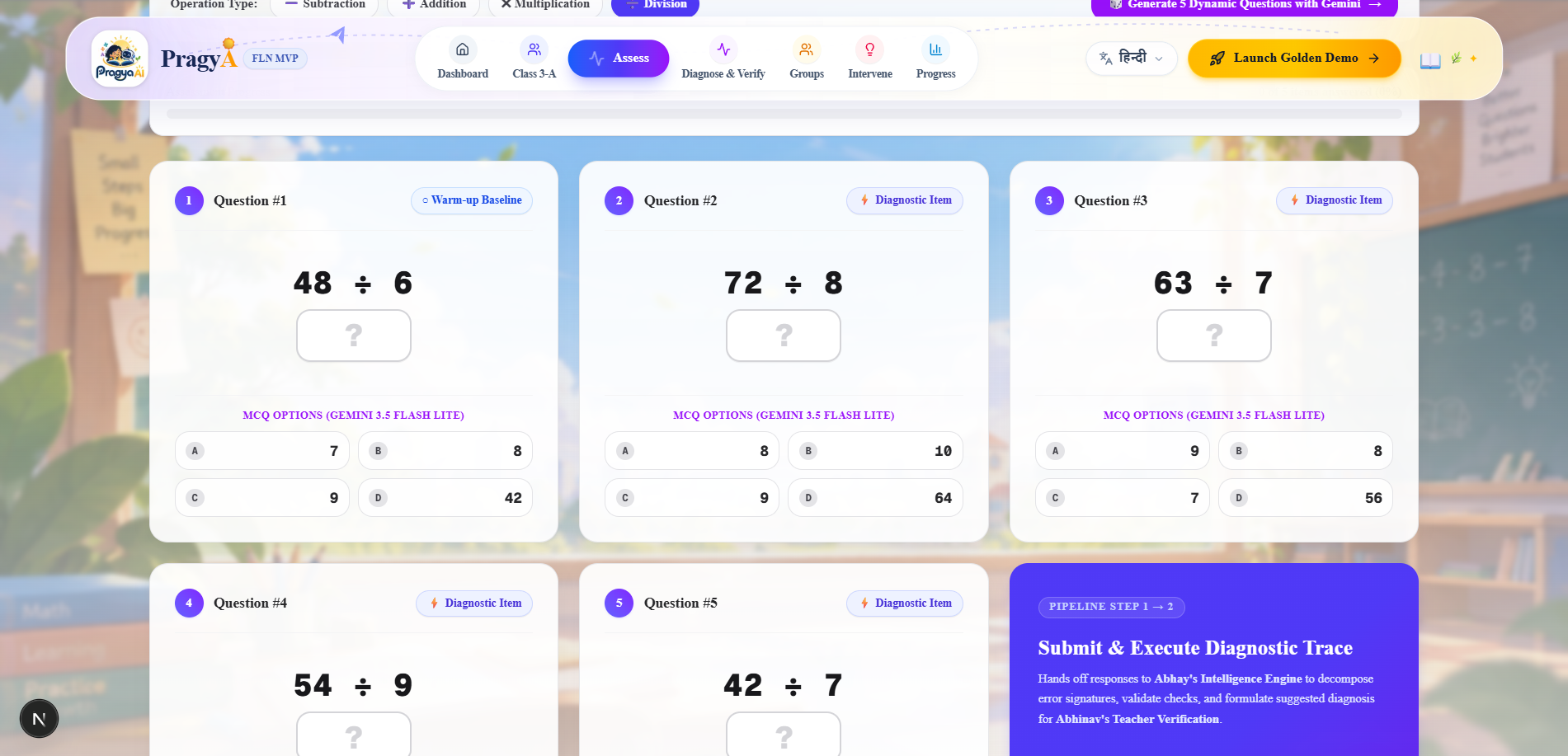
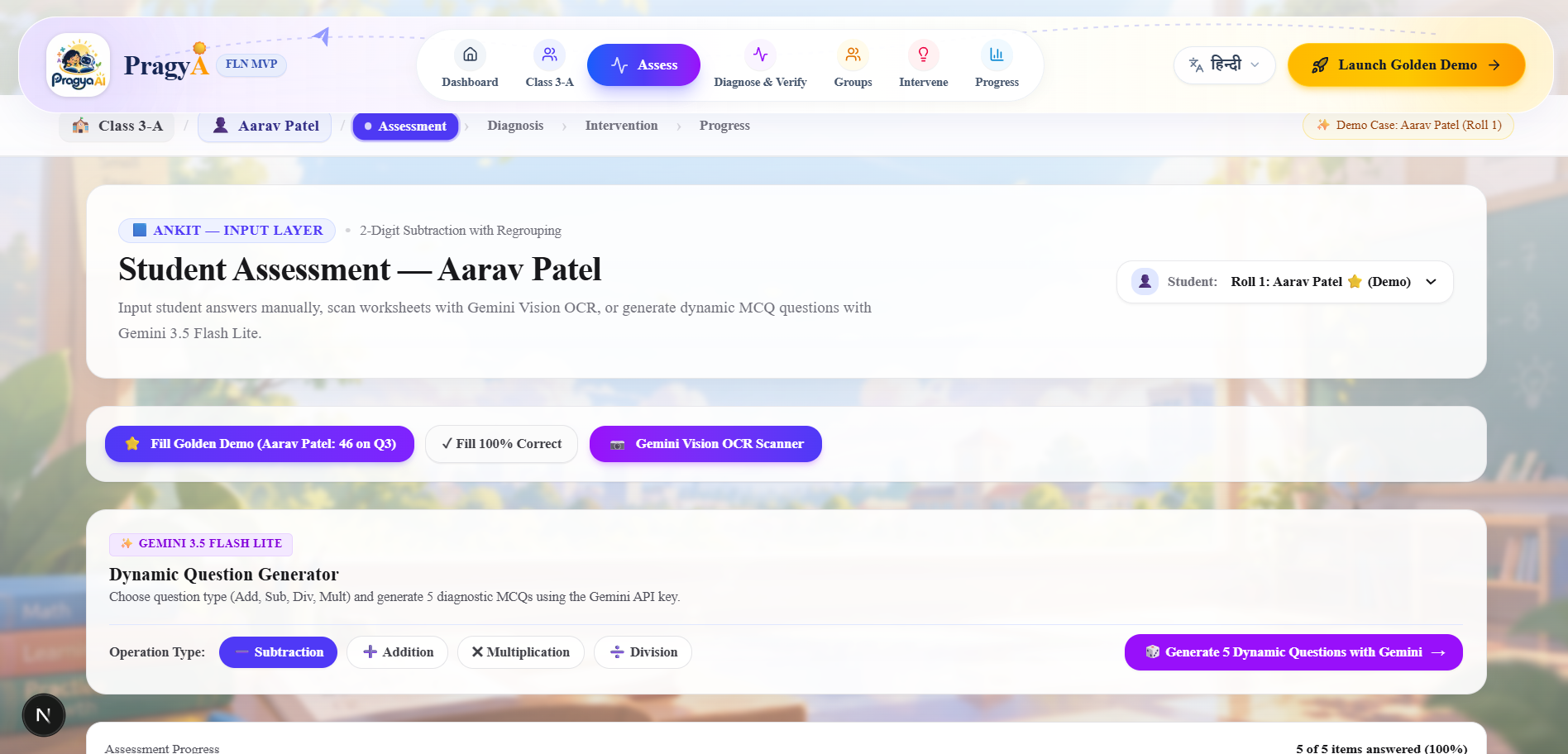
Link to open source: https://github.com/AnkitYadav10533/PRAGYA_AI
Link to Live Project: https://pragya-ai-alpha.vercel.app/
PRAGYA AI — Explainable FLN Diagnostic & Intervention Platform
1. Overview
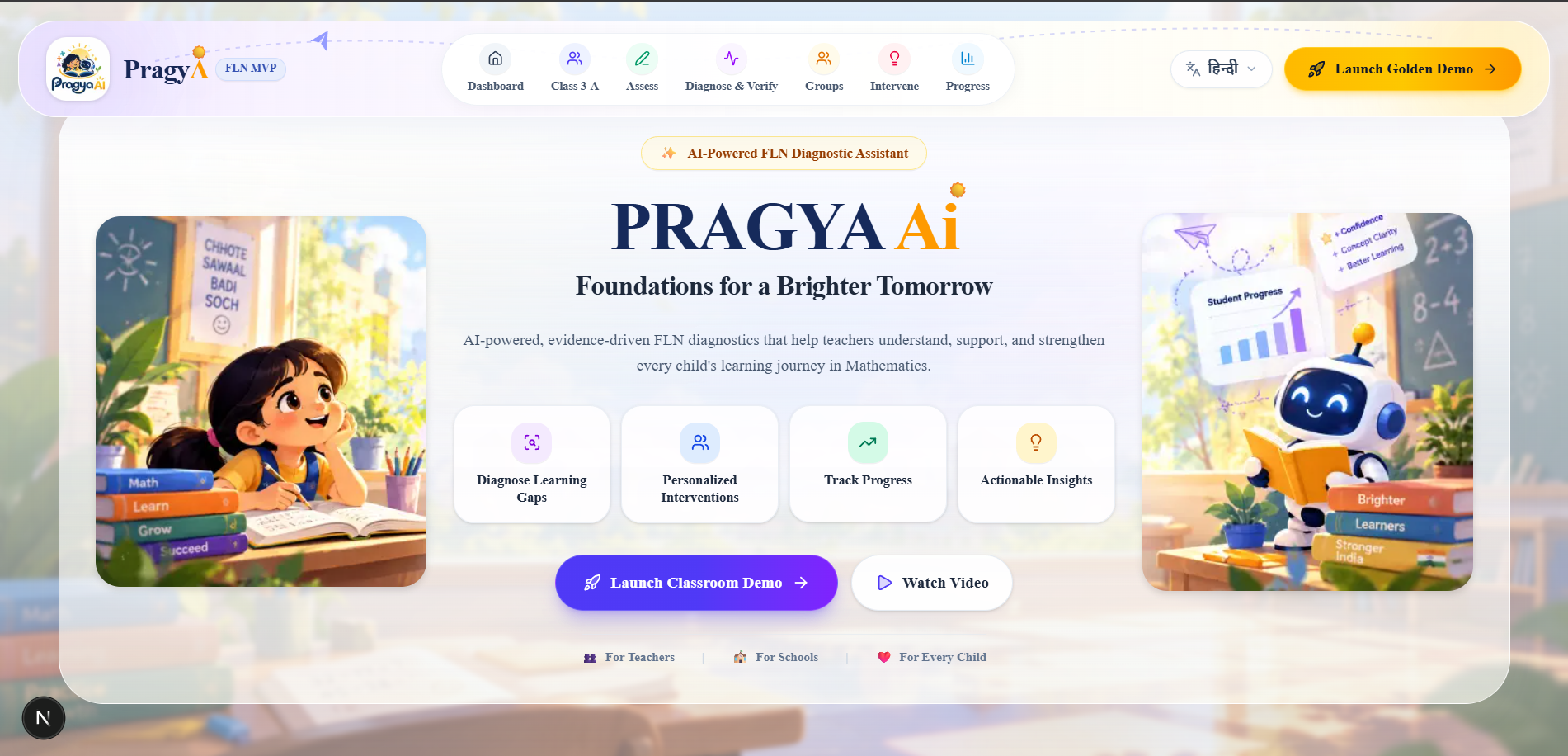
PRAGYA AI is an explainable learning-diagnostics platform designed to help teachers identify specific Foundational Literacy and Numeracy (FLN) gaps rather than simply marking student answers as correct or incorrect.
PRAGYA analyzes student responses, including handwritten responses through OCR, validates the mathematical work, traces recurring error patterns, and converts those patterns into evidence-backed learning-gap diagnoses. Teachers can then verify or modify the diagnosis before students are grouped for targeted intervention and reassessed to measure actual progress.
Core philosophy:
Don't just detect the wrong answer. Understand the misconception behind it.
2. The Problem
In a conventional classroom assessment, a student's response such as:
83 − 47 = 46 ❌
is usually recorded simply as wrong.
However, the answer itself does not explain why the student made the mistake.
The student may understand subtraction but fail to perform the regrouping operation correctly.
This distinction matters because two students can receive the same wrong answer while requiring completely different interventions.
Teachers therefore need a system that can move from:
Wrong Answer → Error Pattern → Learning Gap → Targeted Intervention
without removing the teacher from the decision-making process.
3. Our Solution
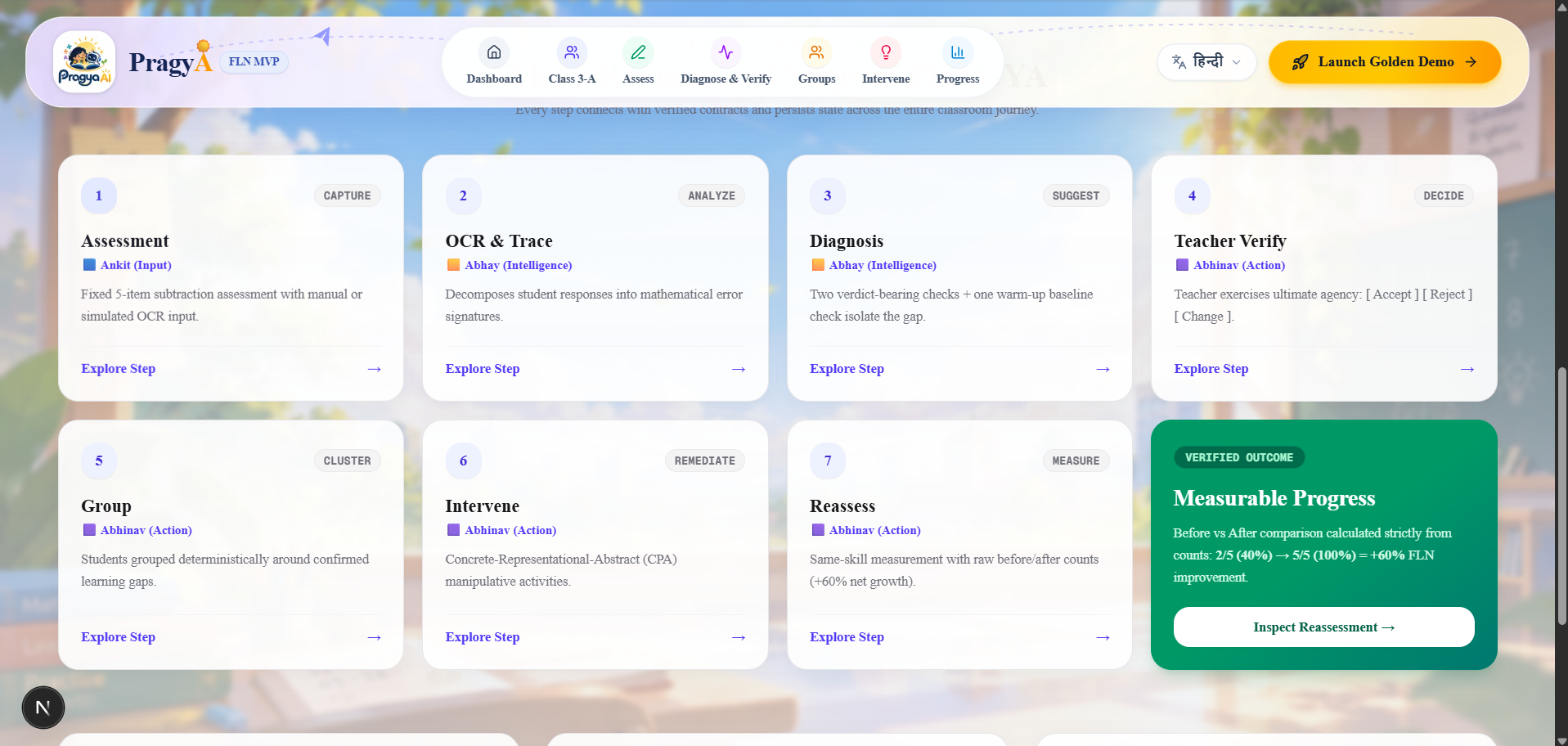
PRAGYA creates a complete diagnostic learning loop:
Assess → OCR → Validate → Trace → Diagnose → Verify → Group → Intervene → Reassess → Report
Assessment
Students solve a short, skill-specific assessment.
OCR
Handwritten responses can be captured and converted into machine-readable answers.
Validation
The system checks whether the extracted response is mathematically correct and flags uncertain OCR results for teacher review.
Error Tracing
Instead of looking only at the final answer, PRAGYA analyzes the response for recognizable error signatures.
Diagnosis
Repeated error patterns are mapped to potential learning gaps.
Teacher Verification
The teacher can Accept, Reject, or Change the suggested diagnosis.
Grouping
Students with the same confirmed learning gap can be grouped for targeted intervention.
Intervention
PRAGYA recommends a focused remedial activity based on the confirmed gap.
Reassessment
Students are assessed again after intervention to determine whether the identified gap has actually improved.
Reporting
Progress can be communicated through teacher dashboards and parent-friendly reports.
4. Example: From Mistake to Diagnosis
Consider:
83 − 47 = 46 ❌
PRAGYA does not stop at the incorrect answer.
It traces the student's work and identifies a pattern where the student performs the regrouping in the ones column but does not appropriately decrement the tens column.
This produces an evidence chain:
Student Response
↓
Regrouping Error Signature
↓
Suggested Gap: Regrouping
↓
Teacher Verification
↓
Targeted Activity: Borrow & Build
↓
Reassessment
↓
Measure whether the gap closed
This makes the system diagnostic rather than merely evaluative.
5. What Makes PRAGYA Different
PRAGYA is not designed as just another:
- ❌ Answer checker
- ❌ Handwriting OCR tool
- ❌ AI chatbot
- ❌ Generic educational dashboard
- ❌ Automated student scoring system
Instead, it combines these capabilities into an explainable diagnostic pipeline.
The system maintains a connection between:
Response → Evidence → Diagnosis → Teacher Decision → Intervention → Outcome
The AI provides a suggestion supported by evidence, while the teacher retains final authority over the diagnosis.
6. Current Working Prototype
The current prototype demonstrates PRAGYA using:
Domain
Foundational Numeracy
Skill
2-digit subtraction with regrouping
Prototype capabilities
- Student profiles
- Skill-specific assessment
- Manual response entry
- Handwriting OCR pipeline
- Mathematical validation
- Error-signature detection
- Explainable diagnosis
- Teacher verification
- Learning-gap based student grouping
- Targeted remedial activities
- Pre/post reassessment
- Progress visualization
- Parent progress reporting
The prototype uses deterministic seed data to demonstrate classroom-level grouping and intervention workflows while keeping the diagnostic logic transparent and reproducible.
7. Diagnostic Categories
The current prototype can distinguish between patterns such as:
| Observed Pattern | Learning Gap |
|---|---|
| Regrouping performed incorrectly | Regrouping Gap |
| Digits treated without proper place-value reasoning | Place Value Gap |
| Method is understood but arithmetic operation slips | Calculation Gap |
| Consistently correct responses | Mastery |
These categories allow students to receive different interventions instead of a single generic worksheet.
8. Teacher-in-the-Loop Design
A key design principle of PRAGYA is:
AI assists the teacher; it does not replace the teacher.
For every suggested diagnosis, the teacher can:
Accept → Confirm the suggested gap
Reject → Discard the suggestion
Change → Select the appropriate confirmed gap
The teacher-confirmed diagnosis becomes the basis for subsequent grouping, intervention, and reporting.
9. Technology
Frontend
- Next.js
- React
- TypeScript
- Tailwind CSS
- shadcn/ui
Intelligence Layer
- Mathematics OCR pipeline
- Image preprocessing
- Mathematical expression parsing
- Mathematical validation
- Deterministic error classification
- Explainable diagnostic engine
Application Architecture
- Local-first MVP architecture
- Shared typed data contracts
- Deterministic classroom seed data
- Modular OCR and diagnostic components
Communication
- Resend for parent progress reports
10. Impact
PRAGYA aims to shift classroom assessment from:
“How many questions did the child get wrong?”
to:
“What specific concept is preventing the child from progressing, and did the intervention work?”
For teachers, this can reduce the effort required to manually inspect patterns across student responses.
For students, it enables targeted remediation instead of generic practice.
For parents, it provides a clearer view of what the child is learning and how they are progressing.
11. Future Scope
The current prototype establishes the diagnostic architecture around a single numeracy skill. The same architecture can be extended to:
- Additional numeracy concepts
- Foundational literacy
- Hindi and other Indian-language learning contexts
- More handwriting/OCR scenarios
- Larger classroom datasets
- Longitudinal student learning profiles
- Personalized intervention pathways
The long-term goal is to build a system where student responses become actionable learning evidence rather than just marks.
PRAGYA AI
See the mistake. Understand the misconception. Close the gap.
This build was uploaded as a hackathon project
22


