Sahara | The Voice for Complete Indic Patient Care
Link to open source: https://github.com/ace-ify/sahara-app
Link to Live Project: https://vocal-banoffee-510128.netlify.app/
Sahara
A Multilingual Voice AI Ecosystem for Elderly Patients & Everyday Healthcare
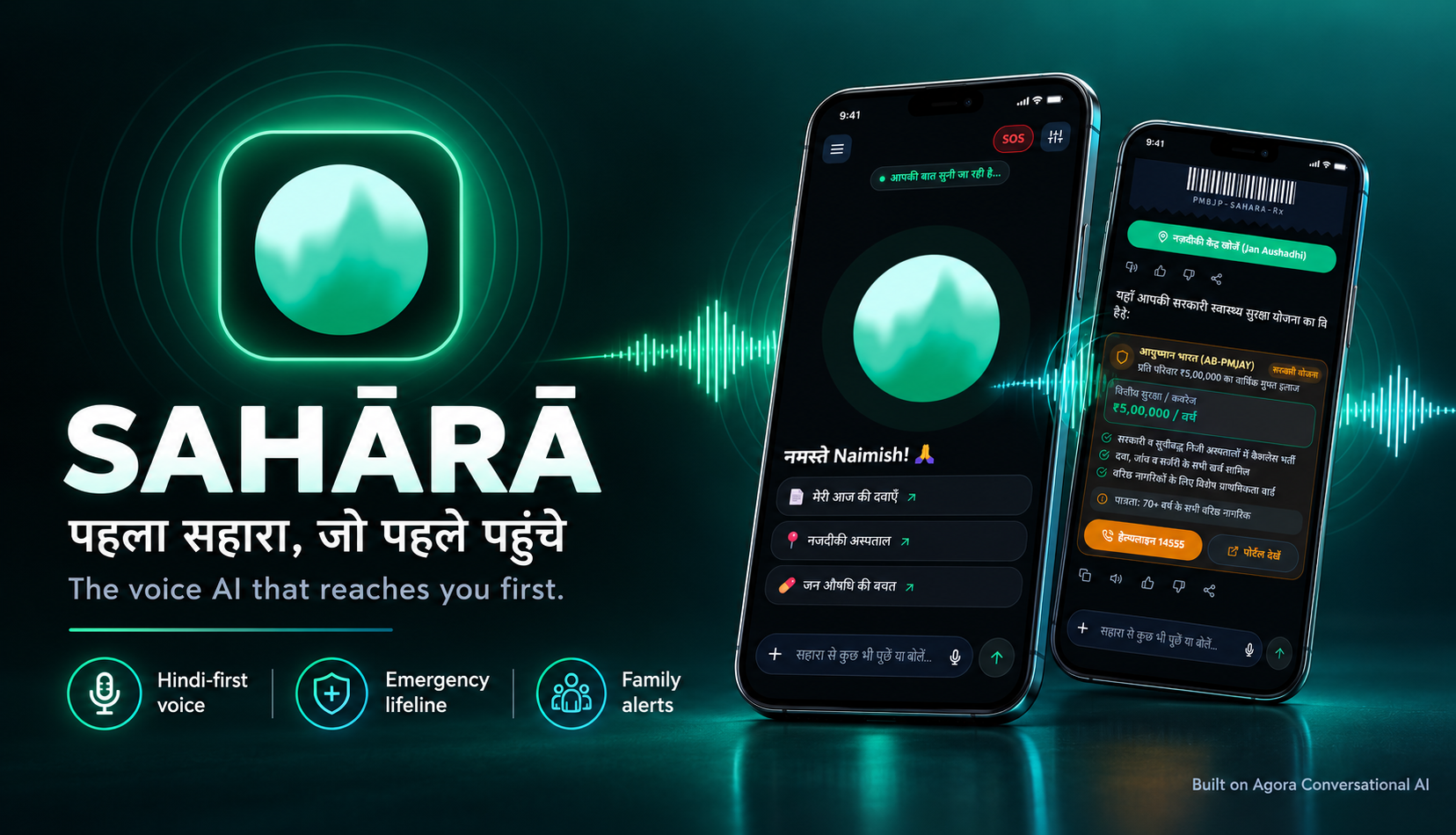
Sahara is a multilingual voice AI ecosystem for elderly patients and everyday users. It works as a daily health helper and transforms into an emergency lifeline the moment something goes wrong.
The patient only has to talk. If they can't, a family member or anyone nearby can take over.
Built for the Agora Voice AI Hackathon 2026, Sahara was conceptualized, designed, and built in just 3 days.
THE PROBLEM
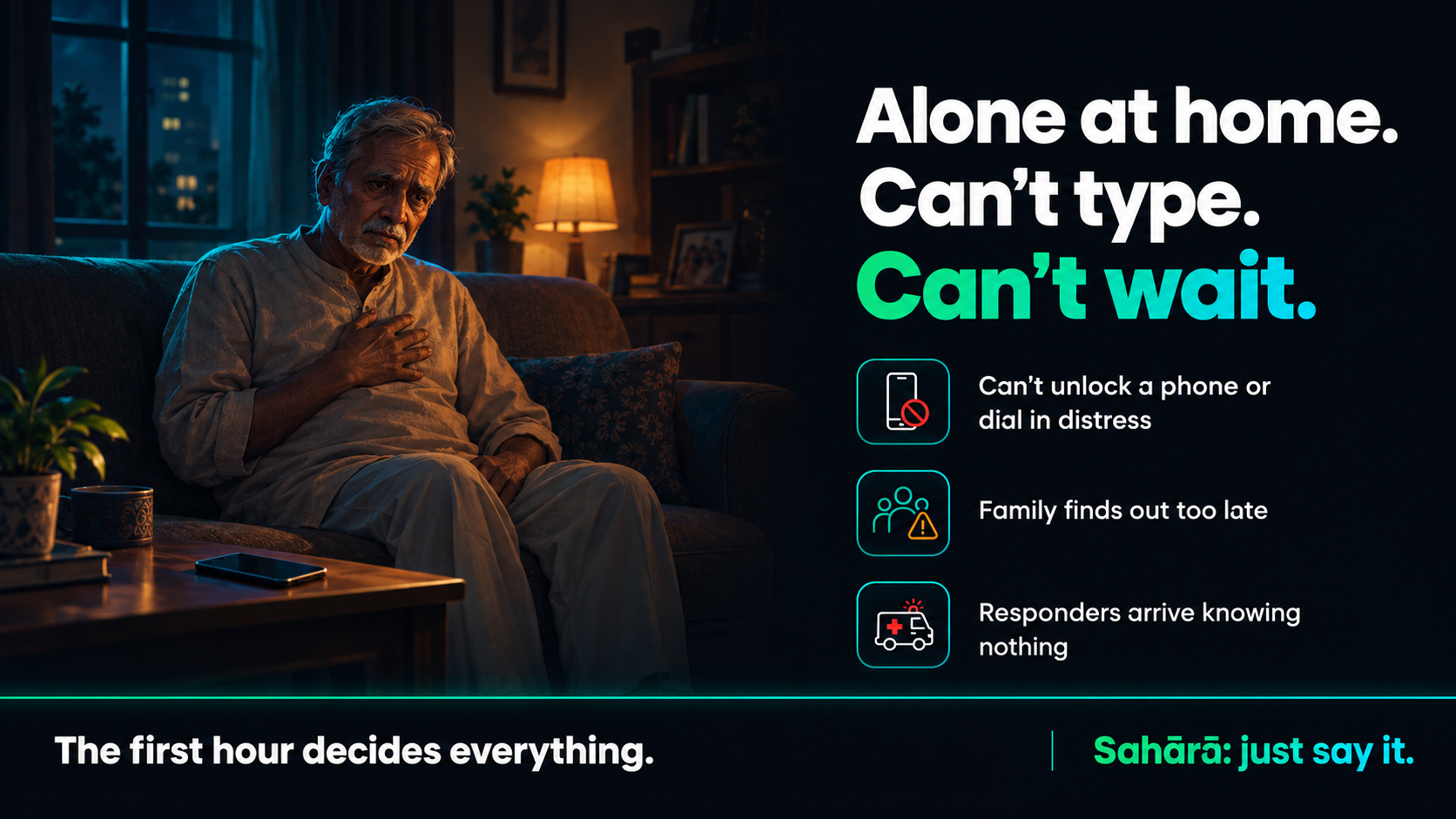
Many elderly people in India live with high blood pressure, diabetes, or heart conditions and spend long hours alone.
During a heart attack, stroke, or fall:
-
They may not be able to unlock a phone.
-
They may not be able to type.
-
Family members may find out too late.
-
When help finally arrives, nobody may know the patient's medical history.
-
The most important first hour can be wasted.
On normal days, there are smaller but equally important problems:
-
Forgetting medicines
-
Difficulty using English-first health apps
-
Language barriers
-
Overpaying for branded medicines
-
Not knowing which government health schemes they are eligible for
Healthcare should not become harder simply because someone is elderly, alone, or not comfortable with technology.
OUR SOLUTION
One voice assistant for everyday care + emergencies.
Sahara lets patients communicate naturally in Hindi, Hinglish, English, and more languages, with multilingual voice support powered by Murf AI TTS.
There is:
No typing.
No complicated menus.
No switching between apps.
The entire experience revolves around the patient, with Sahara and its tool-calling ecosystem working around them.
WHAT SAHARA DOES
🗣️ 1. Natural Voice Conversations
Sahara talks like a person.
-
Real-time two-way voice
-
Patients can interrupt the assistant
-
Conversation context is remembered
-
Previous information can be used even in a later call
-
Supports Hindi, Hinglish, English, and more
The patient simply speaks instead of navigating an app.
🛡️ 2. Type-Safe AI Health Decisions with Laya
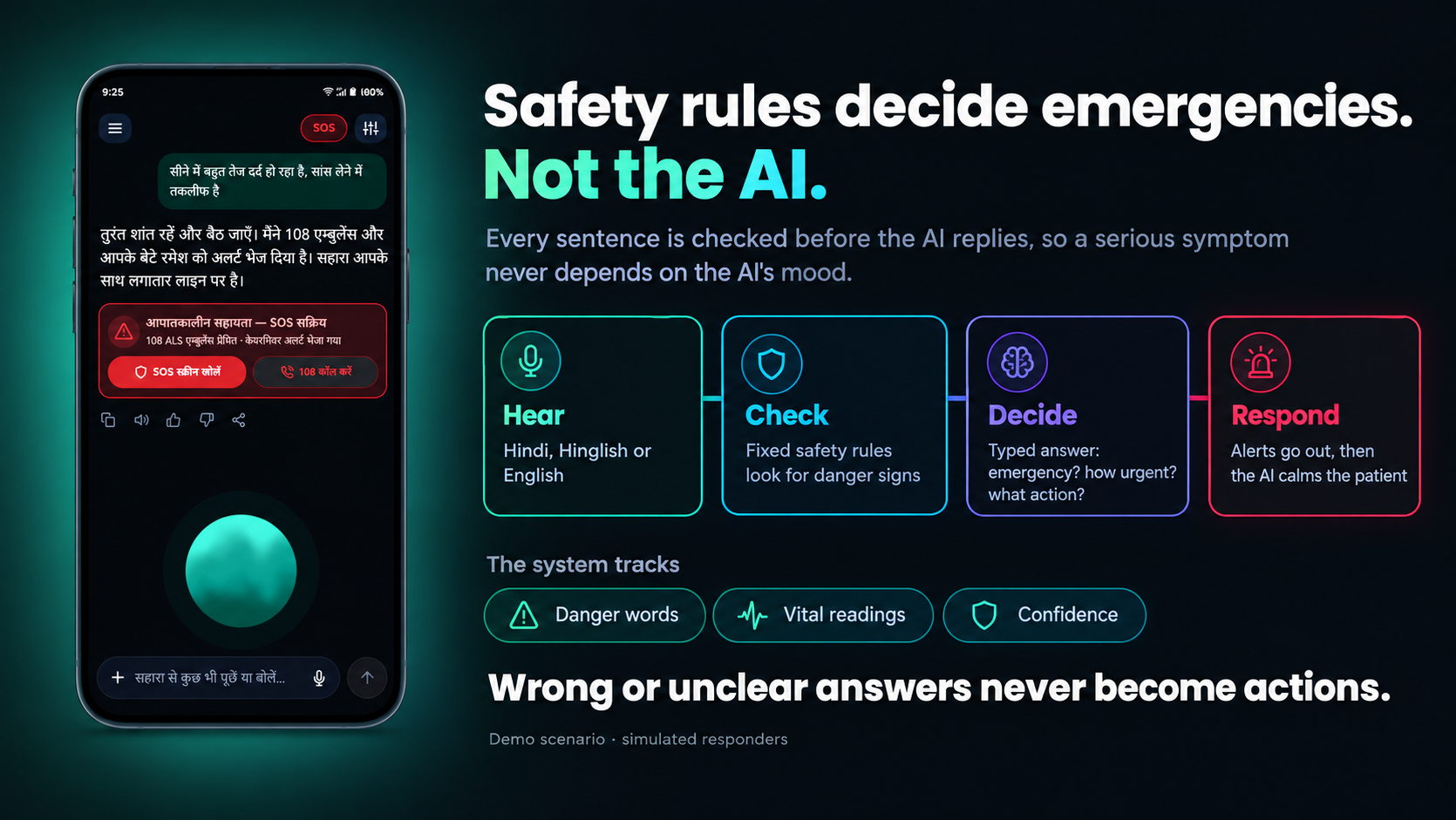
Health decisions cannot depend on unpredictable free-form AI responses.
Sahara uses Laya for type-safe AI decisions.
Every health decision produces:
-
A fixed, checked response
-
A confidence score
-
A structured output
This means a wrong AI-generated sentence cannot directly trigger a critical action.
❤️ 3. Hospital-Standard Risk Scoring
Sahara evaluates:
-
Blood pressure
-
Pulse
-
Oxygen saturation
-
Blood sugar
-
Symptoms
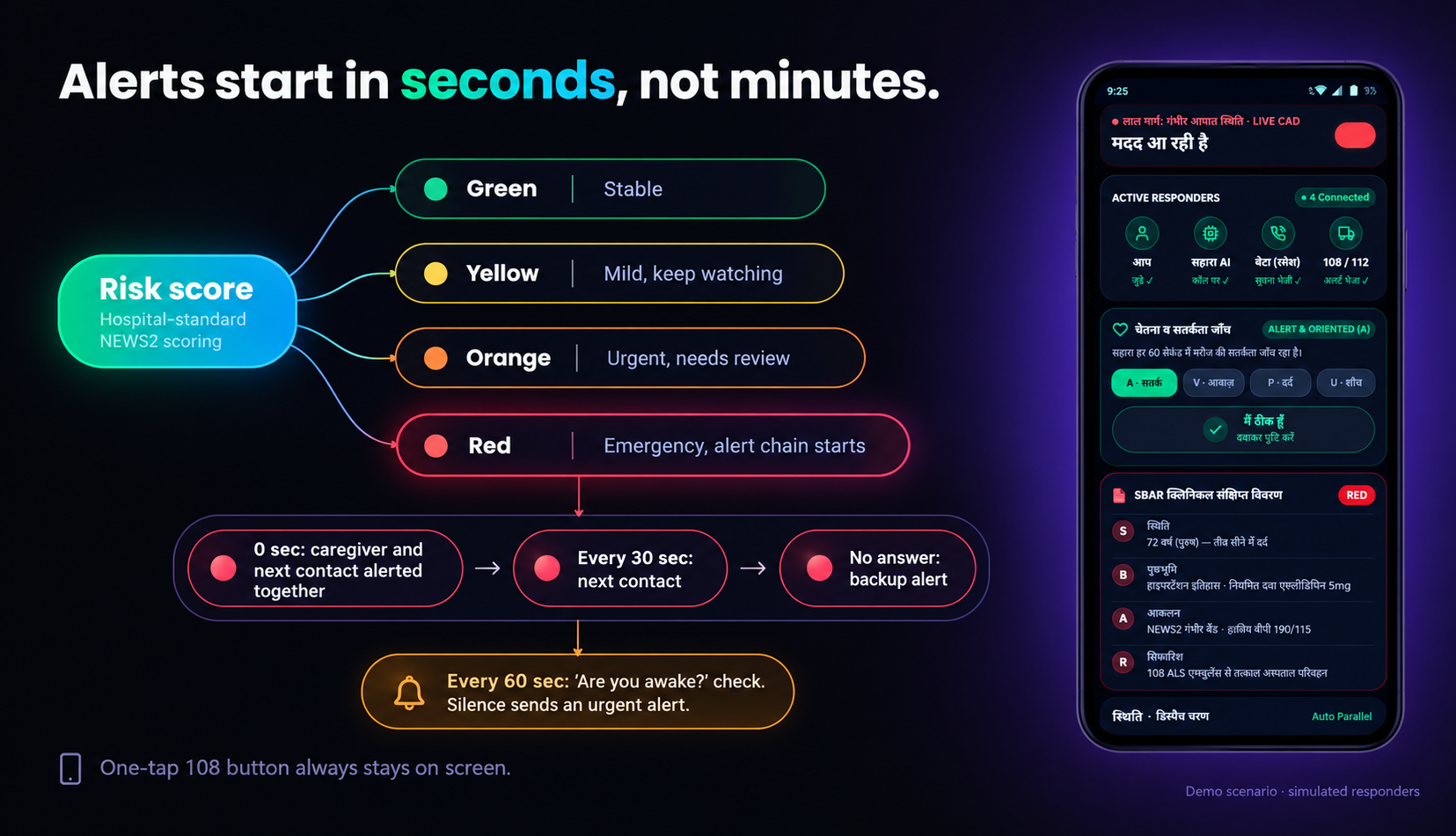
The system uses NEWS2 (National Early Warning Score 2) principles to classify risk.
Risk Levels
🟢 GREEN — Stable
🟡 YELLOW — Needs attention
🟠 ORANGE — High risk
🔴 RED — Emergency
A single dangerous reading can be enough to trigger a RED emergency state.
🚨 4. Emergency Alert Chain
When the system detects a RED emergency:
-
The caregiver and next contact are alerted.
-
If nobody responds, Sahara continues trying the next contacts.
-
The system retries every 30 seconds.
-
Backup emergency alerts are triggered if nobody responds.
-
A large one-tap 108 button remains available on the patient's screen.
The goal is simple:
Don't let one missed call become a missed rescue.
🏥 5. Doctor-Style Emergency Handoff
When an emergency happens, responders and family shouldn't have to reconstruct the situation themselves.
Sahara automatically creates a concise SBAR-style handoff summary containing:
-
What happened
-
Relevant medical history
-
Current risk
-
What should happen next
This gives caregivers and responders immediate context.
👁️ 6. "Are You Awake?" Emergency Check
During an active emergency, Sahara checks on the patient every 60 seconds.
It asks:
"Are you awake?"
If the patient becomes unresponsive or stops responding:
→ Sahara automatically sends an urgent WhatsApp alert.
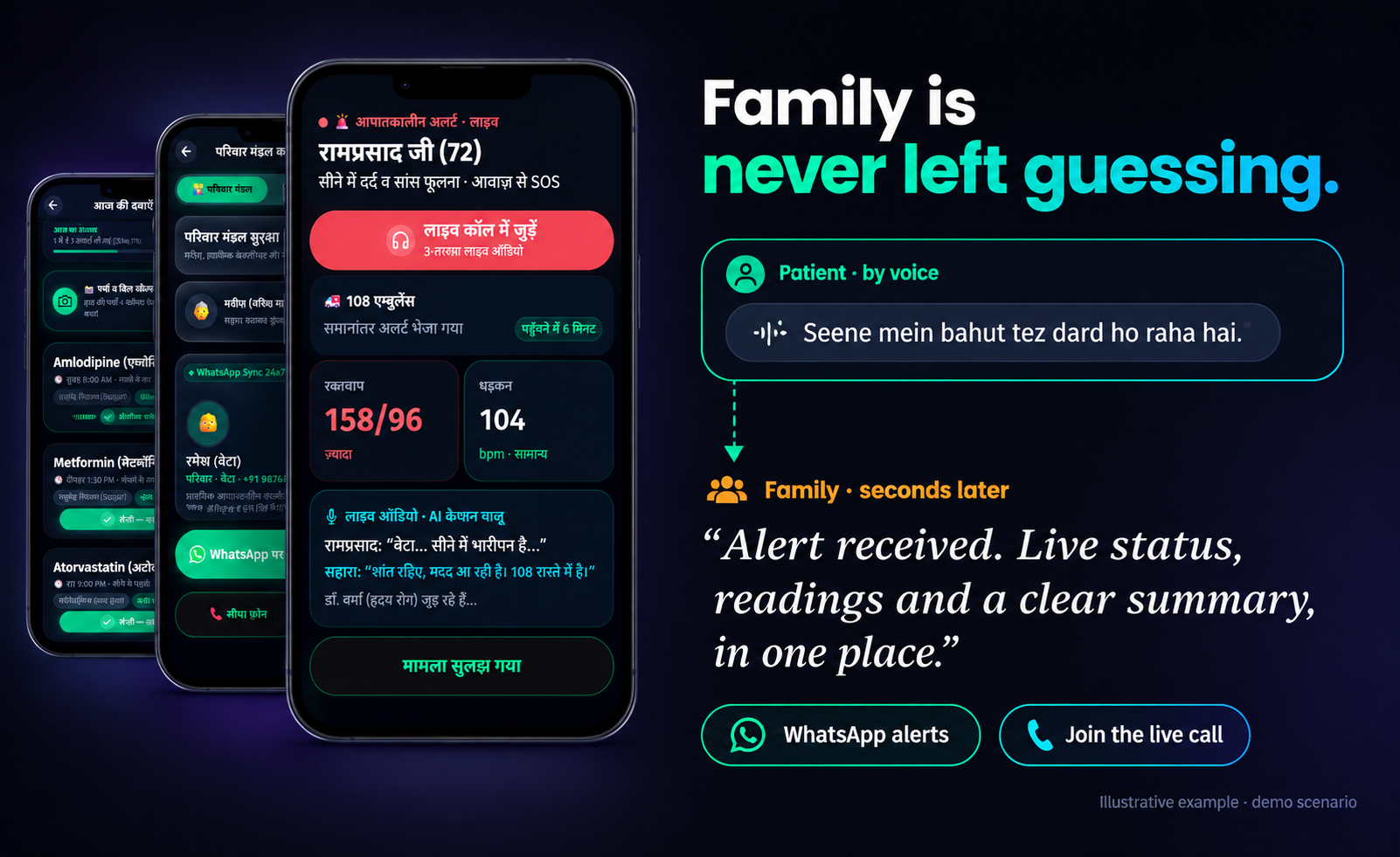
👨👩👧 7. Family & Caregiver Connection
Sahara connects the patient with their trusted care network.
Caregiver features
-
Caregiver pairing
-
Live caregiver emergency screen
-
WhatsApp emergency alerts
-
Unresponsive alerts
-
Emergency-resolved notifications
-
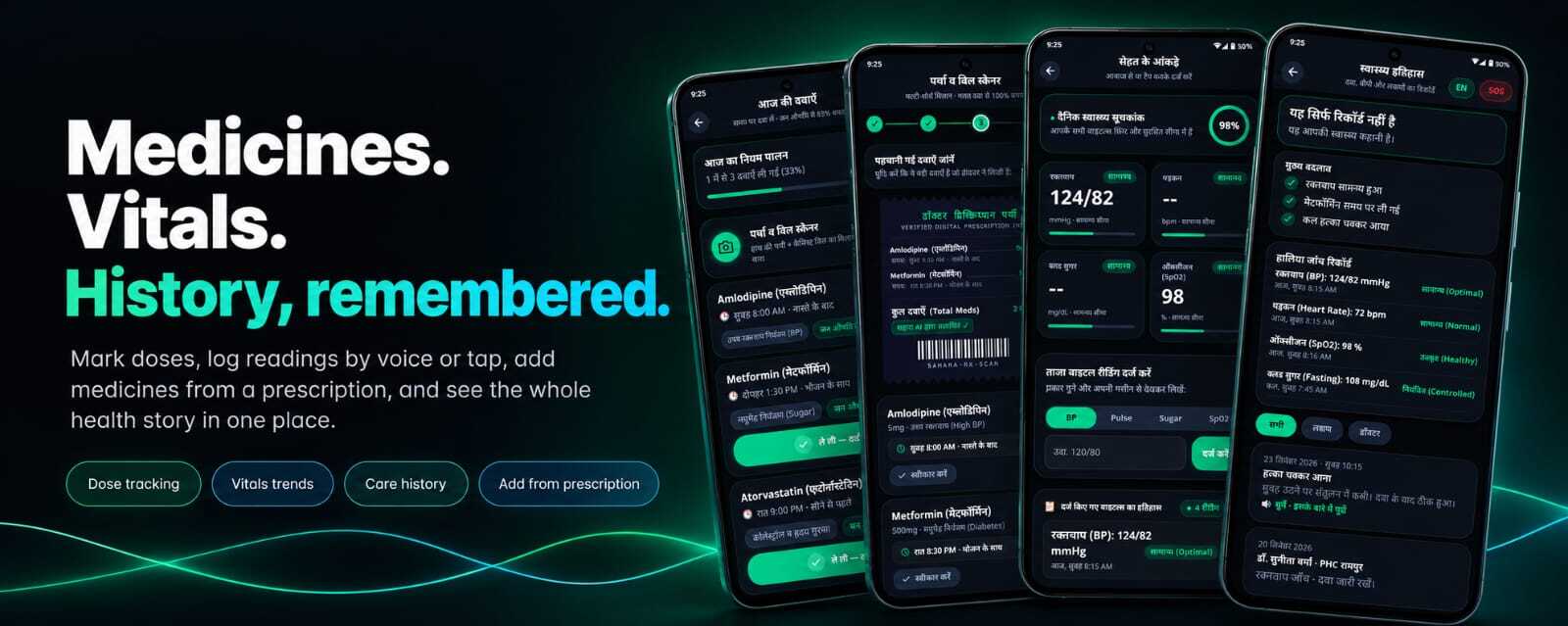
Daily medicine reports
-
Care history
-
Vitals trends
Family members can stay informed without constantly calling the patient.
💊 8. Everyday Medicine Assistance
Sahara isn't only for emergencies.
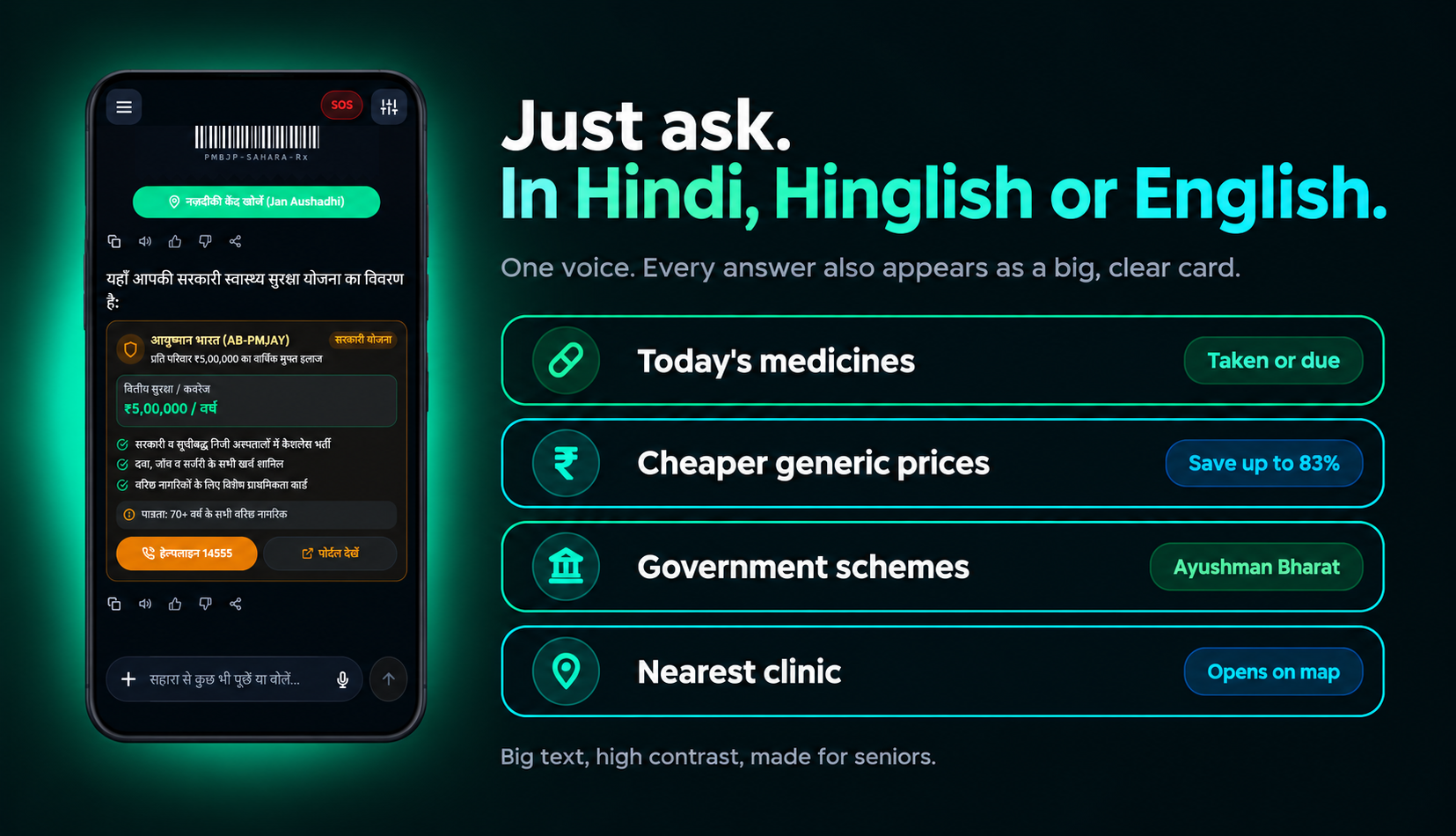
Patients can use their voice to:
-
Ask about today's medicines
-
Say "I took it" to log a medicine
-
Set reminders such as "Remind me at 8 PM"
-
Save BP readings
-
Save sugar readings
-
Track their health history
💰 9. Cheaper Medicine Discovery
Branded medicines can be expensive.
Sahara helps patients compare medicines with cheaper Jan Aushadhi / government generic alternatives.
It currently covers 43 medicines, with live lookup available for additional medicines.
The goal is to help patients understand:
"Is there a cheaper generic alternative to what I'm buying?"
🇮🇳 10. Government Healthcare Schemes
Sahara explains government healthcare schemes in simple language, including:
Ayushman Bharat
It explains the scheme and its coverage, including treatment benefits of up to ₹5 lakh where applicable.
It also covers 12 additional government health schemes, explained in simple Hindi.
📍 11. Nearby Healthcare Discovery
Through voice, users can ask Sahara to find:
-
Nearby clinics
-
Medicine stores
-
Healthcare facilities
No typing or map navigation is required.
👀 12. Big Visual Health Cards
Every voice response can also appear as a large, high-contrast visual card.
This means the patient can:
Hear it + See it
The UI is designed around accessibility rather than information density.
👴 BUILT FOR SENIORS
Sahara is intentionally designed for elderly users.
Accessibility-first design
-
Hindi / English language switch
-
Three-step onboarding
-
Extra-large touch buttons
-
High-contrast interface
-
Clear Devanagari text
-
Large visual cards
-
Simple interactions
-
"I'm OK" button when speaking is difficult
The interface tries to remove the need to understand how an app works.
⚙️ HOW AGORA POWERS SAHARA
Agora Conversational AI powers the complete voice conversation.
The pipeline includes:
Speech → AI → Voice
with:
-
Deepgram for speech-to-text
-
AI reasoning
-
Murf for Hindi text-to-speech
Agora's real-time audio provides low-delay voice communication, while live captions flow through Agora's data channel.
🧠 OUR AI ARCHITECTURE
Our own Python FastAPI server plugs into Agora as the AI brain.
Whenever the patient speaks:
1. Patient speaks
↓
2. Server receives the request
↓
3. Safety checks run first
↓
4. Appropriate tool is selected
↓
5. Health / emergency action is executed
↓
6. Visual card is generated
↓
7. AI generates the conversational response
↓
8. Response is spoken back to the patient
This architecture keeps safety-critical actions outside unrestricted AI generation.
📱 PLATFORM SUPPORT
Sahara works across:
-
Android
-
iOS
-
Web
🧰 TECH STACK
| Layer | Technology |
|---|---|
| Mobile App | React Native + TypeScript |
| Backend | Python + FastAPI |
| Voice / RTC | Agora |
| Speech-to-Text | Deepgram |
| Text-to-Speech | Murf AI |
| AI Models | Groq + OpenAI + Claude |
| Emergency Communication | WhatsApp Business API |
| Maps / Places | OpenStreetMap |
| Deployment | Render |
🔥 THE HARD PARTS WE SOLVED
Building Sahara in just 3 days meant solving several difficult problems simultaneously.
1. Emergency reliability + conversational AI
The AI needed to feel friendly and natural while emergency actions had to remain predictable and controlled.
2. Hindi & Hinglish understanding
Real users don't always speak textbook Hindi or English.
Sahara needed to understand natural Hindi + English mixing.
3. Voice + UI synchronization
The spoken response, live captions, health data, and visual cards all needed to stay synchronized.
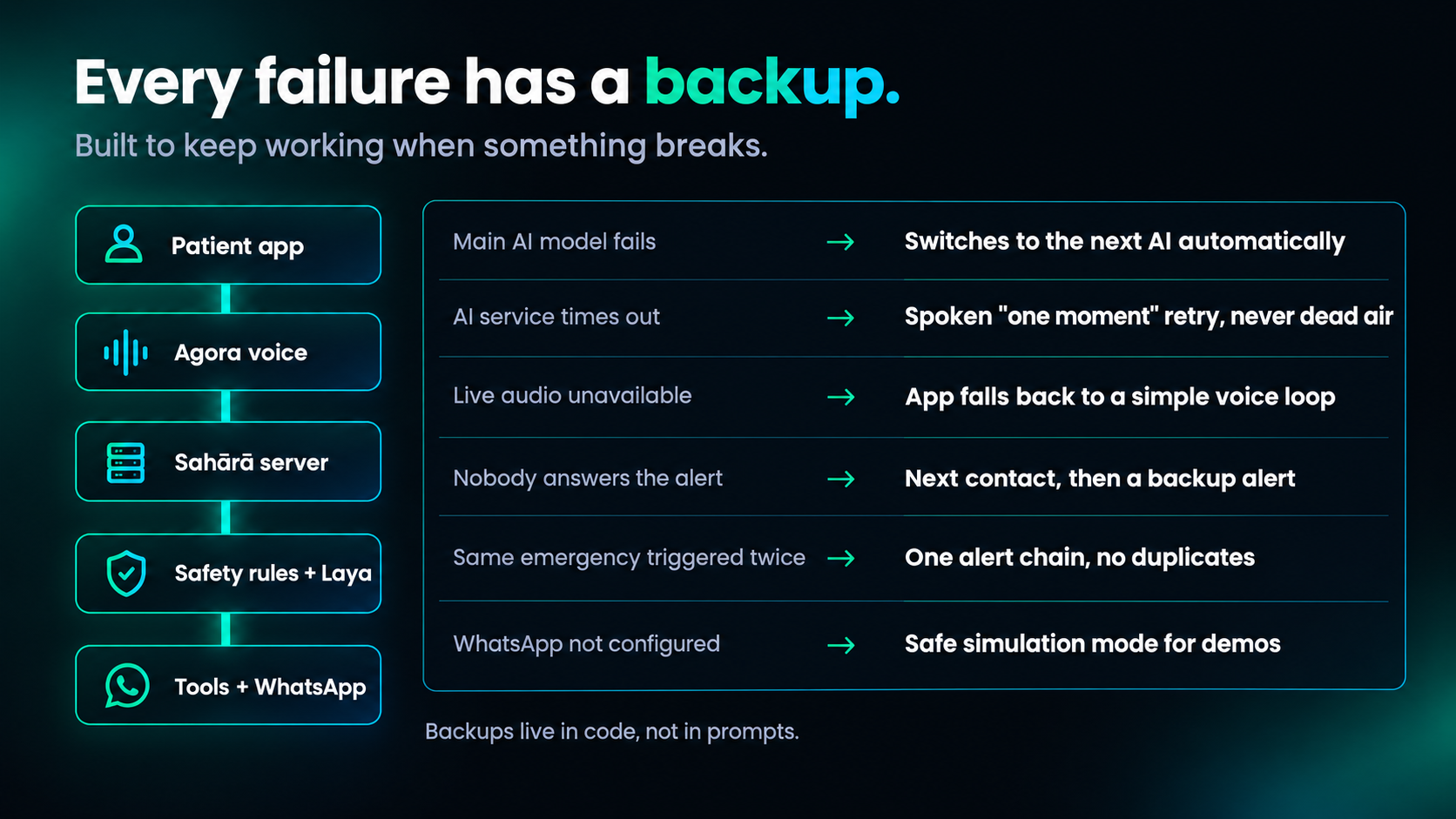
4. Live failure recovery
The system needed fallback AI providers and alternate voice flows so the demo could continue even when individual services failed.
5. Duplicate emergency prevention
The same emergency must never result in multiple duplicate alert chains.
⚠️ HONEST LIMITATIONS
Sahara is a prototype built during a hackathon, and we want to be transparent about what is and isn't connected today.
🚑 Emergency services
Ambulance and hospital alerts are designed into the system, but they are not yet connected to real 108/112 or hospital systems.
Today:
-
Real alerts go to family members through WhatsApp.
-
The patient has a one-tap 108 call button.
💾 Data storage
Data currently lives in memory.
A production system would require:
-
Secure database
-
User authentication
-
Proper patient identity management
-
Long-term health record storage
📷 Prescription reading
Prescription photo reading is currently being connected to a vision AI.
Manual entry works today.
🩺 Medical disclaimer
Sahara is a support tool, not a doctor.
It is designed to assist patients and caregivers, not replace qualified medical professionals.
🚀 WHAT'S NEXT
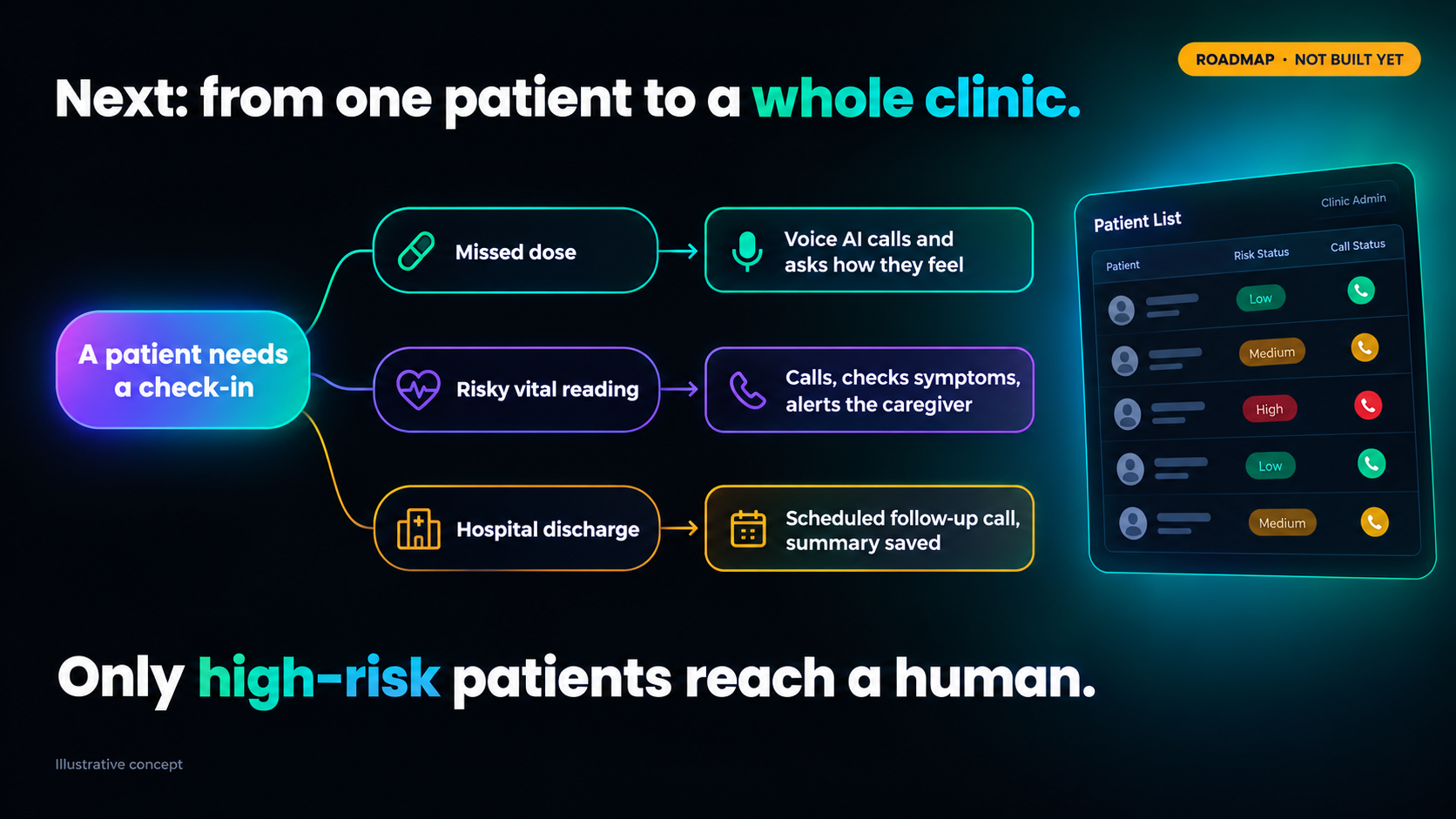
🏥 1. Clinic & Hospital Admin Dashboard
The next step is taking Sahara beyond the patient app.
Healthcare staff could manage follow-ups through a central dashboard.
For example:
Patient discharged
↓
Sahara automatically calls them
↓
"How are you feeling today?"
↓
Patient responds naturally
↓
Sahara saves a structured summary
↓
Only high-risk patients are escalated to a human
The same system could automatically follow up after:
-
Hospital discharge
-
Missed medication
-
Risky vitals
-
Missed appointments
This can save staff time while making patients feel continuously cared for.
🚑 2. Real Emergency Integration
Future versions can integrate with:
-
108 / 112
-
Hospitals
-
Ambulance systems
-
Hospital pre-alert workflows
So responders can receive the patient's context before they arrive.
🦾 3. Fall Detection
Integrate device and phone sensors to automatically detect potential falls and start the emergency workflow.
📡 4. Connected Medical Devices
Sahara can connect directly with:
-
Blood pressure monitors
-
Pulse oximeters
-
Glucose meters
-
Other home health devices
This removes the need for manual readings.
🗣️ 5. More Indian Languages
Expand beyond Hindi and English into:
-
Tamil
-
Bengali
-
Marathi
-
Telugu
-
And more Indian languages
All within the same patient-first system.
🪪 6. ABHA & Healthcare Ecosystem Integration
Future integrations include:
-
ABHA health records
-
Family mode
-
ASHA worker mode
-
Privacy and consent management
🌱 THE BIGGER VISION
Sahara isn't trying to build another healthcare app.
It is trying to build a voice-first healthcare layer around the patient.
On normal days:
"Did I take my medicine?"
On difficult days:
"What's my BP?"
And when something goes seriously wrong:
"I can't do this myself."
That's when Sahara stops being just an assistant—
and becomes a lifeline.
Built for the Agora Voice AI Hackathon 2026
Built in 3 days.
Designed around one simple idea:
Healthcare should listen.
This build was uploaded as a hackathon project

