SaveYourPlant

Link to open source: https://github.com/samridhikapoor/Plant-disease-detector
Save Your Plant
Link to the live Demo (YouTube Link): https://www.youtube.com/watch?v=_STzQfh7fhI&t=1s
Inspiration
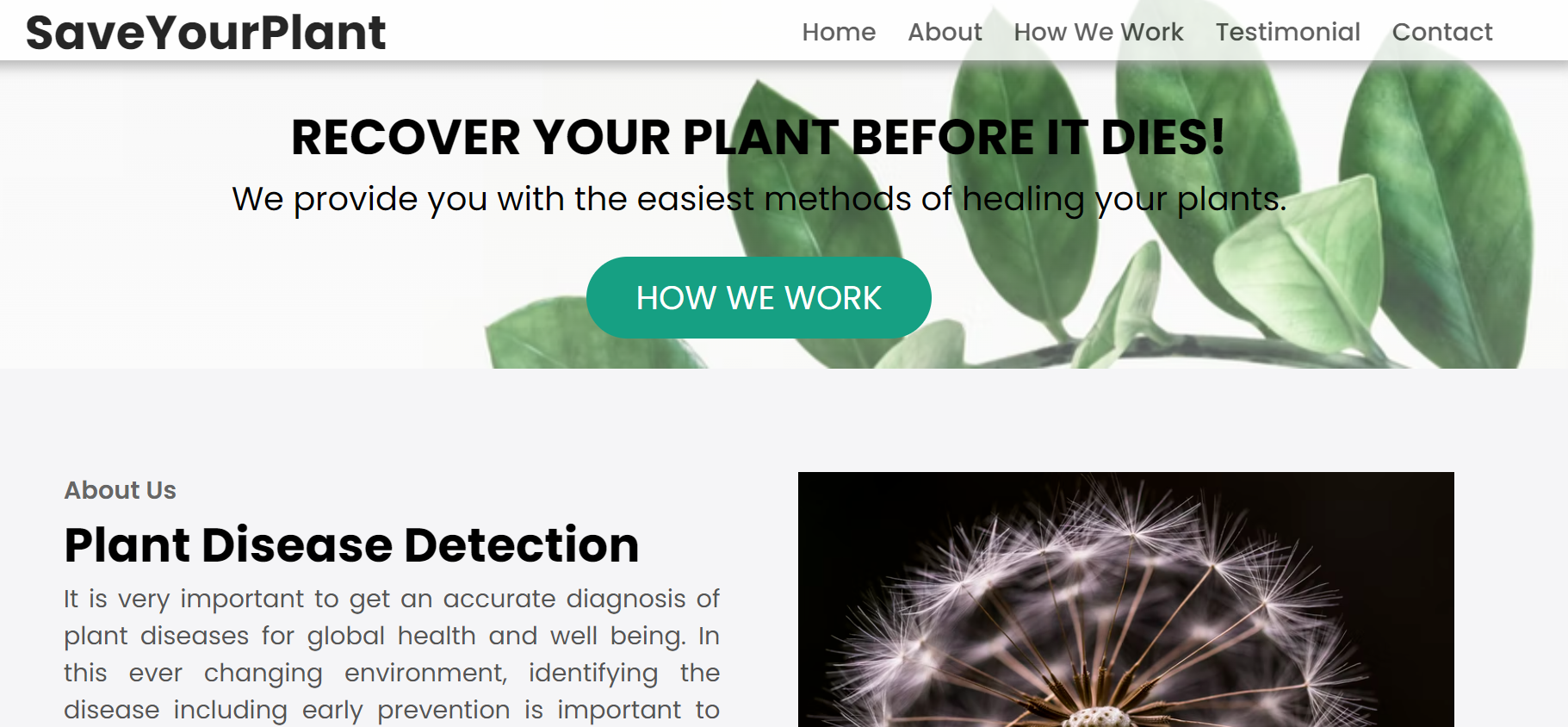
We were watching Shark Tank where a farmer had bought an innovation to the table by creating a plowing machine that carried the pesticide sprayer farmers used to carry on their backs. We researched pesticides and found out that a large number of crops get damaged due to the lack of knowledge of which pesticide/fertilizer to use. We thought that what if we could find an easy way to find out which fertilizer to use? That is when SaveYourPlant was born. It helps the farmer know about the required fertilizer/pesticide to use on their crop so that they can save it before deterioration.
Plant disease can directly lead to stunted growth causing bad effects on yields. An economic loss of up to $20 billion per year is estimated all over the world. In addition, traditional methods mainly rely on specialists, experience, and manuals, but the majority of them are expensive, time-consuming, and labor-intensive with difficulty detecting precisely. Therefore, a rapid and accurate approach to identify plant diseases seems so urgent for the benefit of business and ecology to agriculture.
How is it useful to others
In India about 70% of the populace relies on agriculture. Identification of the plant diseases is important in order to prevent the losses within the yield. It's terribly troublesome to observe the plant diseases manually. It needs tremendous quantity of labor, expertize within the plant diseases, and conjointly need the excessive time interval. Hence, image processing and machine learning models can be employed for the detection of plant diseases. In this project, we have described the technique for the detection of plant diseases with the help of their leaves pictures. Image processing is a branch of signal processing which can extract the image properties or useful information from the image. Machine learning is a sub part of artificial intelligence which works automatically or give instructions to do a particular task. The main aim of machine learning is to understand the training data and fit that training data into models that should be useful to the people. So it can assist in good decisions making and predicting the correct output using the large amount of training data. The color of leaves, amount of damage to leaves, area of the leaf, texture parameters are used for classification. In this project we have analyzed different image parameters or features to identifying different plant leaves diseases to achieve the best accuracy. Previously plant disease detection is done by visual inspection of the leaves or some chemical processes by experts. For doing so, a large team of experts as well as continuous observation of plant is needed, which costs high when we do with large farms. In such conditions, the recommended system proves to be helpful in monitoring large fields of crops. Automatic detection of the diseases by simply seeing the symptoms on the plant leaves makes it easier as well as cheaper. The proposed solution for plant disease detection is computationally less expensive and requires less time for prediction than other deep learning based approaches since it uses statistical machine learning and image processing algorithm.
What it does
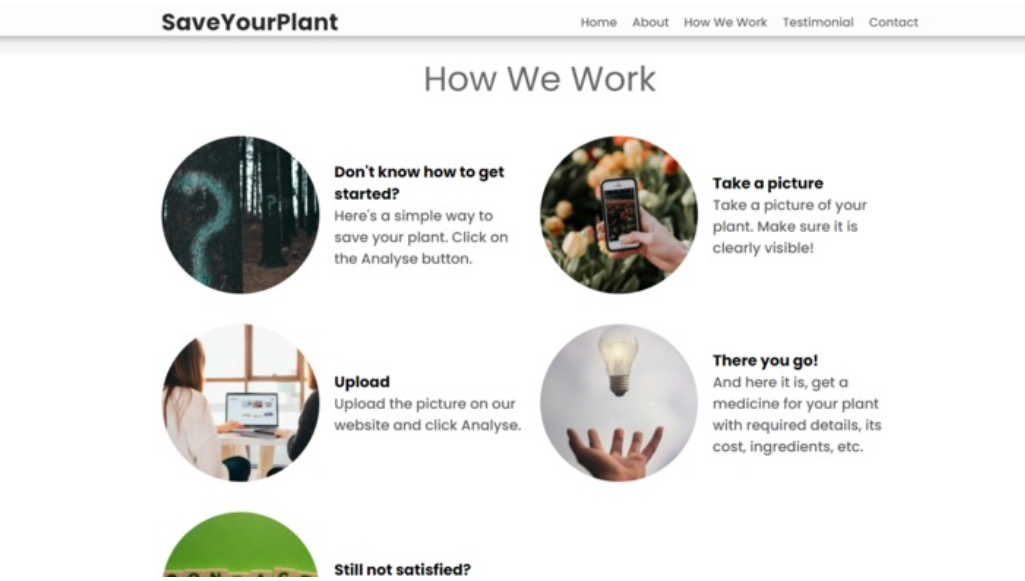
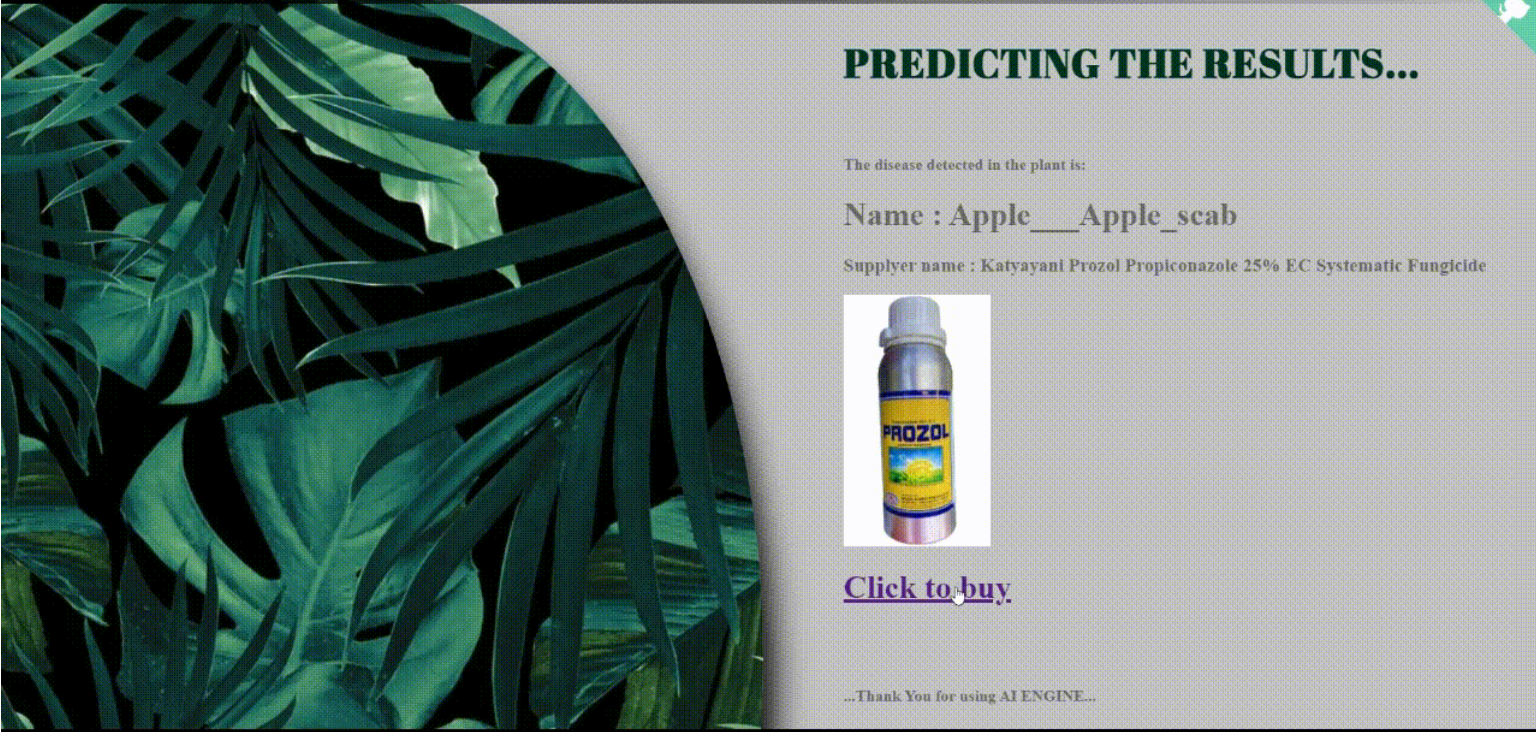
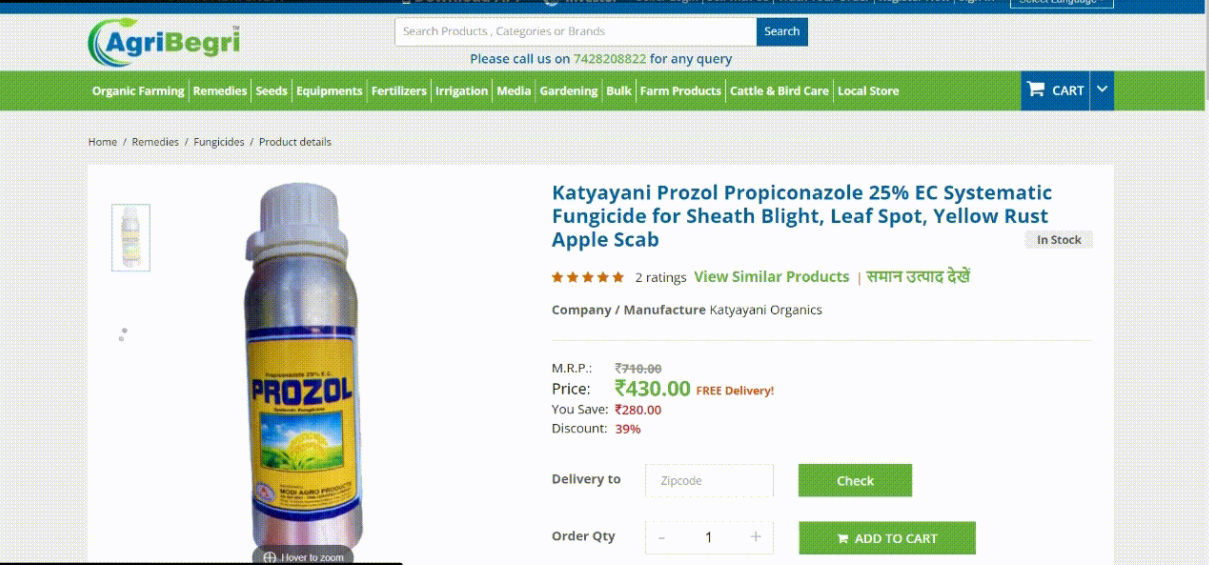
Our website aims to find out the reason behind a plant's weak health and find a solution for it by linking our users to the right medicines, their cost, the place from where a farmer could order that medicine, etc. A simple image of a leaf or a strand of the crop is to be uploaded to the website, and it gives our users the solution to their crop's weak health!
How we built it
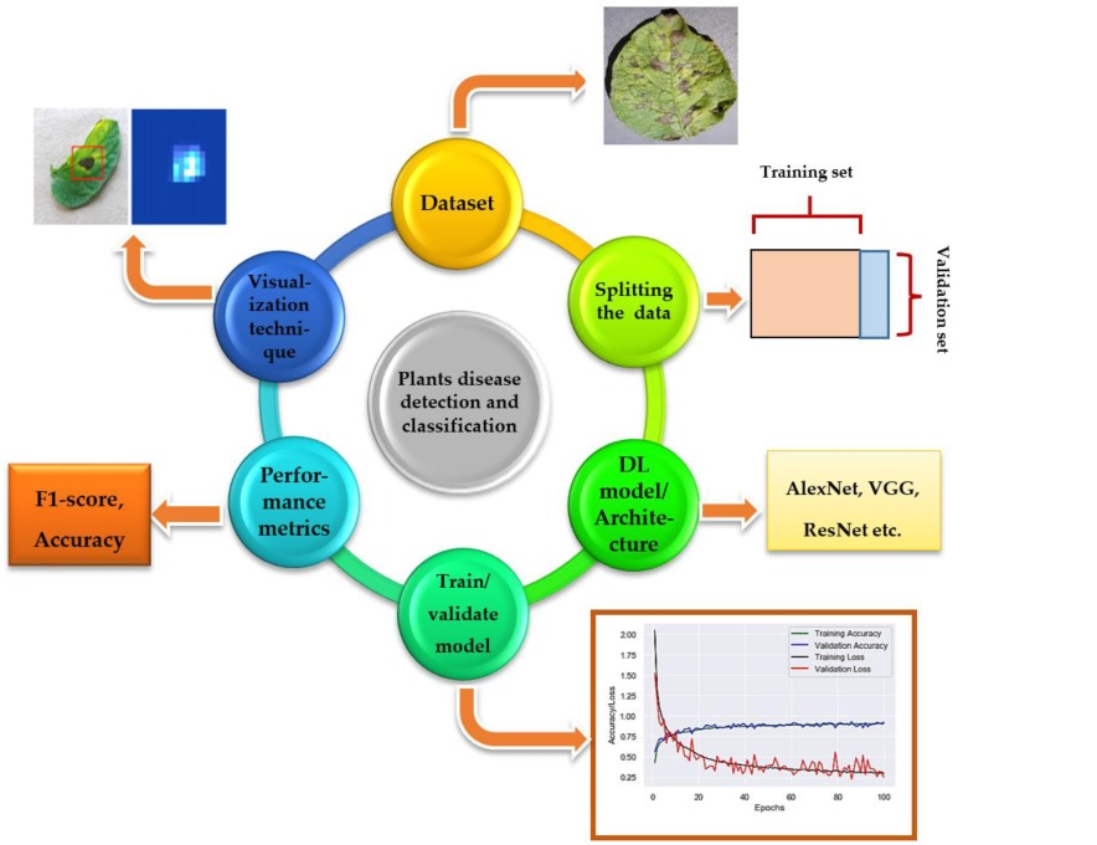
For training and testing purposes, we used the standard open-access PlantVillage dataset, which consists of 54,305 numbers of healthy- and infected-plant leaves. Detailed database information, the number of classes and images in each class, their common and scientific names, and the disease-causing viruses. The database contains 38 different classes of 14 different plant species with healthy- and disease-affected-leaf images. All images were captured in laboratory conditions.
Challenges we ran into
We had a very hard time trying to deploy our flask app using various different platforms since it exceeded the storage limit. But we could finally get it done. It was also very hard to figure out the accurate model for our ML cutting edge technology but we finally achieved around 87% accuracy which we believe is an accomplishment in itself.
Accomplishments that we're proud of
The main advantages of our solution include high processing speed and high classification accuracy. A plant disease recognition system can work as a universal detector, recognizing general abnormalities on the leaves, such as scorching or mold. However, our further research is related to the precise recognition of particular diseases.
In a real-time scenario, farmers suffer a huge loss of crops and money as the crop gets spoilt because of the attack caused by pests, etc. Our model, on the other hand, provides just a single time uploading of images and detection of the disease striking off the scope for crop failures.
The detection is a single-step easy process which is done by our pre-trained model, that will contribute to saving precious time.
The dataset used is quite flexible that corresponds to standardized and globally accepted results as per agricultural researchers all over the globe.
An economic loss of up to $20 billion per year is estimated all over the world as they go undetected. Our model provides timely detection of tumors thereby saving a million lives. It is estimated that 84,170 people will receive a primary diagnosis of plant disease in 2021 with the aid of our model.
What we learned
In this work, we developed a deep convolutional neural network (CNN) based on a recently developed VGG19 CNN model. The model was fine-tuned and trained for the detection of healthy and different unhealthy crop leaf images. The obtained results show that our model outperforms some recent deep learning techniques by using the most popular publicly available Plant Village dataset.
We have successfully implemented, executed, and tested our model
In the best model scenario, it provides accuracy up to 94.47% is far beyond the reach of manual testing
What's next for SaveYourPlant
For further development and improvement of our model and idea, we have deployed our model by creating a web application with a user-friendly interface that could further simplify the process for the user.
We plan to seek an accuracynear to 100% and pitch the idea to the government so that we could link our website to their National Food Security Mission so that the project could get more exposure to the farmer's problems and be of help to more and more of them. After all, farmers are the backbone of India!


