Share your environments securely using envault.
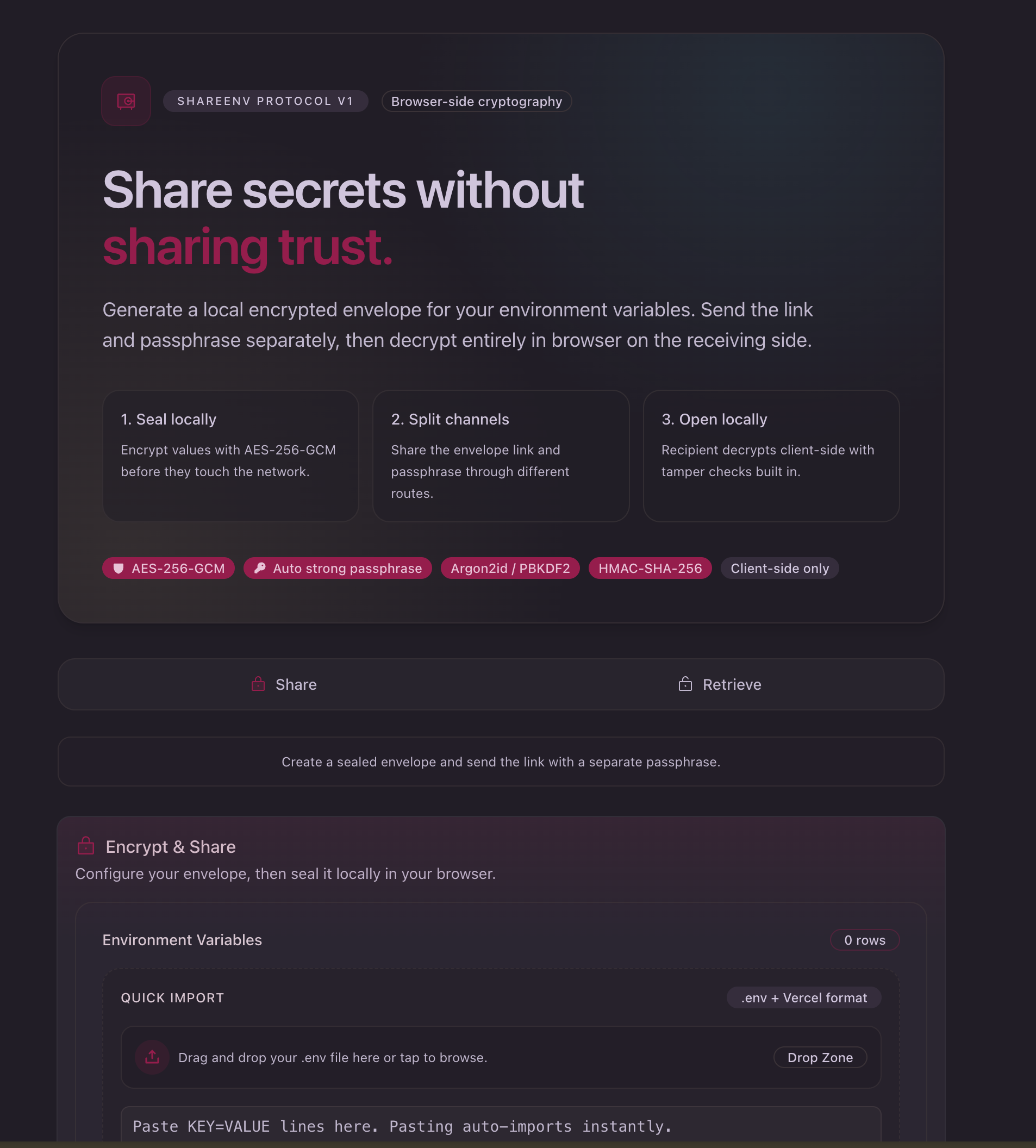
Link to open source: https://github.com/Srijan-Baniyal/envault
Link to Live Project: https://envault-seven.vercel.app/
Envault is a zero-knowledge secret-sharing app for environment variables: you paste your .env values, they are encrypted locally in your browser with modern cryptography, and you share a one-time link plus passphrase separately. The server only stores encrypted envelopes, never plaintext secrets or passphrases, so recipients can decrypt securely on their side while preserving end-to-end confidentiality.
Envault is designed for one thing: sharing sensitive environment variables safely, without ever exposing plaintext secrets to the server.
You encrypt in your browser, share a one-time link, and the recipient decrypts locally with the passphrase.
-
Prepare your secrets
Gather the .env values you want to share, such as API keys, tokens, and service credentials. -
Encrypt locally
Open Envault, paste your variables, and generate or enter a strong passphrase.
Encryption happens entirely in your browser before anything is stored. -
Create the envelope
Seal the payload to generate:- a one-time share link
- an envelope ID
- your passphrase (kept separate from the link)
-
Share safely
Send the share link through one channel (for example, chat) and the passphrase through another (for example, voice or password manager note).
Never send both in the same message. -
Recipient retrieves the envelope
The recipient opens the link, enters the passphrase, and decrypts locally in their browser. -
Copy and use the output
After successful decryption, the real .env content appears and can be copied as:- standard .env text
- JSON format
-
One-time protection
Once retrieved, the link is consumed and cannot be opened again.
This reduces accidental re-access and limits exposure.
Best Practices
- Use a long, unique passphrase every time.
- Share link and passphrase via separate channels.
- Keep TTL short when possible.
- Ask recipients to store secrets in a secure vault after decryption.
- Rotate secrets after high-risk sharing events.

