SignalForge
Link to open source: https://github.com/SauravMukherjee44/SignalForge
Link to Live Project: https://signalforge-ai-incident-command.up.railway.app/
SignalForge is an enterprise incident-intelligence control plane that connects an organization’s existing communication, observability and work-management systems into one live operational workspace.
Instead of forcing companies to replace Slack, Datadog, Jira or their monitoring stack, SignalForge works across them. Teams connect their services through a simple integration interface, join an Agora-powered incident room and immediately receive a continuously updated view of the incident.
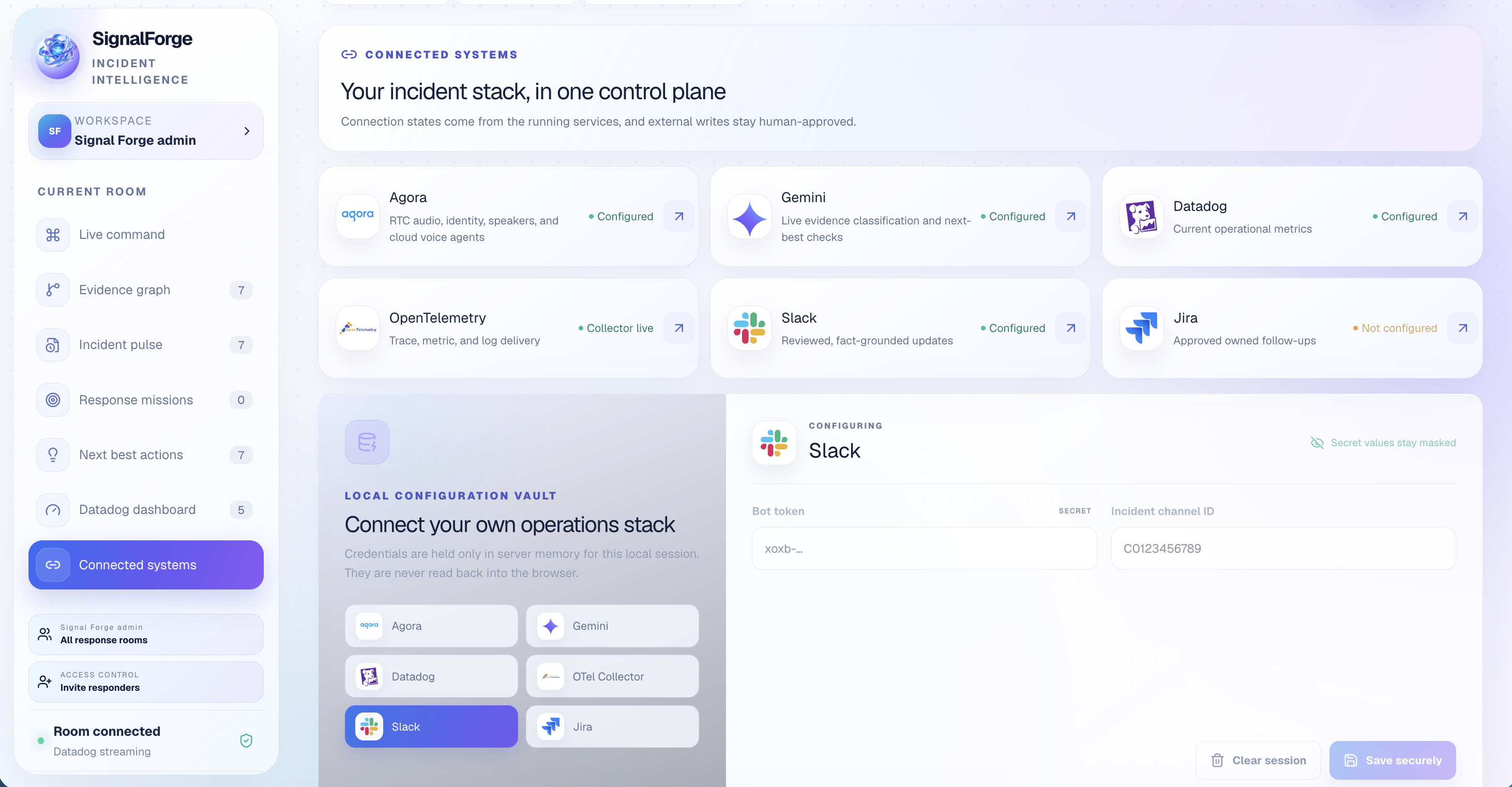
Enterprise integration is the core of SignalForge
SignalForge brings the complete incident-response stack into one interface:
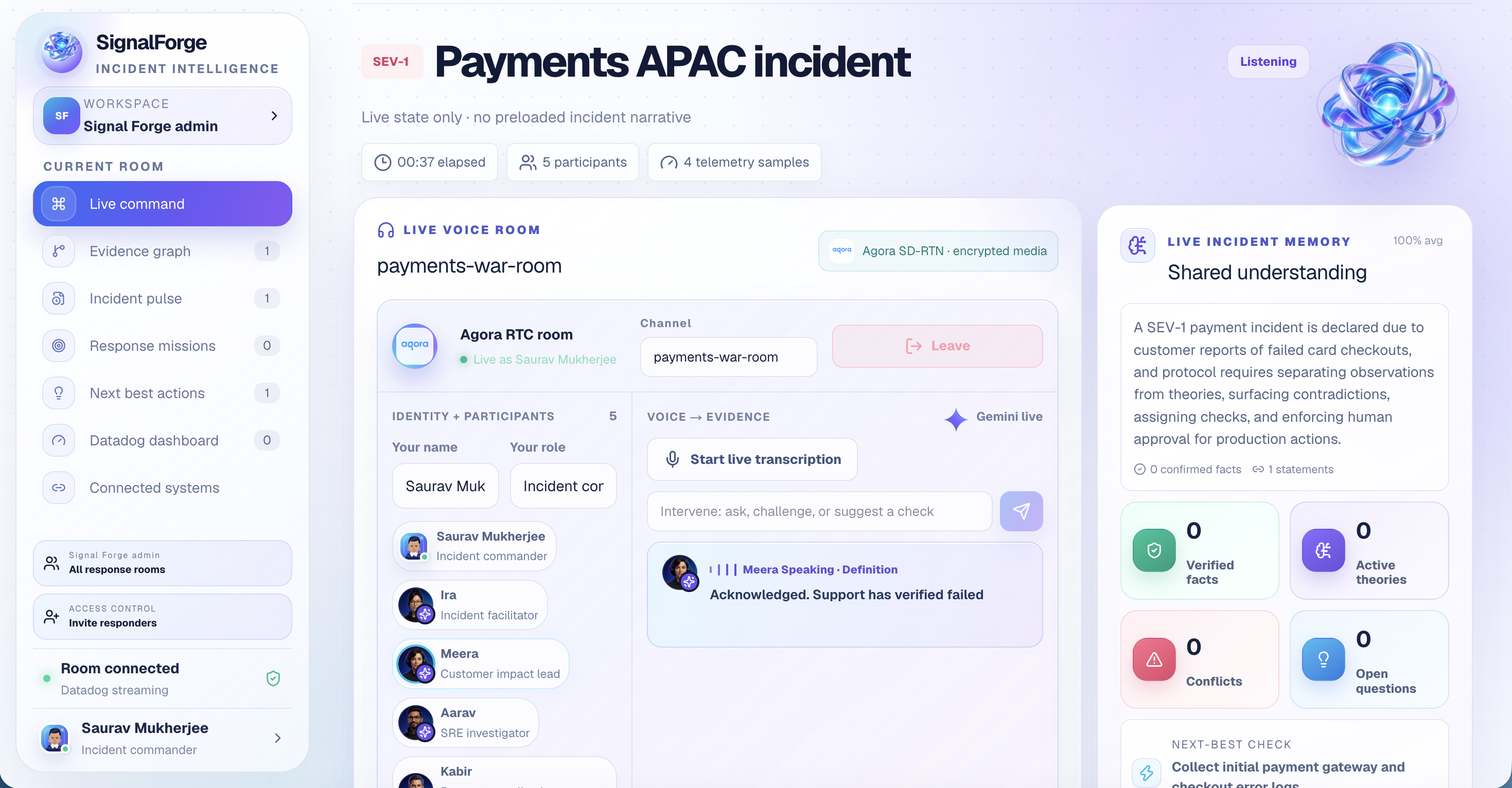
- Agora RTC and Agora conversational ai Agents provide secure live voice, participant presence, speaker identity, remote audio and specialist AI responders.
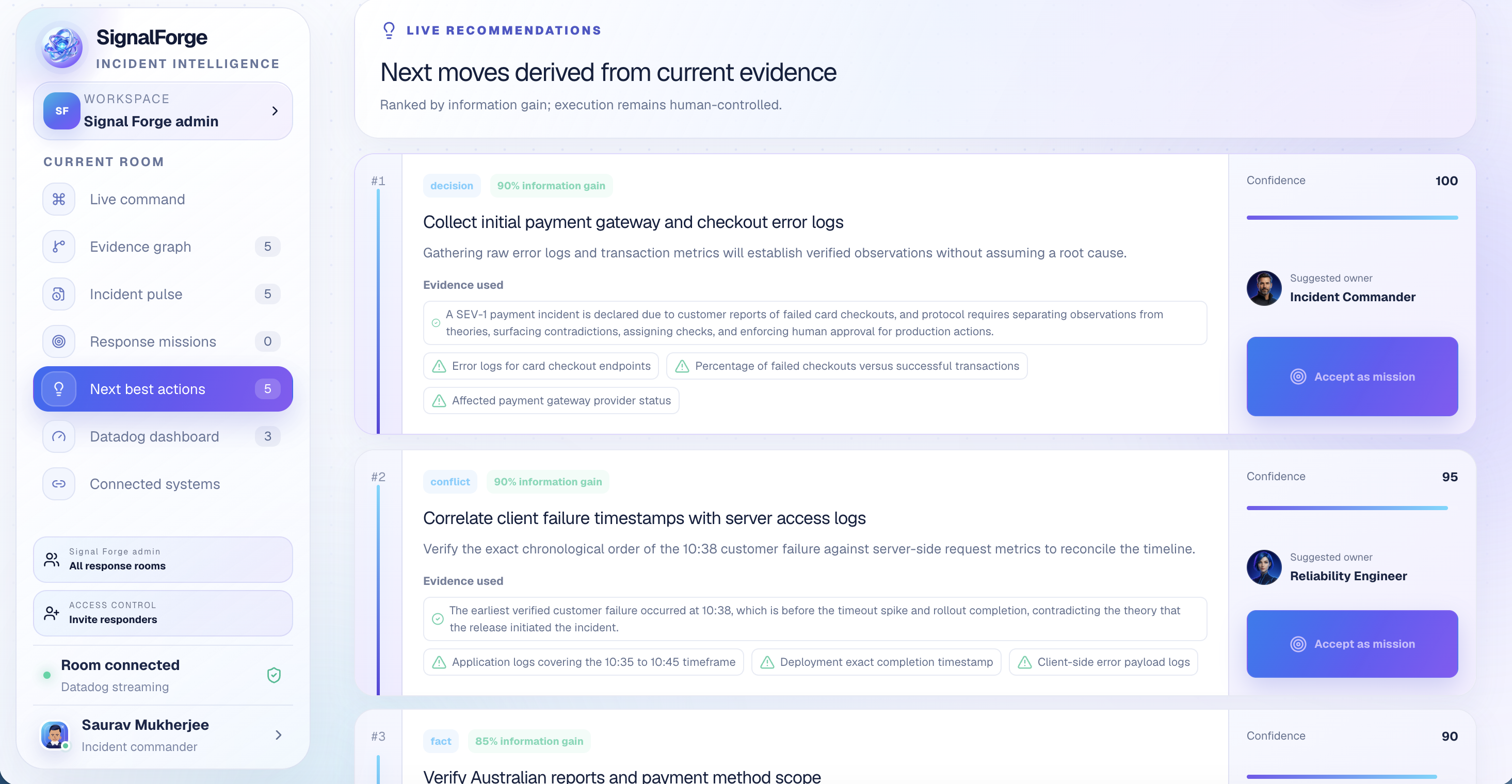
- Gemini Flash and Gemini Live convert finalized speech into structured evidence, contradictions, questions, decisions and recommended checks.
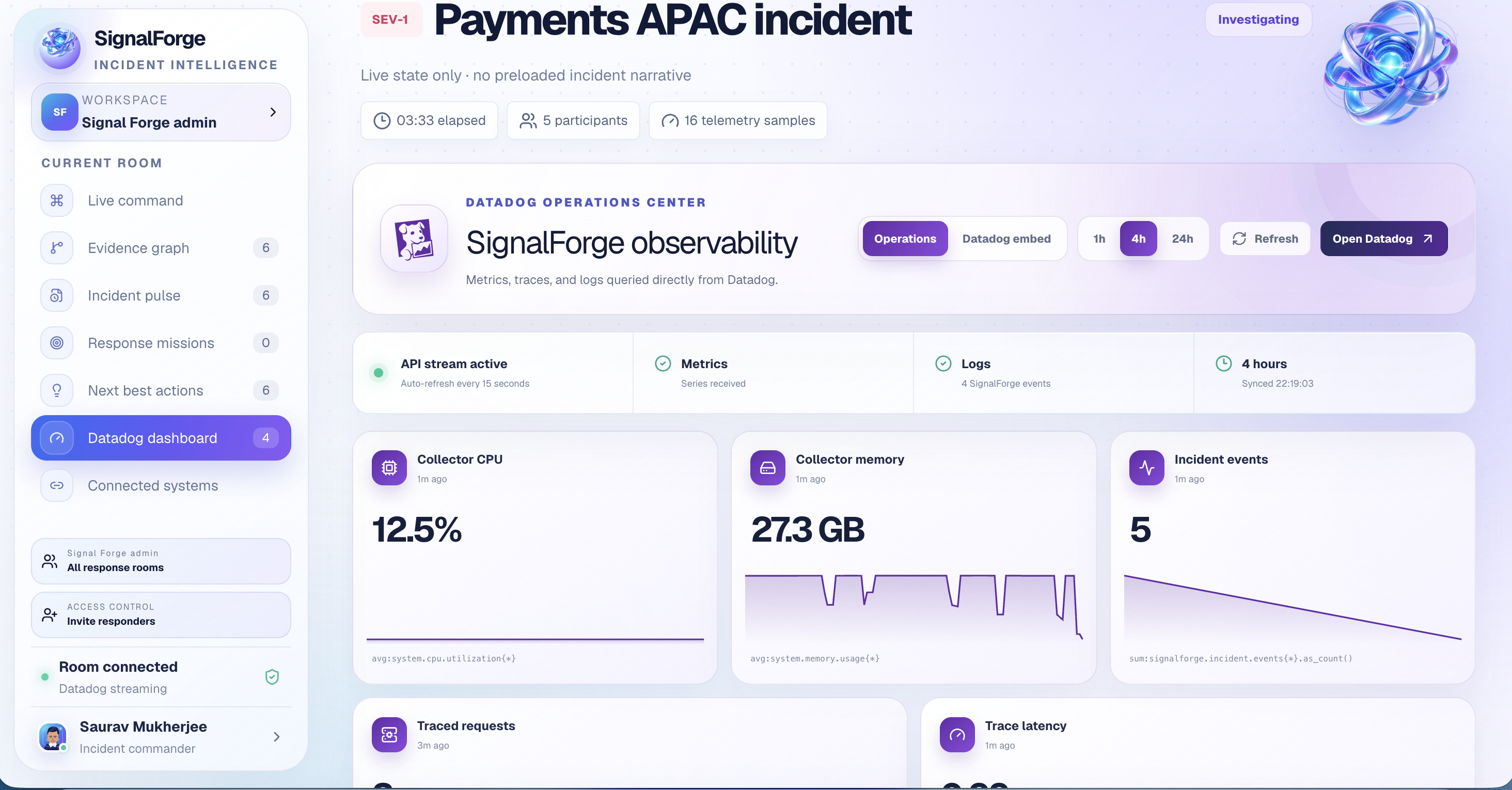
- Datadog supplies live metrics, traces, logs and recovery signals through an enterprise operations dashboard inside SignalForge.
- OpenTelemetry provides a vendor-neutral telemetry pipeline. Organizations can connect their existing OTel Collector instead of rewriting application instrumentation.
- Slack receives reviewed incident updates, decisions and final summaries through the SignalForge bot.
- Jira can receive approved, owned follow-up tasks.
- Additional monitoring and collaboration systems can be added through the same adapter architecture.
Integration credentials are configured from one Connected Systems interface. Their status is detected from running services, sensitive values stay masked, and credentials remain server-side in encrypted deployment variables.
This makes adoption practical for an enterprise: connect the tools already in use, authorize the appropriate workspace and begin operating without migrating the entire incident-management process.
Why SignalForge is different
Most incident AI products fall into one of three categories:
- Meeting transcription tools that summarize the conversation after it ends.
- Monitoring dashboards that show signals but do not understand the team’s discussion.
- Autonomous agents that attempt to diagnose or execute changes without sufficient evidence.
SignalForge combines the live conversation, operational telemetry and response workflow while preserving human authority.
It does not simply produce a transcript. Every finalized statement is classified as a:
- Confirmed fact
- Hypothesis
- Conflict
- Open question
- Decision
- Action item
Each statement retains its speaker, timestamp, confidence, evidence requirements and relationship to other claims. The same incident state continuously powers the evidence graph, incident timeline, shared understanding, recommendations, missions and final report.
SignalForge also refuses to manufacture certainty. If new evidence contradicts an existing theory, the system visibly weakens that theory and recommends a falsifiable check. It never independently announces a root cause.
Agentic incident coordination
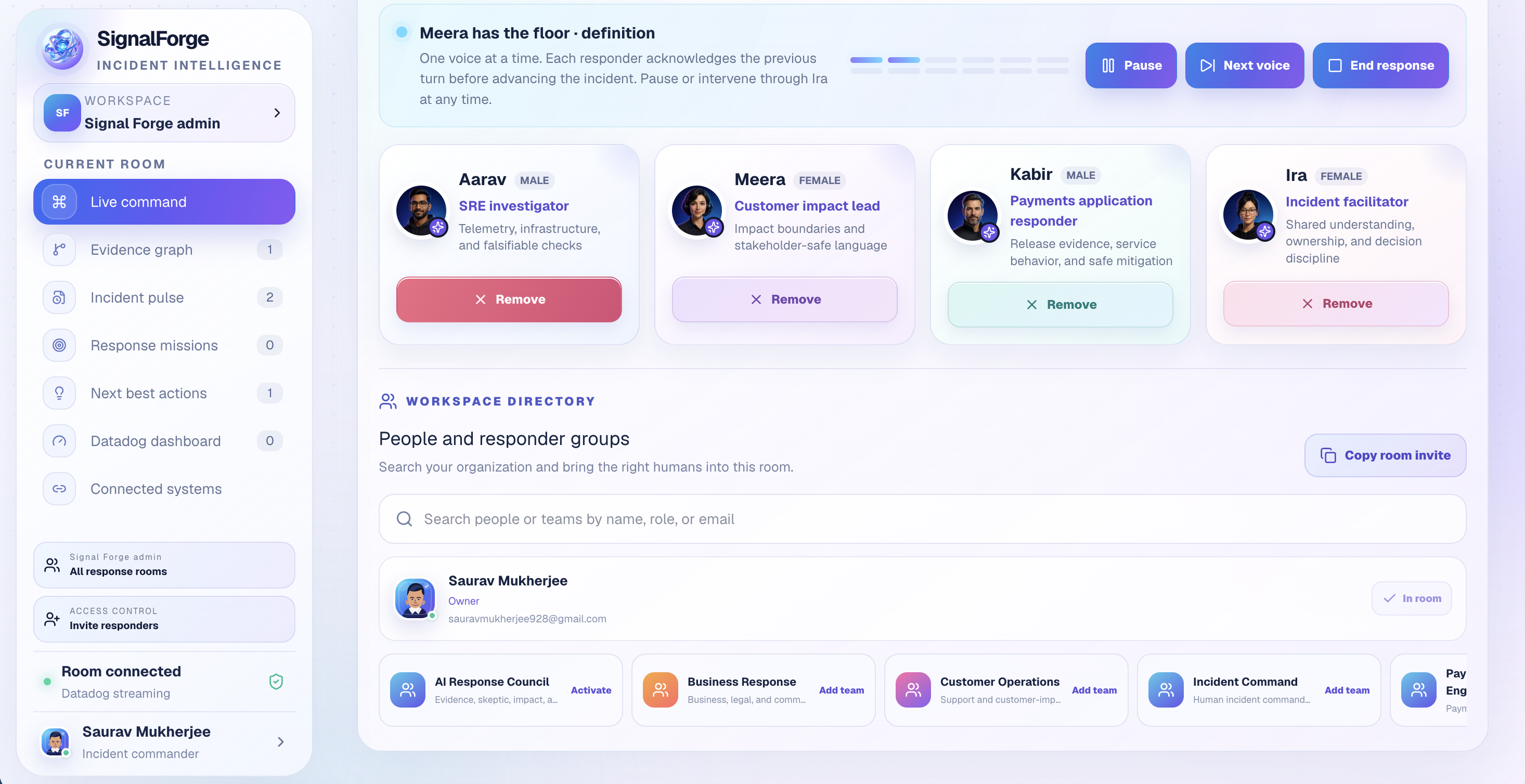
SignalForge uses a bounded council of specialist voice agents:
- Ira — Incident Facilitator: maintains shared understanding, ownership, decisions and approval gates.
- Aarav — SRE Investigator: analyzes telemetry and proposes safe, falsifiable infrastructure checks.
- Meera — Customer Impact Lead: establishes affected customers, regions and workflows.
- Kabir — Payments Application Responder: evaluates application behaviour, release evidence and reversible mitigations.
These agents share incident memory but have different responsibilities and guardrails. A response director enforces one voice at a time, ensuring agents acknowledge the previous contribution before continuing.
Human participants can pause, advance or intervene in the discussion at any moment.
Human-controlled enterprise operations
SignalForge separates three states that are often confused during incidents:
- A mitigation has been proposed.
- A mitigation has been approved and executed.
- Recovery has been verified through telemetry.
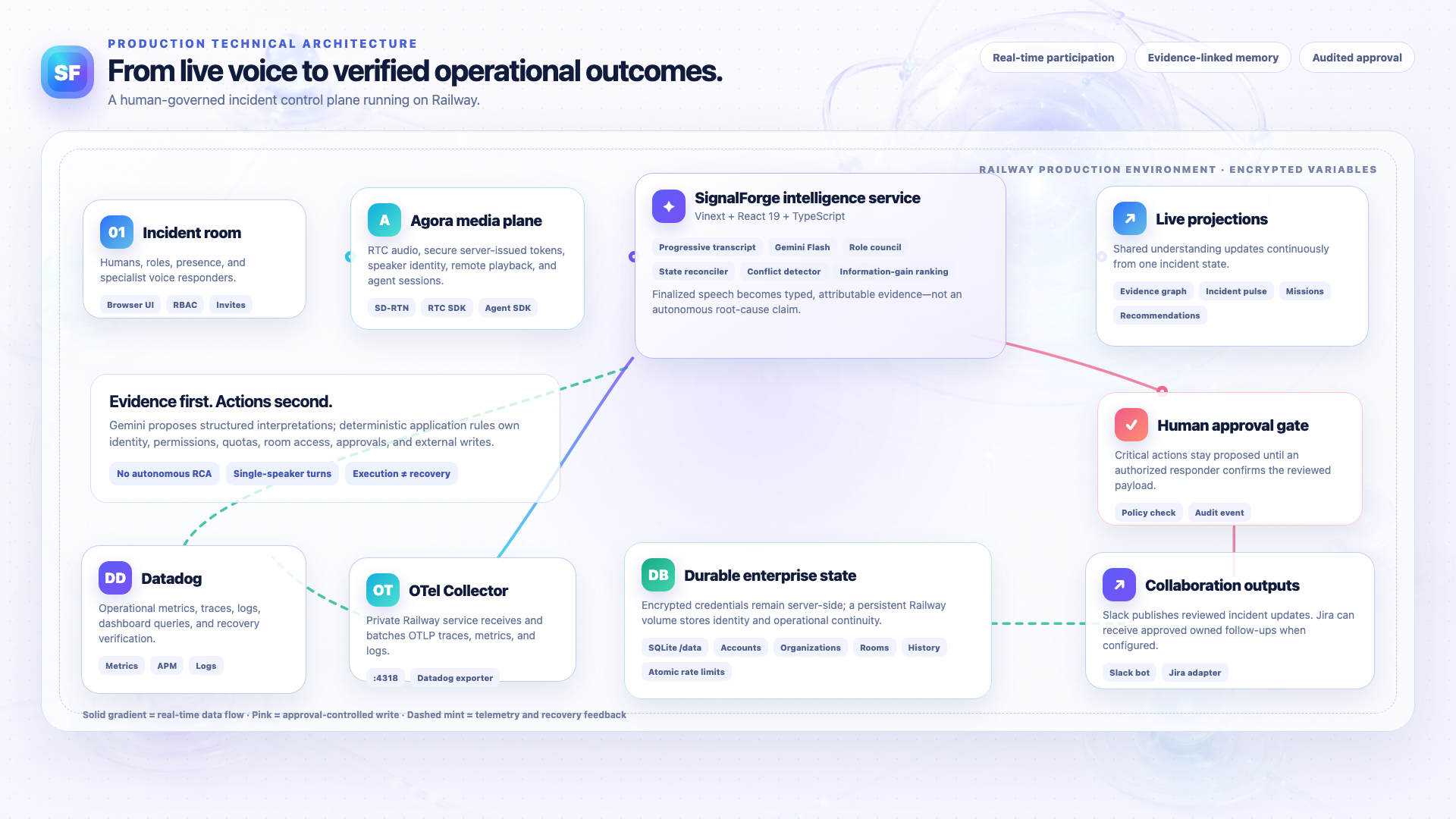
Critical actions and external writes remain proposals until an authorized human confirms them. Slack updates and Jira work items use reviewed payloads, and recovery is only reported when connected monitoring evidence supports it.
This approach allows enterprises to benefit from AI coordination without giving an LLM unrestricted production authority.
Enterprise-ready workspace
SignalForge includes:
- Email/password authentication and secure HTTP-only sessions
- Organization workspaces
- Owner and member roles
- Room-level access control
- Searchable people and responder groups
- Secure team invitations and shareable room links
- Multiple incident rooms and conversation history
- Persistent incident and organization data
- Daily rate limits for Gemini, Agora, voice agents, invitations and critical actions
- Server-generated, short-lived Agora tokens
- Server-side secret storage
- Integration-health monitoring
- OpenTelemetry-based audit and operational signals
The production runtime is split into two Railway services:
- SignalForge web and API service — serves the React workspace, authenticates users, enforces room permissions and quotas, issues Agora tokens, orchestrates Gemini analysis, and owns approval-gated integrations.
- OpenTelemetry Collector — receives OTLP traffic over Railway’s private network, batches and enriches telemetry, exposes health status, and exports traces, metrics, and logs to Datadog.
A persistent Railway volume stores SQLite state under /data. Platform variables hold provider credentials outside the repository and browser bundle.
Expected enterprise impact
SignalForge helps organizations:
- Reach shared understanding faster
- Reduce repeated or conflicting investigations
- Detect unsupported certainty before it becomes a costly decision
- Keep task ownership visible
- Produce consistent stakeholder updates
- Measure whether mitigation actually improved the system
- Preserve a high-quality incident record for audits and post-incident reviews
- Adopt AI without abandoning existing enterprise tools
SignalForge is therefore not another meeting assistant. It is the coordination layer between the incident room, the monitoring stack, the response team and the systems where operational work happens.
Evaluation access
Live application:
https://signalforge-ai-incident-command.up.railway.app/
Evaluation account
Email: judges@signalforge.app
Password: SignalForge2026Judge
The account provides an isolated evaluation workspace with owner access and fresh usage quotas.
After signing in:
- Open the Payments APAC incident room.
- Join the Agora voice room.
- Start the specialist response team or live transcription.
- Observe evidence, conflicts, questions and recommendations update.
- Explore the integrated Datadog operations dashboard.
- Review the Connected Systems interface and human-controlled actions.
| Layer | Technology | Responsibility |
|---|---|---|
| Experience | React 19, TypeScript, Vinext | Responsive enterprise workspace and live incident projections. |
| Real-time media | Agora RTC SDK | Voice room, presence, participant identity, encrypted media transport, and remote audio. |
| Voice responders | Agora Agents SDK | Specialist sessions and ordered speech orchestration. |
| Intelligence | Gemini Flash / Gemini Live | Evidence classification, confidence, contradictions, summaries, and next checks. |
| Identity and state | SQLite on a Railway volume | Accounts, organizations, memberships, rooms, invites, agents, sessions, and daily usage. |
| Observability | OpenTelemetry Collector | Receives, enriches, batches, and exports logs, metrics, and traces. |
| Operations data | Datadog | Live dashboard queries, APM, logs, incident signals, and recovery verification. |
| Collaboration | Slack | Human-reviewed incident updates and final summaries. |
| Work tracking | Jira adapter | Optional human-approved, owned follow-up tasks. |
| Runtime | Railway + Docker | Persistent web/API service, private collector service, encrypted variables, and health checks. |
This build was uploaded as a hackathon project


