Smart query ai
Link to open source: https://github.com/sandeep-striver/InnoVentures-Project
Link to Live Project: https://github.com/sandeep-striver/InnoVentures-Project
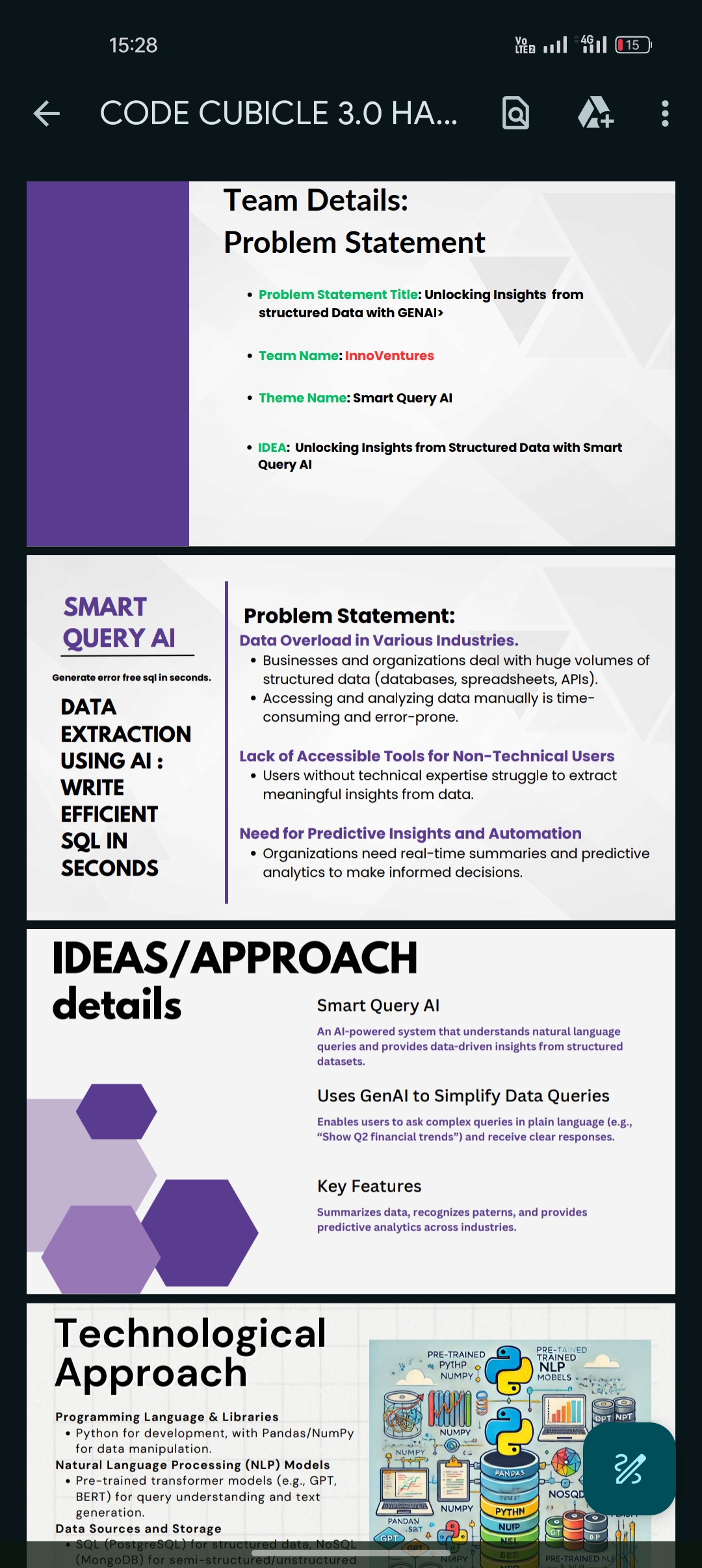
The Smart Query AI System with GenAI is an innovative solution designed to simplify the handling and interpretation of structured data through natural language queries. By employing advanced Generative AI (GenAI) models, this system aims to enhance decision-making across various sectors, including finance, healthcare, education, and logistics. It automates the extraction of insights and summaries from complex datasets, making it easier for users to obtain actionable information without needing extensive technical expertise.
Addressing Real-World Challenges
Finance Sector
In finance, analysts frequently manage and interpret large volumes of data to generate reports and make predictions. For instance, when preparing a quarterly sales report or forecasting market trends, analysts traditionally spend significant time analyzing data manually. The Smart Query AI System transforms this process by allowing users to query the system in natural language—e.g., "Show me the profit margins for Q3" or "Predict next month's sales." The AI automatically processes the data, identifies trends, and produces comprehensive reports swiftly. This automation not only accelerates report generation but also minimizes the risk of human error, leading to more accurate financial forecasting and analysis.
Healthcare Sector
In healthcare, managing extensive patient records and predicting treatment outcomes are crucial tasks. Hospitals and clinics handle vast amounts of structured data, such as medical histories and treatment plans. The Smart Query AI System can streamline these tasks by summarizing patient records and predicting treatment outcomes based on historical data. For example, a healthcare professional might query, "Summarize the patient's history and suggest possible treatments." The system then provides a concise summary and treatment recommendations, which aids healthcare providers in making informed decisions quickly, thereby improving patient care and operational efficiency.
Education Sector
Educational institutions often need to analyze student performance data to enhance teaching methods and outcomes. Administrators might seek insights into trends across different subjects to adjust strategies accordingly. By using the Smart Query AI System, school administrators can input queries like "Summarize the performance trends for math and science over the past year." The system processes this query and provides detailed insights into student performance, enabling educators to identify areas needing additional support and refine their teaching approaches.
Logistics Sector
Effective supply chain and inventory management are vital for logistics operations. Supply chain managers frequently need to predict stock requirements and summarize inventory data. The Smart Query AI System assists by analyzing historical inventory data to forecast future stock needs. For instance, a query such as "Predict the stock needs for the next quarter" allows the system to provide forecasts based on past data, helping managers optimize stock levels and reduce excess inventory.
Implementation and Benefits
Implementation Phases:
Problem Understanding and Dataset Identification: Define and acquire the relevant datasets, such as financial transactions or patient records.
Technology Stack Selection: Utilize technologies like Python, transformers for AI, and SQL databases for integration.
Data Preprocessing and Integration: Ensure effective data ingestion and transformation.
Model Training and Development: Train GenAI models to interpret queries and generate insights.
Query Understanding and Summarization: Develop NLP capabilities for interpreting queries and summarizing data.
Frontend and API Development: Build a user-friendly interface and backend API for interaction.
Testing and Evaluation: Validate the system’s accuracy and performance.
Deployment and Scaling: Deploy on cloud platforms and ensure scalability.
Benefits:
Efficiency: Automates complex data analysis tasks, saving time and effort.
Accuracy: Reduces human error and enhances the reliability of insights.
Accessibility: Makes advanced data analysis accessible to non-technical users.
Scalability: Adaptable across different industries and datasets, accommodating growth and varied applications.
This build was uploaded as a hackathon project
